
Updated on 30-Dec-2025
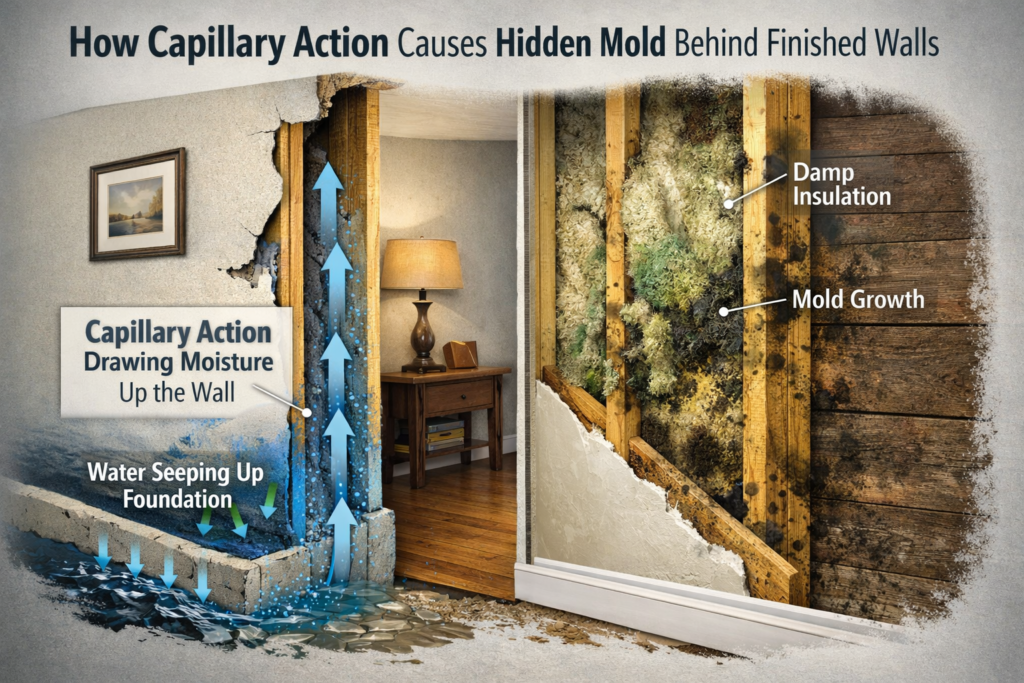
Capillary action allows moisture to travel inside walls without visible leaks, causing hidden mold growth behind finished surfaces. Learn how it happens.
Hidden mold behind finished walls is one of the most misunderstood moisture problems in buildings. Many property owners assume mold requires a visible leak or flooding event. In reality, mold often develops silently through a process called capillary action.
Capillary action allows moisture to move through building materials without dripping, pooling, or leaving obvious water stains. By the time mold becomes visible, the problem has usually existed for months.
Table of Contents
What Capillary Action Is in Building Materials
Capillary action is the ability of a material to draw moisture through its internal pore structure.
In buildings, this means water can travel:
- Upward
- Sideways
- Across assemblies
against gravity and without pressure.
Materials commonly affected include:
These materials are hygroscopic, meaning they naturally absorb and retain moisture.
Why Finished Walls Are Especially Vulnerable
Finished walls create a concealed environment where moisture movement goes unnoticed.
Behind finished walls:
- Air circulation is limited
- Evaporation is restricted
- Moisture becomes trapped
Capillary action allows moisture to wick from one area into another, even when the source is several feet away.
This is why mold often appears in walls that never had a visible leak.
Common Moisture Sources That Feed Capillary Action
Capillary-driven moisture often originates from subtle or indirect sources.
Common examples include:
- Foundation moisture migrating upward
- Condensation forming on cold surfaces
- Minor plumbing seepage
- Window or exterior wall intrusion
- Ground moisture entering slab edges
These sources provide just enough moisture to sustain mold growth without triggering obvious warning signs.
Why Mold Develops Without Water Stains
Capillary action distributes moisture evenly rather than flooding a surface.
As a result:
- Walls may feel dry to the touch
- Paint may remain intact
- No discoloration appears initially
However, moisture content inside the wall cavity remains elevated, creating ideal conditions for mold to grow on drywall backing, insulation, and framing.
The Role of Temperature and Dew Point
Capillary action often works alongside dew point movement.
When warm, humid air contacts cooler wall assemblies:
- Moisture condenses inside cavities
- Materials absorb the condensation
- Capillary action spreads moisture further
This is why hidden mold is common on exterior walls, basements, and north-facing surfaces.
Why Surface Drying Does Not Stop Capillary Moisture
Drying visible surfaces does not remove moisture absorbed within materials.
Capillary-held moisture:
- Remains locked inside pores
- Re-distributes after surface drying
- Sustains microbial growth
This explains why mold can return even after walls appear dry.
How Hidden Mold Spreads Inside Wall Assemblies
Once moisture is present, mold growth follows material pathways.
Mold often develops:
- Along drywall seams
- At framing intersections
- Around fasteners and plates
Because the growth is concealed, contamination may spread extensively before discovery.
Why Capillary Action Is Missed During Inspections
Standard inspections focus on visible damage.
Capillary moisture:
- Does not drip
- Does not pool
- Does not always stain
Without moisture mapping and building science evaluation, this type of problem is easily overlooked.
How Ultimate Mold Crew Identifies Capillary-Driven Mold
Ultimate Mold Crew investigates mold problems by tracing moisture movement, not just visible damage.
This includes:
- Moisture profiling across wall assemblies
- Identifying hygroscopic material behavior
- Locating indirect moisture sources
- Assessing temperature and humidity patterns
This approach uncovers mold that surface inspections miss.
Why Capillary Action Explains Many “Mystery Mold” Cases
When mold appears without an obvious cause, capillary action is often the explanation.
It accounts for:
- Mold behind new drywall
- Mold in recently renovated spaces
- Mold returning after surface repairs
- Mold on walls far from leaks
Understanding this process prevents repeated failures.
Key Takeaway on Capillary Action and Hidden Mold
Capillary action allows moisture to travel invisibly through building materials.
When that moisture becomes trapped behind finished walls, mold growth is only a matter of time.
Effective mold remediation requires identifying and interrupting these hidden moisture pathways, not just cleaning visible growth.
Frequently Asked Questions About Capillary Action and Mold
Can mold grow without a visible leak?
Yes. Capillary action allows moisture to move through materials without visible water damage.
Why does mold appear behind walls but not on the surface?
Moisture is often trapped inside wall cavities where air circulation is limited, allowing mold to grow unseen.
Does repainting stop capillary moisture?
No. Paint does not prevent moisture migration within porous materials.
Is capillary action common in basements?
Yes. Foundation walls and slab edges are frequent sources of capillary moisture movement.
Can dehumidifiers stop capillary action?
Dehumidifiers help control air moisture but do not remove moisture already absorbed into materials.
How is capillary moisture detected?
Detection requires moisture mapping, material analysis, and understanding of building science principles.
Why does mold return after wall repairs?
If capillary moisture pathways are not addressed, mold regrows behind repaired surfaces.
Does insulation worsen capillary moisture problems?
Some insulation types can trap moisture and reduce drying potential when improperly installed.
Is capillary action seasonal?
Yes. Temperature changes and humidity shifts can intensify moisture migration.
How does Ultimate Mold Crew address capillary-driven mold?
Ultimate Mold Crew identifies moisture pathways, removes contaminated materials, and implements strategies to interrupt capillary moisture movement.
