
Updated on 09-Apr-2026
Learn how HVAC systems spread mold in condos, the hidden dangers in ducts and coils, warning signs, and proven ways to prevent contamination.
Ever notice this?
You feel fine outside… but symptoms get worse when your AC turns on.
That’s not random.
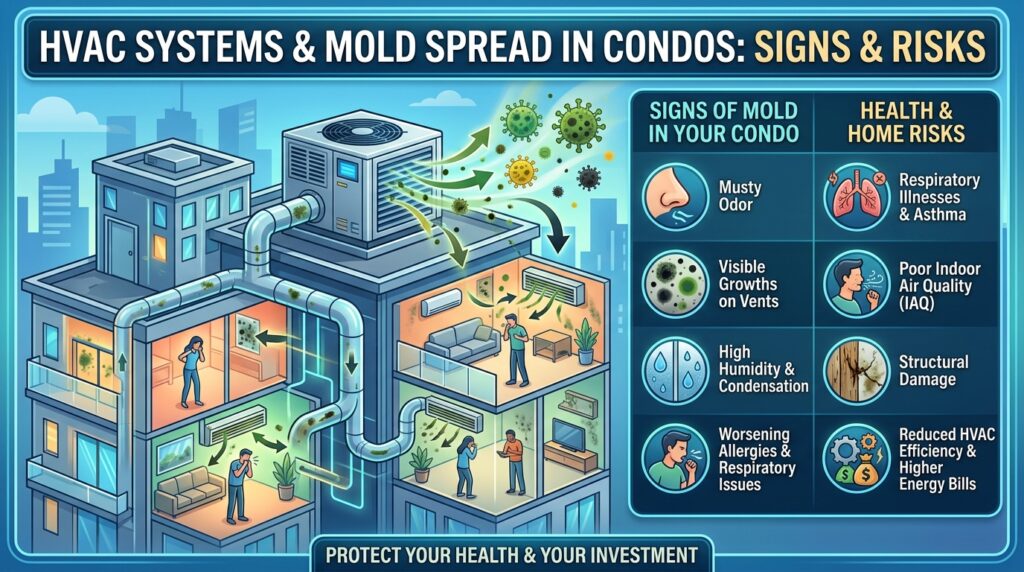
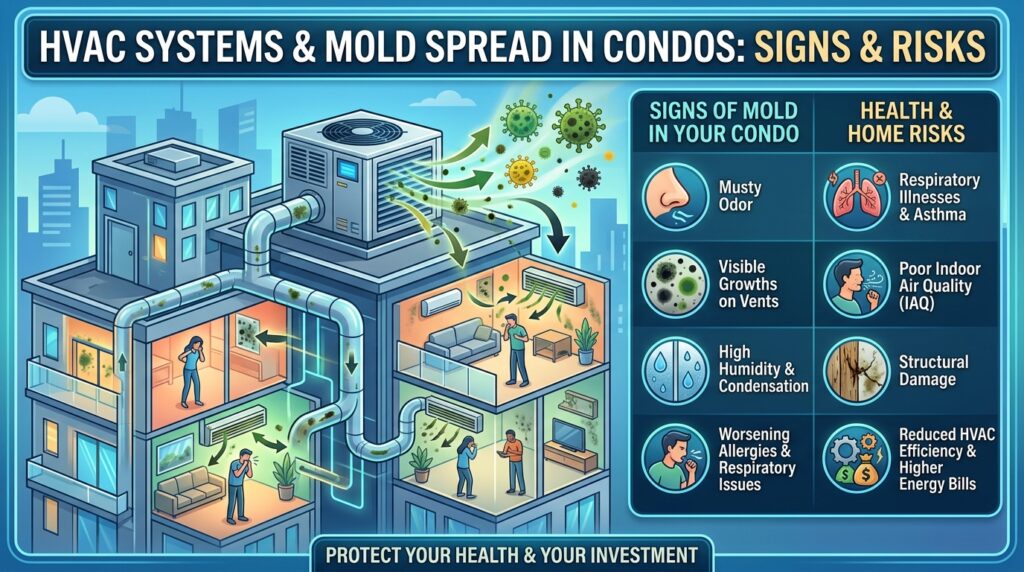
In many Toronto condos, the HVAC system becomes the main pathway that spreads Black Mold in Air Vents, Ducts from one area to another.
Table of Contents
How HVAC Systems Work in Condos
Shared Air Systems Explained
Many condos use:
- Central HVAC systems
- Shared ductwork
- Vertical air shafts connecting units
This means air—and anything in it—can travel between spaces.
Why Condos Are More Vulnerable
Condos face unique risks:
- Limited control over maintenance
- Shared infrastructure
- Higher indoor humidity from dense living
This combination creates the perfect environment for mold to spread unnoticed.
-
Study of 238 homes in North Carolina
-
19% of homes demonstrated transmission of mold spores from crawl space into indoor environment via HVAC system
-
45% showed no transmission, 36% indeterminate
-
Confirmed HVAC systems can serve as conduits for mold spore transmission.
Why HVAC Systems Are a Major Mold Vector in Condos
In condominium buildings, HVAC systems don’t just regulate temperature—they directly influence indoor air quality (IAQ) across multiple units.
When mold develops inside an HVAC system, it can act as a distribution network, spreading spores from one area to another. In condos, this risk is amplified due to:
- Shared infrastructure
- Limited ventilation control
- High occupant density
How Mold Develops Inside HVAC Systems
Moisture + Dust = Ideal Growth Environment
Your HVAC system does one job:
It pulls air → conditions it → pushes it back into your living space
Now add mold into that cycle:
Mold growth inside system → releases spores → airflow distributes spores across rooms
That’s how a small hidden issue becomes a whole-home problem.
HVAC systems naturally accumulate:
- Dust (organic material)
- Moisture (from condensation)
This creates the perfect environment for mold growth, especially in:
- Evaporator coils
- Drain pans
- Air ducts
- Filters
Key Trigger: Condensation
Cooling systems (AC units) generate condensation as they remove humidity from the air. If this moisture is not properly drained, it leads to:
- Persistent damp surfaces
- Biofilm formation
- Mold colonization
How Mold Develops Inside HVAC Systems
Moisture Buildup in Coils
HVAC systems naturally create moisture during cooling. When warm air hits cold coils:
- Condensation forms
- Water collects in drain pans
If not properly drained, this moisture becomes a breeding ground for mold.
Dust and Organic Debris as Food
Mold doesn’t just need moisture—it needs food. HVAC systems provide plenty:
- Dust
- Pollen
- Skin cells
These particles accumulate inside ducts and coils, feeding mold growth.
The Role of Humidity in HVAC Mold Spread
Improper Humidity Control
If HVAC systems fail to regulate humidity:
- Indoor levels rise above 60%
- Condensation increases
- Mold growth accelerates
Overcooling Problem
Oversized or inefficient AC systems:
- Cool air quickly
- Do not run long enough to remove humidity
- Leave moisture behind
-
Mold growth linked to dew point conditions rather than just relative humidity
-
Sustained mold growth occurs when wet conditions produced through condensation
-
Microbial growth found on any HVAC surface where water available: metal ducts, plastic-lined flex duct, conditioning coils, mixing box dampers, internal duct liners
Where Mold Grows Inside Condo HVAC Systems
Most condo units use fan coil systems or centralized HVAC, and these areas are high risk:
1. Cooling Coils (Primary Hotspot)
Cooling coils create condensation when warm air hits cold surfaces.
Condensation + dust → creates → ideal mold environment
This is where mold often starts.
Common species found here:
- Aspergillus
- Cladosporium
2. Drain Pans (Standing Water Problem)
Every HVAC system has a drain pan to collect moisture.
If it doesn’t drain properly:
Water sits → mold grows → spores release into airflow
3. Air Ducts (Distribution Network)
Ducts don’t usually create mold, but they spread it.
Contaminated ducts → circulate → spores throughout condo
That’s why multiple rooms show similar mold patterns in reports.
Cross-Unit Contamination in Condos
In condos, the risk is even greater:
- Shared ducts can carry spores between units
- One contaminated system can affect multiple residents
This makes early detection critical.
4. Air Filters (Overlooked Source)
Dirty or low-quality filters can:
- Trap moisture
- Accumulate organic debris
- Become mold reservoirs
Instead of stopping spores, they start releasing them.
The Role of HVAC Filters
Dirty or Ineffective Filters
Filters are your first line of defense—but only if they’re maintained.
Problems occur when:
- Filters are clogged
- Cheap filters are used
- Filters aren’t replaced regularly
Limitations of Standard Filters
Most standard filters:
- Capture large particles
- Do NOT trap microscopic mold spores effectively
Upgrading to HEPA-level filtration can make a big difference.
Signs Your HVAC System Is Spreading Mold
Symptoms That Worsen Indoors
Watch for:
- Sneezing or coughing indoors
- Headaches or fatigue
- Symptoms improving when you leave
Musty Smells from Vents
A strong indicator is a persistent:
- Damp, earthy odor when AC runs
This often points directly to mold inside the system.
How to Test for HVAC Mold Contamination
You can confirm HVAC-related mold through:
- Air sampling (compare indoor vs outdoor levels)
- Surface testing inside vents
- Professional duct inspections
If spore counts spike when HVAC runs, that’s a strong indicator.
Practical Steps to Stop HVAC Mold Spread
Immediate Fixes
- Replace air filters
- Clean visible vent areas
- Use a dehumidifier
Long-Term Prevention
- Schedule professional HVAC cleaning
- Install UV lights in ducts
- Maintain humidity below 50%
- Ensure proper drainage in AC units
HVAC Mold Remediation Cost
| Source | Cost Range for HVAC Mold |
|---|---|
| Angi (2026) | $3,000 – $10,000 |
| This Old House (2026) | $3,000 – $10,000 |
| HomeAdvisor (2025) | $3,000 – $10,000 |
| Ultimate Mold Crew | $3,000 – $10,000 |
| ATI Restoration (2025) | $2,000 – $6,000 (air ducts/vents) |
Quick Self-Check
Ask yourself:
- Do symptoms get worse when AC runs?
- Do all rooms show similar mold levels?
- Is there a musty smell near vents?
If yes:
Your HVAC system is very likely involved.
Where This Fits in the Bigger Picture
Mold is not always about what you see.
Sometimes it’s about what your system is circulating every minute.
Understanding how HVAC systems spread mold in condos can help you catch problems early and prevent serious health and property damage. These systems don’t just cool your air—they can also distribute hidden contaminants if not properly maintained.
The key takeaway?
- Control moisture
- Maintain your HVAC system
- Act quickly when warning signs appear, Contact a mold removal expert in Toronto near you.
In condo living, staying proactive isn’t optional—it’s essential.
FAQs About HVAC Mold in Condos
1. Can mold spread between condo units through HVAC?
Yes, especially in shared systems or connected ductwork.
2. Why do symptoms worsen when AC is on?
Because the system circulates mold spores through the air.
3. Are air filters enough to stop mold?
Not always—most standard filters don’t capture microscopic spores.
4. How often should HVAC systems be cleaned?
Every 1–2 years, or sooner if mold is suspected.
5. Can I clean HVAC mold myself?
Surface cleaning is possible, but internal contamination requires professionals.
6. What’s the fastest way to confirm HVAC mold?
Air testing combined with inspection of ducts and coils.
- https://uniluxcrfc.com/wp-content/uploads/2019/10/U_of_T_Paper_-_Fan_Coil_Contamination.pdf
- https://pubmed.ncbi.nlm.nih.gov/17487721/
- https://pubmed.ncbi.nlm.nih.gov/22206197/
- https://insulationinstitute.org/wp-content/uploads/2022/05/The-Facts-About-Mold-Growth-in-Glass-Fiber-Air-Transmission-Systems.pdf
- https://upperrestoration.com/can-mold-spread-through-hvac-systems/
Research-Based Citations for HVAC Mold Contamination in Condominiums
| # | Citation | Key Focus |
|---|---|---|
| 1 | University of Toronto (2025). Fan Coil Contamination of Growing Concern: Mechanical, Biological, and Legal Complexities of Mould in Condos. | Landmark technical paper analyzing the specific risks of mold growth within fan coil units (FCUs) in Toronto high-rises, detailing how dust and condensation create ideal microbial reservoirs. |
| 2 | Liu, Y., et al. (2025). Fungal communities in split air conditioners and associated respiratory health risks in residential buildings. | 2025 study in Building and Environment identifying common fungal species like Aspergillus and Cladosporium in residential AC units and their direct link to indoor respiratory symptoms. |
| 3 | Beswick, A., et al. (2025). Exposure Risks from Microbiological Hazards in Buildings and Their Control—A Rapid Review of the Evidence. | 2025 review in Atmosphere examining how high-rise apartment infrastructure and shared HVAC systems facilitate the aerosolization and spread of harmful microorganisms between units. |
| 4 | Mycometer (2025). Successful Mold Growth Remediation in HVAC Systems: Strategies and Lessons from Industrial Hygiene. | 2025 technical report on remediation strategies for HVAC systems, emphasizing the importance of addressing evaporator coils and drain pans to prevent spore distribution. |
| 5 | Fylak, N. M. (2025). Moisture issues and the growth of mold in Multi-Unit Residential Buildings (MURBs) and Condos. | 2025 research thesis investigating how pressurized corridor systems and ventilation faults in modern condos contribute to humidity imbalances and subsequent mold colonization. |
| 6 | ASCE Civil Engineering (2025). An unintended consequence of energy-efficient structures: Insufficient ventilation and mold growth. | 2025 report from the American Society of Civil Engineers discussing how airtight, energy-efficient condo designs can trap moisture and accelerate mold growth in HVAC components. |
| 7 | Alassafi, H. T., et al. (2024). HVAC maintainability risks in residential facilities: A design optimization and maintenance perspective. | 2024 study in Facilities identifying maintenance risks in fan coil units (FCUs) and air handling units (AHUs) that lead to biofilm formation and persistent indoor odors. |
| 8 | RubyHome (2026). Mold Statistics 2026: Leakage Issues and Asthma Links in Residential and Office Buildings. | 2026 statistical report highlighting that 21% of asthma cases are linked to indoor dampness and that HVAC systems are a primary vector for allergen distribution in multi-family units. |
