
Updated on 13-Feb-2026
Table of Contents
Mold Containment: Proper Isolation Is Critical During Mold Remediation
Will mold spread during removal?
That is the first question most homeowners ask. And it is a valid one.
Mold spores are microscopic. The moment contaminated materials are disturbed, spores become airborne. If the work area is not isolated, those spores can move into clean rooms, HVAC systems, and hidden cavities.
Mold containment exists to stop that from happening.
Under the IICRC standard ANSI/IICRC S520, containment is not optional. It is a required safety control designed to protect occupants, workers, and unaffected areas of the building.
Plastic barriers and machines may look disruptive, but they exist for one reason.
Protection.
- Mold Containment → protects → indoor air quality
- Mold Containment → prevents → secondary contamination
- Mold Containment → reduces → long-term cost
During mold remediation, the goal is not just removal. It is controlled removal.
If mold is discovered in your property, ensure containment is part of the plan.
Schedule a professional Toronto mold testing and remediation assessment to ensure proper isolation is established from the start.
Containment is not just plastic on walls. It is a controlled engineering system.
Let dive into details now,
What Is Mold Containment?
Mold containment is the process of isolating contaminated areas during remediation to prevent mold spores from spreading to clean parts of a building. Containment creates controlled work zones using physical barriers and pressure differentials.
Containment is not optional. It is a core risk-control step referenced by industry standards and public health guidance, including IICRC S520 and EPA mold remediation recommendations.
Cleaning vs Controlled Remediation
Many people confuse cleaning with remediation.
Cleaning:
- Surface wiping
- No airflow control
- No pressure management
- No isolation barriers
Controlled remediation:
- Physical barriers
- Engineered airflow control
- HEPA filtration
- Decontamination procedures
The difference is containment.
Without isolation, disturbance spreads spores. With containment, contamination stays controlled.
Why Mold Containment Is Necessary
1. Prevents Cross-Contamination
Mold spores are microscopic and easily become airborne during demolition, drywall removal, or HEPA vacuuming. Without containment, spores can:
-
Spread through HVAC systems
-
Settle on furniture and porous materials
-
Create secondary mold growth zones
2. Protects Occupants and Workers
Containment reduces exposure risks for:
-
Occupants with asthma, allergies, or respiratory sensitivity
-
Workers operating in active remediation zones
This aligns with occupational safety principles referenced by OSHA.
3. Maintains Regulatory and Insurance Compliance
Improper containment is a common reason for:
-
Failed post-remediation verification
-
Insurance claim disputes
-
Repeat remediation costs
4. Preventing Secondary Contamination
Spores that settle in new areas can create new growth sites if moisture is present.
- Cross-contamination → causes → secondary mold growth
- Secondary growth → increases → remediation scope
Containment stops the problem from expanding.
Types of Mold Containment Used in Remediation
Source Containment
Used for small, localized mold areas.
-
Polyethylene sheeting around the affected zone
-
Limited access points
-
Suitable for low-contamination scenarios
Full Containment
Used for moderate to extensive mold growth.
-
Floor-to-ceiling poly barriers
-
Zippered or flap entry doors
-
Negative air pressure using HEPA-filtered air scrubbers
Critical Barriers
Installed to protect non-remediated areas such as:
-
Hallways
-
Stairwells
-
Adjacent rooms
Often used when full containment is not feasible.
Negative Air Pressure: The Backbone of Containment
Negative air pressure ensures that:
-
Air flows into the containment area, not out
-
Airborne spores are captured through HEPA filtration
-
Contaminants are exhausted safely outside
This principle is central to professional remediation protocols and is explicitly addressed in IICRC S520 guidance.
Materials and Equipment Commonly Used
-
6-mil polyethylene sheeting
-
HEPA air scrubbers
-
Negative air machines
-
Zippered containment doors
-
PPE (respirators, coveralls, gloves)
Each component works together to maintain environmental control throughout the remediation process.
Common Containment Mistakes (and Their Consequences)
-
Loose seals: Leads to spore leakage
-
No pressure differential: Causes airborne migration
-
Improper HVAC shutdown: Distributes spores building-wide
-
DIY containment: Often fails under real remediation conditions
These errors frequently result in mold returning, even after surface cleaning.
How Negative Air Pressure Works
Containment without airflow control is incomplete.
The real protection comes from negative pressure.
What Is Negative Air Pressure?
Negative air pressure means the air pressure inside the containment area is lower than the air pressure outside.
- Lower pressure inside → pulls → air inward
- Higher pressure outside → pushes → air into containment
This ensures air flows into the contaminated zone, not out.
If pressure is not negative, spores escape.
How Negative Air Pressure Protects Your Home During Mold Remediation
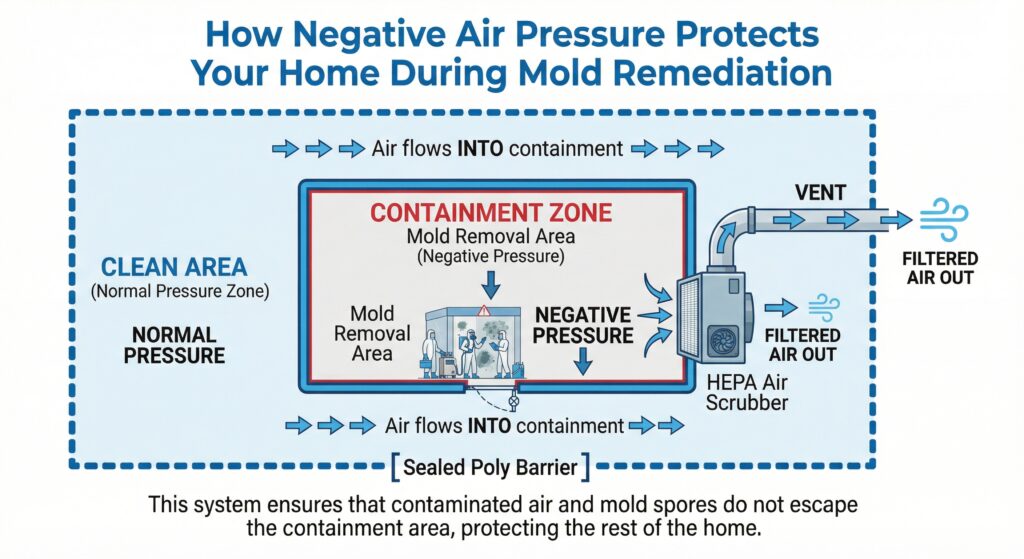
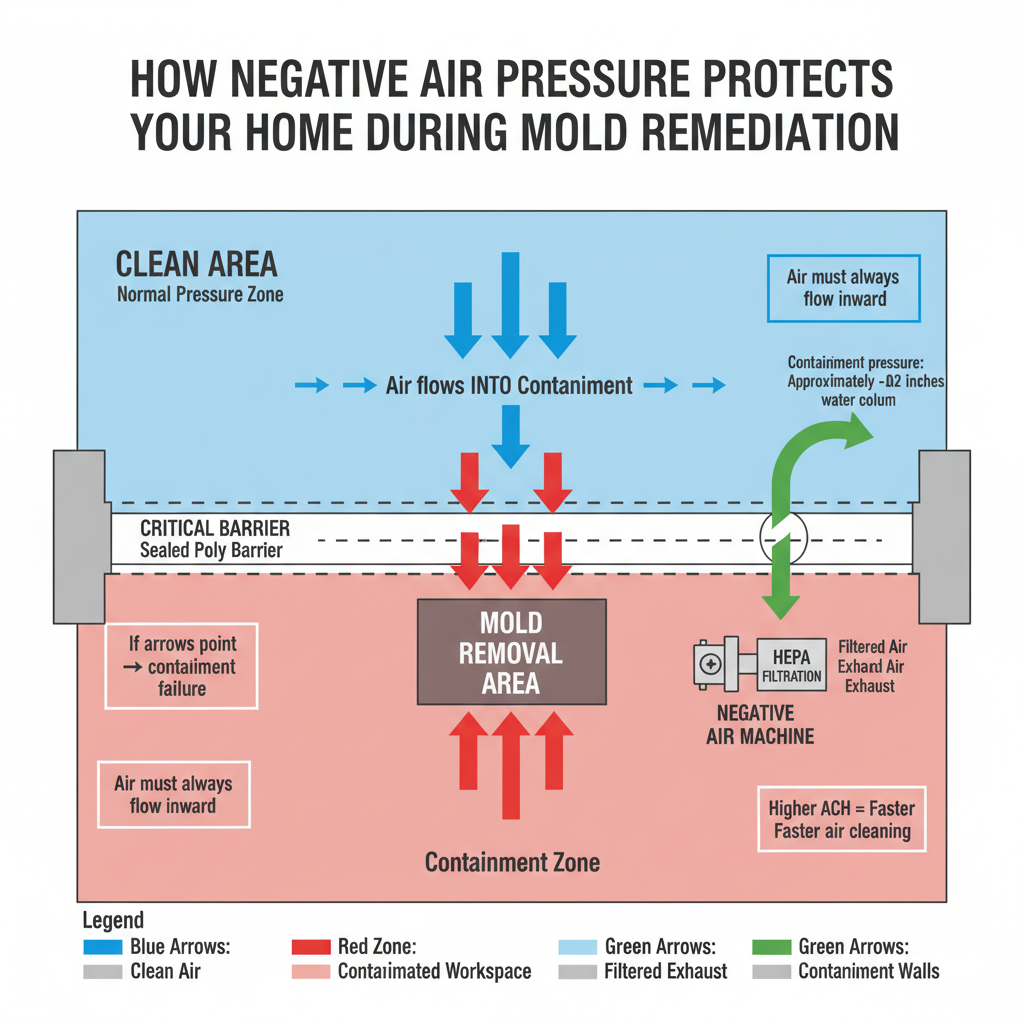
Proper mold containment creates controlled negative air pressure so contaminated air cannot escape into clean areas. Air always flows into the work zone, gets filtered through HEPA equipment, and is safely exhausted.
Why Air Must Flow Into Containment
Air always moves from areas of higher pressure to lower pressure.
If containment is under proper negative pressure:
- Clean air → flows → into work zone
- Contaminated air → gets filtered → before discharge
If containment fails:
- Contaminated air → flows → into clean rooms
- Spores → spread → throughout property
That directional control is the entire purpose of engineering containment.
The Role of HEPA Filtration
Negative air machines use HEPA filters.
- HEPA filtration → captures → 99.97% of particles at 0.3 microns
Mold spores typically range between 2–10 microns. That means HEPA filtration is highly effective at removing them.
HEPA filters:
-
Trap airborne spores
-
Reduce particulate load
-
Prevent re-distribution
Filtered air is then exhausted either:
-
Outside the building, or
-
Into adjacent space after filtration, depending on setup
Air Changes Per Hour (ACH)
Air Changes Per Hour refers to how many times the air inside containment is replaced within one hour.
ACH → measures → airflow turnover rate
Example:
If a containment area is 1,000 cubic feet and the negative air machine moves 500 cubic feet per minute:
-
500 CFM × 60 minutes = 30,000 cubic feet per hour
-
30,000 ÷ 1,000 = 30 ACH
Higher ACH:
-
Improves air cleaning speed
-
Reduces airborne particle concentration
S520 guidance supports maintaining sufficient air exchange to control contamination.
Pressure Monitoring
Professional setups use pressure monitoring devices.
- Pressure differential monitors → confirm → containment integrity
Typical pressure difference:
-
Around 0.02 inches water column negative
If pressure rises toward neutral:
-
Containment breach may exist
-
Barriers may be leaking
-
Equipment may have failed
Monitoring ensures the system remains effective throughout remediation.
Negative Air Machine vs Air Scrubber
Negative air machine:
-
Creates pressure differential
-
Exhausts filtered air
-
Controls airflow direction
Air scrubber:
-
Filters air inside space
-
Does not necessarily create negative pressure
Both may be used together for enhanced control.
Containment without negative pressure is incomplete.
- Barriers isolate space.
- Negative pressure controls airflow.
- HEPA filtration removes contaminants.
Together, they form the engineered protection system.
Materials and Equipment Used in Mold Containment
Containment is not improvised. It uses specific materials designed for durability, air control, and safety.
Each component serves a defined function in the isolation system.
1. 6-Mil Polyethylene Sheeting
This is the standard barrier material used in professional containment.
- 6-mil polyethylene → creates → airtight separation
- Poly sheeting → prevents → airborne migration
It is typically:
-
Installed floor to ceiling
-
Taped at all seams
-
Secured to framing or structural surfaces
For full containment, double layers may be installed for added durability.
2. Critical Barriers
Critical barriers seal openings such as:
-
Doorways
-
Windows
-
HVAC vents
-
Electrical penetrations
Critical barriers → block → air leakage points
Even small gaps compromise negative pressure integrity.
3. Zipper Entry Systems
Zipper doors are installed within poly sheeting to allow controlled access.
Zipper doors → maintain → containment seal during entry
In larger projects, a multi-chamber decontamination unit is installed.
4. Decontamination Chamber
Used in full containment setups.
It typically includes:
-
Clean room
-
Transition chamber
-
Equipment staging area
Decontamination chamber → separates → clean and contaminated zones
Workers remove PPE and debris in stages to prevent cross-contamination.
This is especially important in heavy Condition 3 environments under S520.
5. Negative Air Machines
These are the core engineering devices that create pressure control.
Negative air machine → generates → pressure differential
Units are sized based on:
-
Cubic footage
-
Required air changes per hour
-
Severity of contamination
They run continuously during active remediation.
6. Air Scrubbers
Air scrubbers supplement containment.
Air scrubbers → filter → airborne particles
They reduce airborne particulate load but do not always create directional airflow.
Often used inside containment to improve air quality during demolition.
7. HEPA Vacuums
HEPA vacuums are used for surface cleaning and debris removal.
HEPA vacuum → captures → settled spores
Standard vacuums → re-distribute → contamination
They are used for:
-
Cleaning framing
-
Removing settled dust
-
Post-remediation surface prep
8. Sealed HVAC Vents and Registers
HVAC systems must be isolated during remediation.
Open vents → pull → contaminated air
Sealed registers → protect → duct systems
Failure to seal HVAC pathways is one of the most common containment mistakes.
How These Components Work Together
Poly sheeting isolates space.
Critical barriers seal gaps.
Negative air machines control airflow.
HEPA filters remove contaminants.
Decontamination chambers protect clean zones.
Each element reinforces the others.
Containment is not a single step. It is a coordinated system.
What Happens If Containment Is Not Done Properly?
Containment failures are not minor mistakes. They change the scope of the entire project.
When isolation breaks down, mold spreads.
1. Spore Migration Into Clean Areas
Improper containment allows airborne spores to escape.
Escaped spores settle on new surfaces.
This can affect:
-
Adjacent rooms
-
Upper floors
-
HVAC duct interiors
-
Furniture and contents
A small 50 square foot removal can become a whole-floor remediation.
2. HVAC System Contamination
If vents are not sealed or pressure control fails:
HVAC return pulls contaminated air.
Spores colonize duct lining.
System cycling redistributes mold throughout property.
Once HVAC contamination occurs, remediation requires:
-
Duct cleaning or replacement
-
Coil inspection
-
System disinfection
Costs increase significantly.
3. Secondary Mold Growth
Spores that land in new areas can begin growing if moisture exists.
Cross-contamination creates new growth sites.
New growth expands remediation footprint.
This often leads to:
-
Extended project timelines
-
Additional demolition
-
Repeated inspections
4. Lingering Musty Odors
Poor containment allows spores and fragments to spread.
Airborne particles settle porous materials.
Contaminated materials emit persistent odor.
Homeowners may notice:
-
Musty smell returning
-
Irritation symptoms continuing
-
Air quality complaints after project completion
Often, the root cause is containment failure.
5. Increased Remediation Costs
Cost escalation example:
Initial affected area: 80 square feet
Containment fails → adjacent 300 square feet contaminated
Project scope → multiplies labor, materials, equipment time
Containment failure almost always increases total project cost.
Prevention is far less expensive than correction.
6. Health Exposure Risks
Mold spores are biological particulates.
Airborne exposure impacts respiratory system.
Disturbance without isolation increases occupant exposure.
Vulnerable individuals include:
-
Children
-
Elderly
-
Individuals with asthma
-
Immunocompromised occupants
Containment exists to reduce that exposure risk.
7. Liability and Professional Responsibility
Under ANSI/IICRC S520, cross-contamination prevention is a professional obligation.
Documentation, pressure logs, and proper setup protect both the homeowner and the contractor.
Containment protects health, property, and legal standing.
Mold Containment and IICRC S520 Compliance
Containment decisions are not random. They are guided by the ANSI/IICRC S520, developed by the IICRC.
This standard provides the procedural framework for professional mold remediation.
Condition 1, 2, and 3 Classifications
S520 categorizes mold conditions to guide remediation strategy.
Condition 1
Normal fungal ecology. No visible growth. No containment required.
Condition 2
Settled spores or minor amplification.
May require limited containment depending on disturbance level.
Condition 3
Active mold growth.
Typically requires full containment and negative pressure.
Higher contamination level → increases containment complexity
The standard does not rely only on square footage. It considers:
-
Extent of visible growth
-
Potential for spore release
-
Building occupancy
-
HVAC involvement
Containment decisions are risk-based.
Worker PPE Requirements
Containment and PPE work together.
Condition 3 → requires respirators, protective suits, gloves
Engineering controls reduce airborne load, but worker protection remains mandatory.
PPE protects workers.
Containment protects the structure and occupants.
Cross-Contamination Prevention
S520 emphasizes preventing contamination of unaffected areas.
- Isolation barriers → prevent spore migration
- Negative pressure → controls airflow direction
- HEPA filtration → removes airborne particulates
Cross-contamination prevention is a core objective of remediation, not a secondary step.
Post-Remediation Verification
After remediation, containment is removed only after cleaning and verification.
Post-remediation verification → confirms → successful removal
Air and surface sampling → validate → cleanliness
Removing containment prematurely can reintroduce contamination.
Documentation and Professional Responsibility
Professional remediation includes:
-
Pressure monitoring logs
-
Equipment runtime records
-
Daily site notes
-
Photographic documentation
Documentation → demonstrates → compliance with standards
Standards-based work protects:
-
Occupant health
-
Property value
-
Contractor liability
Containment is not cosmetic. It is a structured, defensible safety control rooted in industry consensus.
How Containment Fits Into the Mold Remediation Process
Containment is not a standalone step. It connects directly to:
-
Moisture source identification
-
Controlled removal of contaminated materials
-
Cleaning and HEPA vacuuming
Skipping or weakening containment compromises every step that follows.
Protect Your Home with Proper Mold Containment
Mold containment is not just plastic sheeting and tape. It is a controlled isolation system designed to prevent cross-contamination during remediation.
When containment is done incorrectly, spores can spread into unaffected rooms and HVAC systems. When it is done properly, contamination stays controlled.
At Ultimate Mold Crew, containment follows the framework defined in ANSI/IICRC S520.
Why Homeowners Trust Our Process
✔ IICRC-trained mold removal experts in Toronto
✔ S520-compliant containment protocols
✔ Negative air pressure systems with HEPA filtration
✔ Structured moisture source correction
✔ Full documentation for insurance support
✔ Post-remediation verification procedures
If you are unsure whether your mold issue requires containment or how extensive it may be, the safest step is a professional evaluation.
Start with mold inspection in Toronto,
Get in touch with us to see how the full remediation process works?
Early containment reduces spread, protects indoor air quality, and prevents minor mold problems from becoming structural damage.
Schedule your assessment today and protect your home with standards-driven remediation.
