

Updated on 20-Mar-2026
NOTE – Main goal of this article is to help users self-identify mold risk before contacting service. A very important topic that is not covered well by any of the websites in this niche. Usually, everyone gives generic advice, but we will help you understand the exact situation so that you can take correct decisions.
Lets Start,
A question everyone has in their mind, What type of Toronto property has the highest risk for mold and where should you be checking first?
The answer isn’t the same for every home. Mold risk depends heavily on how a property is built, how moisture behaves inside it, and where hidden contamination can develop.
In Toronto, factors like older construction, seasonal humidity swings, and dense urban living make certain property types far more vulnerable than others.
This guide breaks down mold risk by property type so you can identify where problems start, where they hide, and how to catch them early.
We also have a tool to calculate the risk of mold at your property, Feel free tro try it out.
Table of Contents
Mold Risk Overview by Property Type
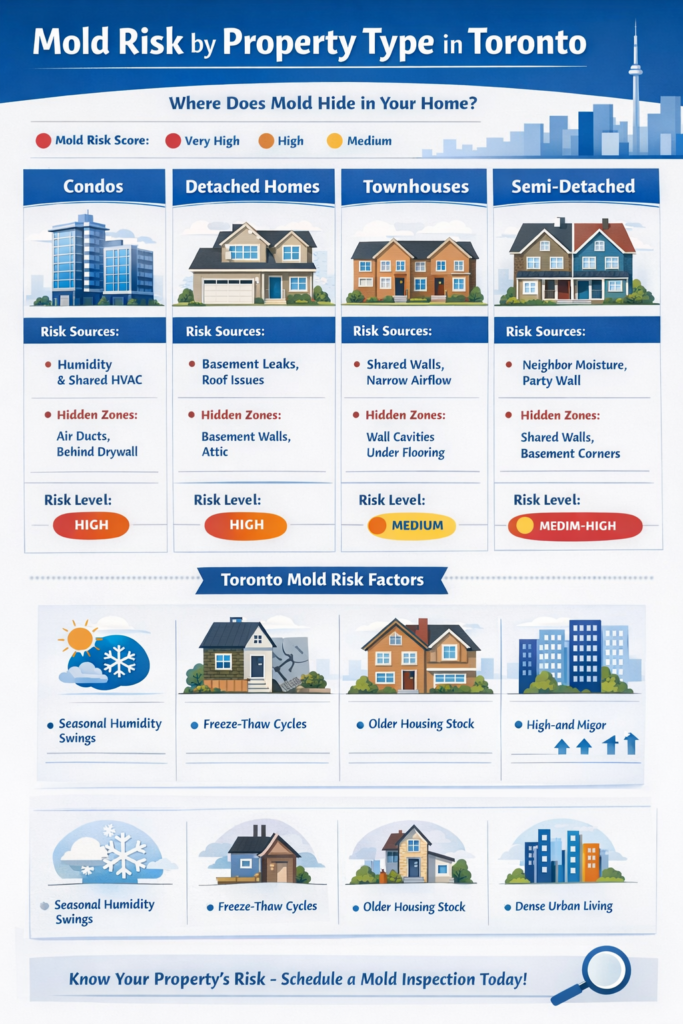
| Property Type | Primary Risk Source | Hidden Mold Zones | Risk Level |
|---|---|---|---|
| Condo | Humidity + HVAC systems | Ducts, behind drywall | High |
| Detached Home | Foundation leaks | Basement walls, subfloor | High |
| Townhouse | Shared walls | Insulation cavities | Medium |
| Semi-Detached | Neighbor moisture transfer | Party walls | Medium–High |
| Basement Apartment | Poor ventilation | Under flooring, wall cavities | Very High |
Condos (High-Rise & Low-Rise)
Structural traits
- Limited natural ventilation
- Shared HVAC systems
- High occupant density
How moisture behaves
Condos tend to trap humidity.
Daily activities like cooking, showering, and drying clothes release moisture into a confined space. That moisture circulates through the unit and can move between units through shared systems.
Common mold zones
- Inside air ducts
- Behind bathroom drywall
- Around windows with condensation
Unique risk factors
- Moisture entering from neighboring units
- HVAC systems spreading spores
- Limited access to internal building structures
Inspection blind spots
- Localized mold that air tests may miss
- Hidden plumbing leaks behind finished walls
Recommended approach
- HVAC inspection and cleaning
- Moisture mapping instead of surface checks only
- Targeted wall cavity inspection where humidity is highest
Detached Homes
Structural traits
- Full basements, common across Toronto
- Older waterproofing systems
- Multiple exposure points including roof, foundation, and plumbing
How moisture behaves
Water often enters at the foundation and moves slowly upward.
Small leaks stay hidden for long periods, especially behind finished basement walls.
Common mold zones
- Basement walls and floors
- Behind baseboards
- Attic insulation and roof sheathing
Unique risk factors
- Aging infrastructure
- Poor exterior drainage
- Inconsistent attic ventilation
Inspection blind spots
- Hairline foundation cracks
- Seasonal leaks that only appear during rain or snow melt
Recommended approach
- Basement moisture testing
- Attic ventilation assessment
- Exterior drainage and grading check
Townhouses
Structural traits
- Shared side walls
- Narrow airflow pathways
- Multi-level layouts
How moisture behaves
Moisture does not stay isolated.
It can travel between units through shared wall cavities, especially if one unit has an unresolved leak.
Common mold zones
- Inside shared wall insulation
- Around bathrooms and kitchens
- Under flooring near entrances
Unique risk factors
- Neighbor-related moisture issues
- Limited airflow in middle units
Inspection blind spots
- Mold inside insulation between units
- Cross-unit contamination
Recommended approach
- Thermal imaging to locate hidden moisture
- Wall cavity inspection
- Assessment of adjacent unit impact
Semi-Detached Homes
Structural traits
- One shared wall (party wall)
- Similar layout to detached homes with added shared exposure
How moisture behaves
Moisture can transfer from one side of the property to the other.
If one home has a leak or ventilation issue, the impact can extend into the neighboring structure.
Common mold zones
- Shared wall sections
- Basement corners
- Attic junction areas
Unique risk factors
- Neighbor maintenance issues
- Uneven airflow between both halves
Inspection blind spots
- Mold entering from the adjacent property
- Hidden contamination inside the party wall
Recommended approach
- Party wall inspection
- Combined moisture and airflow analysis
Basement Apartments (Highest Risk)
Structural traits
- Below-grade living space
- Often retrofitted or converted
- Limited natural airflow
How moisture behaves
Basements naturally retain moisture.
Without proper ventilation and insulation, humidity builds quickly and remains trapped.
Common mold zones
- Under laminate or carpet flooring
- Behind drywall
- Along foundation walls
Unique risk factors
- Poor air circulation
- Improper insulation methods
- Unregulated or poorly built conversions
Inspection blind spots
- Subfloor mold growth
- Condensation behind finished walls
Recommended approach
- Subfloor inspection
- Dehumidification performance analysis
- Full air quality testing
Toronto-specific mold risk factors
Toronto homes deal with a mix of environmental stressors that increase mold risk:
- Freeze-thaw cycles that create small cracks in structures
- Seasonal humidity swings that drive indoor condensation
- Older housing stock with outdated ventilation systems
- Urban density that allows shared air, walls, and moisture pathways
These factors make mold problems more complex and harder to isolate without a proper inspection.
Real-world scenarios seen across Toronto
These patterns show up frequently during inspections:
- A condo develops mold from a leak in the neighboring unit’s bathroom wall
- A detached home has recurring basement mold from a small foundation crack
- A basement apartment experiences ongoing mold due to trapped moisture under flooring
These are not rare situations. They are common across different property types in the city.
Mold risk score framework
You can estimate your property’s risk using three factors:
- Moisture exposure (1 to 5)
- Ventilation quality (1 to 5)
- Hidden space density (1 to 5)
Higher total means higher mold risk.
Example: Basement apartment
- Moisture: 5
- Ventilation: 2
- Hidden spaces: 5
Total: Very high risk
Expert insight
“In Toronto, the property type tells us where to look first. Condos usually hide mold in ducts or walls, while detached homes show it in basements and attics. If you don’t inspect based on structure, you miss the real source.” — Certified Mold Inspector, GTA (IICRC S520)
Key takeaway
Mold risk is not about how clean a home looks.
It depends on how the property handles moisture, airflow, and hidden spaces.
Each property type in Toronto has a different risk profile. The most effective approach is one that matches how that structure behaves.
Not Sure Where Your Risk Falls?
If you are unsure where mold could be developing in your property, a targeted inspection can reveal hidden risks early.
Ultimate Mold Crew provides detailed mold inspection, air quality testing, and mold remediationin Toronto GTA.
Book an inspection before small issues turn into major repairs.
FAQs
Which property type has the highest mold risk in Toronto?
Basement apartments carry the highest risk due to constant moisture exposure, limited airflow, and hidden subfloor spaces.
Are condos more prone to mold than houses?
Condos face different risks. HVAC systems, shared walls, and trapped humidity increase the chance of hidden mold inside ducts and wall cavities.
Why do detached homes often have basement mold?
Water intrusion through foundations, poor drainage, and older waterproofing systems make basements a common mold zone.
Can mold spread between units in townhouses or semi-detached homes?
Yes. Shared walls allow moisture and spores to move between units, especially if one property has an unresolved leak.
How do I know which areas to inspect first?
Start with areas where moisture collects:
- Basements
- Attics
- Bathrooms
- Around windows and ducts
A professional inspection helps identify hidden zones based on your property type.
