
Updated on 10-Mar-2026
Are you also wondering, why mold problems spike during spring.
Why spring is the season where most of the toronto homeowners face mold issues at their home.
You are not alone,
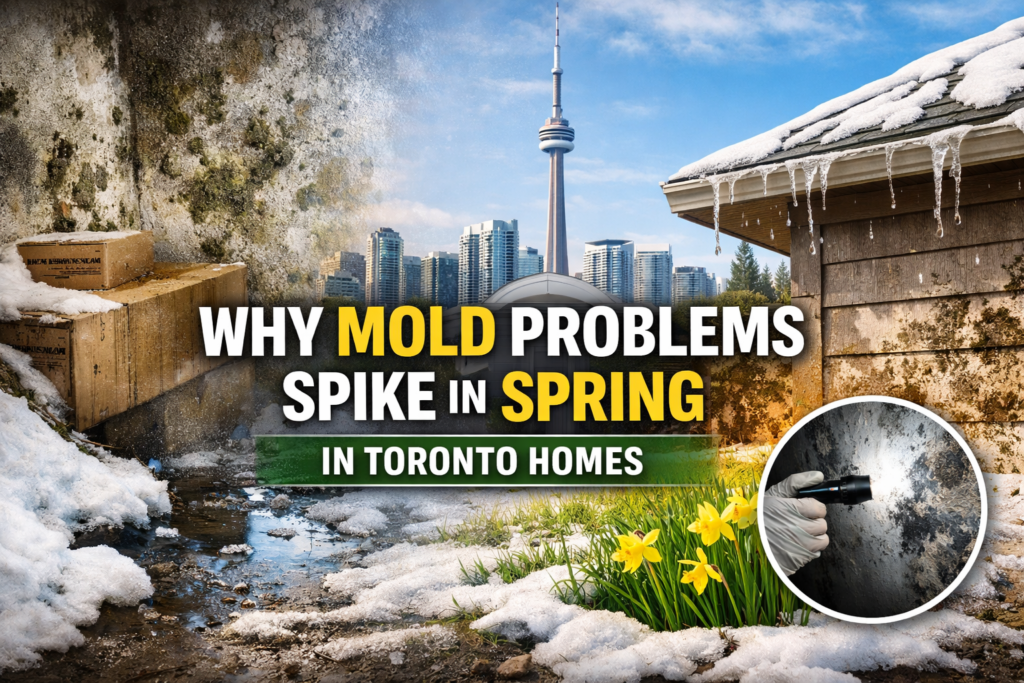
Mold problems often see increase in Toronto homes during spring because melting snow, rising groundwater, and higher humidity introduce moisture into basements, attics, and wall cavities.
Winter condensation that builds up inside building materials can also begin supporting mold growth once temperatures warm. As a result, many homeowners first notice musty odors or visible mold between March and early summer.
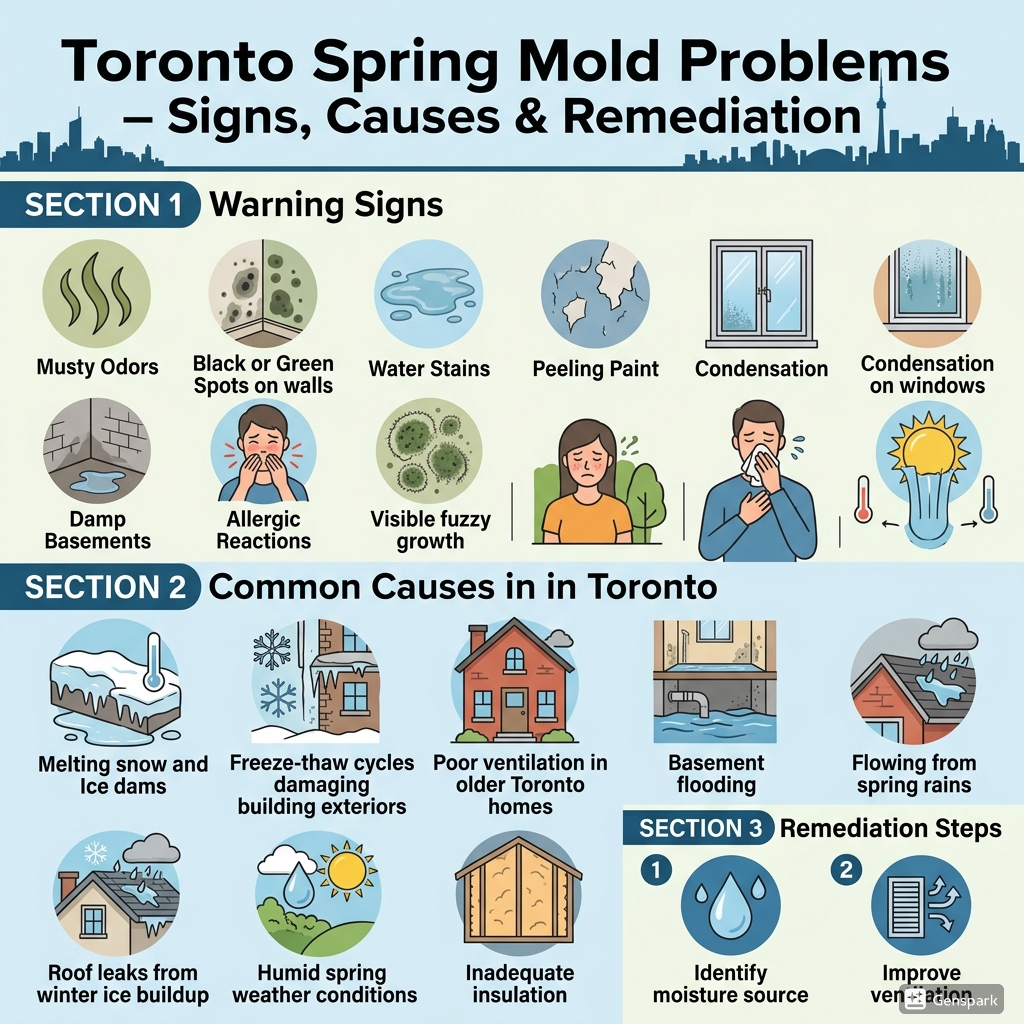
Table of Contents
Why Mold Removal Calls Increase Every Spring in Toronto
Every year, as winter begins to fade in Toronto, many homeowners start noticing something unusual inside their homes.
A basement that seemed dry all winter suddenly smells musty. Storage boxes feel damp. In some cases, dark spots begin appearing along basement walls or attic wood framing.
For mold remediation companies across the Greater Toronto Area, this pattern is very familiar.
“Every spring we see a noticeable increase in calls from homeowners who suddenly start smelling mold in their basement or attic,” explains Johnny C, Owner of Ultimate Mold Crew. “Most of the time, the moisture that caused the problem actually began building up during the winter months.”
This seasonal spike happens because several environmental factors begin changing at the same time when winter ends.
Snow that accumulated for months starts melting around foundations. Groundwater levels rise as the surrounding soil becomes saturated. At the same time, warmer temperatures increase humidity levels inside homes.
Inside the structure itself, moisture that quietly accumulated during winter may begin affecting building materials such as insulation, drywall, and wood framing.
When these conditions combine, they create the exact environment mold needs to grow.
Mold spores already exist in indoor air, so once moisture and warmth are present for long enough, mold colonies can begin developing on damp surfaces.
“Many homeowners assume mold suddenly appeared in spring,” the Ultimate Mold Crew Toronto mold removal specilaists team notes. “In reality, the moisture conditions often started weeks or months earlier during winter.”
This is why many Toronto homeowners first discover mold problem like musty mold smell shortly after winter, even though the underlying moisture issue may have begun long before the snow started melting.
Snow Melt and Rising Groundwater Around Toronto Homes
One of the biggest reasons mold problems increase in Toronto during spring is the large amount of water released when winter snow begins to melt.
Toronto winters often bring months of snowfall. As temperatures rise in March and April, that snow slowly melts and saturates the soil surrounding homes. In many neighbourhoods across the city, this meltwater does not drain immediately. Instead, it accumulates in the ground around building foundations.
When soil becomes heavily saturated, moisture begins pressing against basement walls and foundation materials.
This process is commonly referred to as hydrostatic pressure, where water in the surrounding soil pushes against foundation walls and basement floors. Even small cracks or porous concrete can allow moisture to slowly seep into the structure.
“Many Toronto homeowners are surprised to learn that basements can absorb moisture even when there is no visible flooding,” Johnny Antonio C at Ultimate Mold Crew explains.
“We often find elevated moisture levels inside basement walls after snow melt, especially in homes with older foundations.”
Why Toronto Soil Conditions Make the Problem Worse
In several parts of the Greater Toronto Area, the soil contains significant amounts of clay. Clay soil tends to hold water longer than sandy soil, which means moisture from melting snow may remain trapped near foundations for extended periods.
This creates conditions where basement walls remain damp long after snow has disappeared from the surface.
Homes located in older neighbourhoods or areas with aging drainage systems may experience this problem more frequently.
When basement materials such as drywall, wood framing, carpeting, or stored belongings absorb moisture, they can remain damp for days or even weeks. That extended dampness creates the ideal environment for mold spores to begin growing.
Why Basement Mold Often Appears Weeks After Snow Melt
Another reason mold problems spike in spring is that moisture problems are not always immediately visible.
Water may slowly migrate through concrete or masonry materials before reaching interior surfaces. By the time homeowners notice a musty odor or dark spotting, the materials may have already been damp for some time.
“We often see basement mold appear several weeks after the initial snow melt period, “Homeowners start noticing the smell in April or May, even though the moisture entered the structure earlier.”
Because of these seasonal moisture patterns, basements are one of the most common locations where Toronto homeowners discover mold growth in early spring.
Winter Condensation Inside Toronto Homes
Snow melt is not the only reason mold problems appear in spring. Another common cause is condensation that builds up inside homes during winter.
During cold months, warm indoor air naturally rises toward colder parts of the house. When this warm air reaches surfaces such as attic roof decking or exterior walls, moisture in the air can condense into water droplets.
Over time, this condensation can slowly dampen insulation, wood framing, and roof sheathing.
Because attic spaces are often cooler and less ventilated, moisture may remain trapped there throughout the winter months.
“Attic mold is something we see quite often after winter,” “Homeowners usually discover it in spring when they start noticing musty odors or when an inspection reveals dark staining on roof wood.”
This is one of the main reasons attic mold inspections often increase across Toronto during the early spring months.
Basement Humidity Spikes During Early Spring
As snow melts and groundwater levels rise, humidity inside basements often increases across Toronto homes. Even when there is no visible water entering the basement, moisture can still move through foundation walls and floors.
Concrete and masonry materials contain tiny pores that allow moisture to pass through slowly. When soil surrounding the home becomes saturated after snow melt, that moisture can migrate into basement spaces and raise indoor humidity levels.
In many homes, basement humidity can rise above 60 percent, which creates conditions where mold spores can begin growing on damp materials.
“When we inspect homes in spring, basements are often where the first signs of mold appear,” “A musty smell in the basement is usually one of the earliest indicators that excess moisture is present.” cleaning expert at Ultimate Mold Crew explains.
Early Signs Mold May Be Developing in yor Home This Spring
In many homes, mold does not appear suddenly. It usually begins with small changes that develop over several weeks as moisture builds up inside the structure.
During spring, Toronto homeowners may first notice subtle warning signs before mold becomes clearly visible.
Common early indicators include:
- • Persistent musty odors in basements, attics, or storage areas
- • Damp or humid basement air, especially near exterior walls
- • Small dark spotting on drywall, wood framing, or ceiling corners
- • Condensation around windows or cold surfaces
- • Allergy-like symptoms indoors, such as coughing or sinus irritation
“These early signs are something we hear about frequently during spring inspections,” “Homeowners often mention a new musty smell in the basement or attic before they actually see any mold.”
Recognizing these early warning signs can help homeowners investigate moisture problems before mold spreads further inside the home.
Why Mold Removal Calls Increase Between March and June in Toronto
Across Toronto and the surrounding GTA, mold remediation companies often experience their busiest period during early spring and early summer.
This seasonal spike occurs because several moisture conditions reach their peak at the same time.
When these conditions overlap, moisture that accumulated quietly during winter can begin affecting building materials throughout the home.
Because mold growth often starts in hidden areas such as wall cavities, insulation, or basement materials, the problem may not become obvious until weeks after the initial moisture intrusion occurred.
This is why many Toronto homeowners first discover mold problems during spring, even though the moisture conditions that caused them may have started months earlier.
What to Do If you Notice Mold in Spring
If a musty smell appears in a home during spring, it is usually a sign that excess moisture is present somewhere in the building. Because mold can begin growing within 24 to 48 hours on damp materials, it is important to investigate the cause as soon as possible.
Homeowners can start by checking areas where spring moisture problems commonly occur.
Improving ventilation and managing humidity can also help slow down mold growth. Running bathroom or kitchen exhaust fans, using a dehumidifier in basement areas, and keeping indoor humidity levels below 50 percent can make conditions less favorable for mold.
However, if mold continues spreading, appears across larger areas, or produces strong persistent odors, the problem may involve moisture trapped inside building materials.
“In many spring inspections, the visible mold is only part of the problem,” “We often find that moisture has been sitting inside walls or attic materials for weeks before homeowners notice the smell.”
Final Thoughts
Spring is one of the most common times for mold problems to appear in Toronto homes. Melting snow, rising groundwater, winter condensation, and increasing humidity all contribute to moisture conditions that allow mold spores to begin growing.
Many homeowners first notice the issue through musty odors, damp basement air, or small dark spots on building materials.
Understanding why mold problems spike during spring can help homeowners recognize these warning signs earlier and address moisture problems before they spread further inside the home.
If mold growth continues, spreads beyond small areas, or repeatedly returns after cleaning, it may indicate that moisture is trapped within the structure.
In those situations, proper assessment and remediation can help remove contaminated materials and restore healthy indoor air conditions.
Homeowners who suspect mold problems can learn more about professional mold removal services in Toronto here:
Research Sources for Spring Mold Spikes in Toronto Homes
| # | Citation | Key Focus |
|---|---|---|
| 1 | Conrad, C., et al. (2025). Indoor Mold Concentrations, Prevalence, and Relation to Building Characteristics in Homes in Very Cold Climates. | Peer-reviewed study in Indoor Environments quantifying how building age and density in cold climates (like Toronto) correlate with higher mold concentrations during seasonal transitions. |
| 2 | Haines, S. (2024). Microbial Growth and Material Degradation in Residential Ventilation Systems. | Research from the University of Toronto examining how excess moisture from ventilation failures and seasonal humidity spikes leads to rapid fungal colonization on building materials. |
| 3 | Vecherin, S., et al. (2024). Risk assessment of mold growth across the US due to climate conditions. | Study in Building and Environment detailing a probabilistic framework for mold risk, highlighting how spring runoff and snowmelt accelerate growth in temperate regions. |
| 4 | Al-Shatnawi, Z., et al. (2024). Advances in cold-climate-responsive building envelope design. | Comprehensive review in Buildings on how freeze-thaw cycles and seasonal moisture accumulation in building envelopes create the ideal conditions for spring mold outbreaks. |
| 5 | Liu, Y., et al. (2024). Assessment of hygrothermal performance and mould growth in attics. | Technical research analyzing how the transition from winter to spring increases the risk of mold in attics due to rising humidity and inadequate ventilation during the thaw. |
| 6 | Menneer, T., et al. (2021). Modelling mould growth in domestic environments using relative humidity and temperature. | Study providing a predictive model for mold growth, showing how the 70%-80% relative humidity levels common in Toronto’s spring are the primary driver for fungal activity. |
| 7 | Viitanen, H., et al. (2013). The effect of cyclic moisture and temperature on mould growth. | Foundational research in Building and Environment on how alternating humidity conditions—typical of Toronto’s fluctuating spring weather—can actually accelerate mold development. |
