
Updated on 10-Mar-2026
Table of Contents
Mold After Snow Melt During Spring
Snow melt and rising spring humidity can create hidden moisture that leads to mold growth in basements, walls, and attics.
Mold growth often increases in spring when melting snow raises moisture levels around homes. Water from snow melt can seep into basements, foundations, and crawl spaces while warmer temperatures increase indoor humidity. When building materials stay damp for long periods, mold spores can begin growing, which is why many homeowners first notice mold problems after winter and start looking out for a mold removal specialist nearby in Toronto.
How Snow Melt Creates Hidden Moisture Around Homes
When winter snow begins to melt, the water has to go somewhere. Much of it flows into storm drains or evaporates, but a large portion is absorbed into the soil surrounding homes.
As the ground becomes saturated, moisture begins moving toward the foundation of the house. This is where many hidden moisture problems start.
Even well-built homes are not completely waterproof. Concrete foundations, basement floors, and masonry materials are slightly porous. When the soil around a home holds excess water from melting snow, that moisture can slowly migrate through these materials.
This process is known as moisture intrusion.
How Meltwater Reaches the Basement
Several pathways allow snow melt to introduce moisture into a home.
- Foundation seepage
Water in saturated soil can press against foundation walls and gradually seep through small pores in concrete. - Cracks in basement walls or floors
Tiny cracks created by seasonal expansion and contraction allow meltwater to enter the structure. - Poor exterior drainage
If the ground slopes toward the house or gutters are clogged, snow melt may collect near the foundation. - Capillary moisture movement
Concrete and masonry materials can draw moisture upward from wet soil through microscopic pores.
Because these processes occur slowly, homeowners may not notice obvious water intrusion at first. Instead, building materials inside the basement begin to absorb moisture gradually.
Why Mold Often Follows Snow Melt
Once materials such as drywall, wood framing, insulation, or stored items become damp, they create an environment where mold spores can begin to grow.
Mold spores are naturally present in indoor air. When moisture levels rise and remain elevated for several days, spores can settle on damp surfaces and begin forming colonies.
Basements are especially vulnerable because they are naturally cooler and often have limited airflow. When spring arrives and humidity increases, moisture trapped in basement materials can remain long enough for mold growth to begin.
In many homes, this process happens quietly. By the time a homeowner notices a musty smell or visible mold spots, the underlying moisture problem may have already been present for weeks.
Winter Condensation: The Hidden Moisture Problem That Appears in Spring
Snow melt is only part of the reason mold problems often appear when winter ends. Another major factor is condensation that forms inside homes during the colder months.
Throughout winter, warm indoor air constantly rises and moves toward colder surfaces inside the building structure. When this warm air meets cold materials such as roof decking, exterior walls, or window frames, moisture in the air condenses into small water droplets.
This process happens quietly and often goes unnoticed.
Over the course of several months, condensation can gradually dampen insulation, wooden framing, and drywall inside walls or attic spaces. While the moisture may not be obvious during the winter, it can remain trapped inside building materials.
Why Condensation Problems Become Visible in Spring
When temperatures begin to warm in early spring, several things change inside the home.
Humidity levels start to rise.
Warmer air increases evaporation from damp materials.
Trapped moisture begins moving through the structure.
As these changes occur, previously hidden moisture may finally become noticeable.
Homeowners sometimes begin to observe:
- • musty smells appearing in upper floors or attics
- • damp insulation in attic spaces
- • dark spots forming on wood sheathing
- • condensation marks near ceiling corners
In many cases, the mold growth actually started during winter. It simply becomes visible later when warmer conditions allow mold colonies to expand.
Why Attics Are Especially Vulnerable
Attics are one of the most common places where winter condensation leads to mold growth.
Warm air from inside the house naturally rises toward the attic. If ventilation is limited or insulation is inadequate, that warm air can carry moisture into the attic space. When it contacts the cold roof surface, condensation forms.
Over time, this moisture can accumulate on roof sheathing and wooden framing, creating ideal conditions for mold development.
By the time spring arrives, the combination of winter condensation and rising humidity can allow mold colonies to spread rapidly in attic areas.
Basement Humidity Spikes During Early Spring
Basements are one of the most common places where homeowners first notice mold problems after winter. During early spring, moisture conditions inside basements often change rapidly as snow melts and groundwater levels rise.
When the soil around a house becomes saturated from melting snow, that moisture increases the humidity inside basement spaces. Even if water does not visibly enter the basement, moisture can still migrate through foundation walls and floors.
Concrete may appear solid, but it naturally contains tiny pores that allow moisture to pass through slowly. As a result, basements can begin absorbing moisture from surrounding soil during periods of heavy snow melt.
Why Basement Air Becomes More Humid in Spring
Several environmental changes happen at the same time during early spring.
Outdoor temperatures begin rising.
Snow melts and saturates surrounding soil.
Groundwater levels increase near foundations.
Together, these conditions allow moisture to move toward basement walls and floors.
Once moisture enters the basement environment, it can raise indoor humidity levels significantly. In many homes, humidity levels may exceed 60 percent, which creates ideal conditions for mold spores to begin growing on building materials.
Areas in Basements Where Mold Often Develops
Basement mold frequently appears in places where airflow is limited or moisture collects unnoticed.
Because basements often receive less ventilation than upper floors, moisture tends to remain trapped for longer periods . When damp materials remain wet for several days, mold spores can begin forming colonies.
This is why many homeowners first detect mold during spring through musty odors or visible spots on basement surfaces shortly after snow melt.
Early Signs Mold May Be Developing After Snow Melt
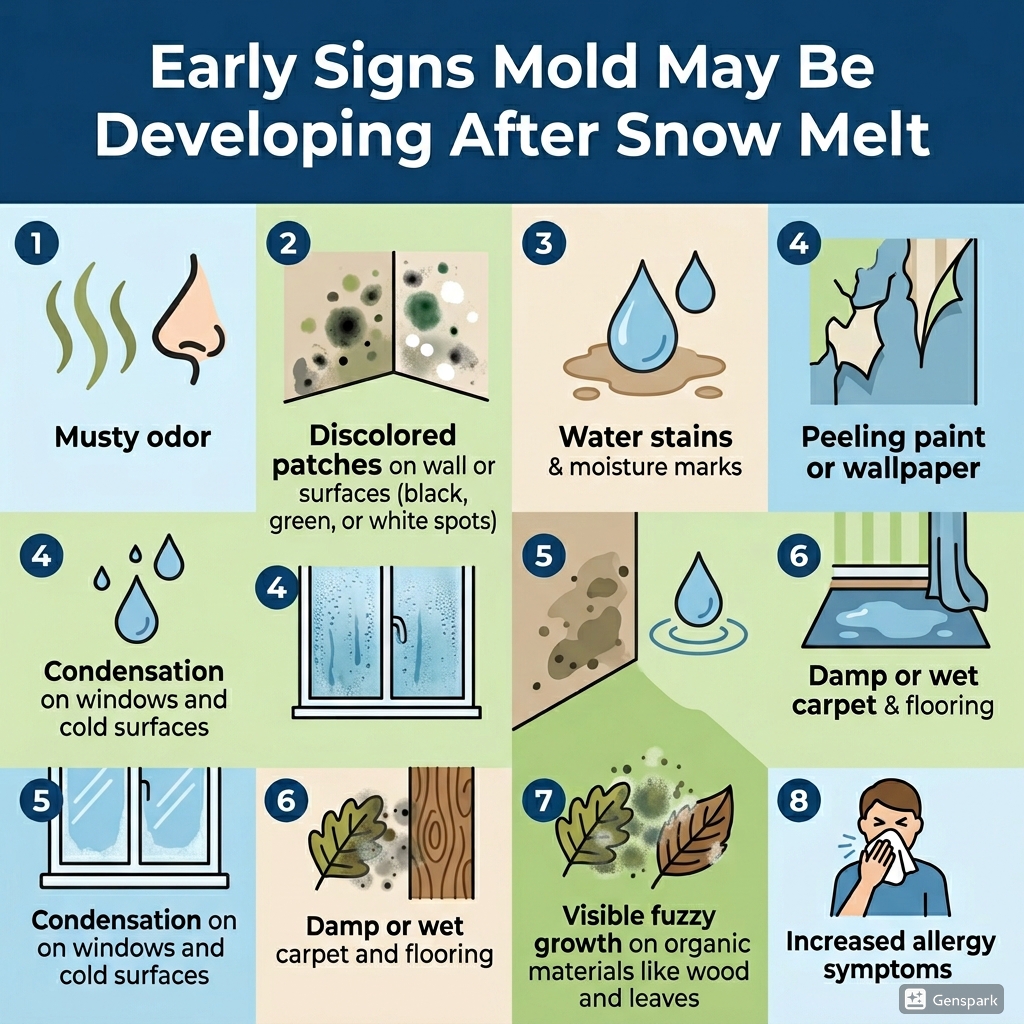
In many homes, mold does not appear suddenly. It usually begins with small changes that develop over several weeks after moisture enters the structure.
Because snow melt and spring humidity increase moisture levels around homes, the first signs of mold often appear gradually during this time of year. Homeowners may notice subtle clues before mold becomes clearly visible.
Common Early Warning Signs
- Persistent musty odors
- Damp surfaces near exterior walls
- Dark spotting on drywall or wood
- Condensation around windows or ceiling corners
- Allergy-like symptoms indoors
These signs do not always mean a severe mold infestation is present. However, they can indicate that moisture conditions are allowing mold to begin growing somewhere in the home.
Why Spring Is Often When These Signs Appear
During winter, moisture from condensation and snow accumulation may remain hidden inside building materials. When temperatures begin to rise in early spring, that trapped moisture becomes more active.
Warmer air and higher humidity levels allow mold spores to begin growing more rapidly. As colonies expand, odors become stronger and visible spots may start appearing on surfaces.
Because of this seasonal pattern, many homeowners first notice mold problems shortly after the snow begins to melt. Identifying these warning signs early can help prevent mold from spreading further inside the home.
What To Do If They Notice Mold After Snow Melt?
If mold begins appearing after winter or during early spring, the most important step is to identify where the moisture is coming from. Mold cannot grow without moisture, so solving the water problem is essential before any cleanup efforts will be effective.
In many homes, spring mold growth is connected to snow melt, foundation moisture, or condensation that built up during the colder months.
Start by Investigating Moisture Sources
Homeowners can begin by checking areas where spring moisture commonly enters a house.
Look for signs such as:
• water stains along basement walls
• damp insulation in attic spaces
• condensation around windows or exterior walls
• leaks under sinks or around plumbing fixtures
• pooling water near the home’s foundation outside
These clues can help narrow down where excess moisture may be entering the structure.
Improve Ventilation and Humidity Control
Spring often brings higher humidity levels indoors, which can accelerate mold growth. Improving airflow inside the home can help reduce moisture buildup.
Maintaining indoor humidity levels below 50 percent can significantly reduce the likelihood of mold developing.
Address Mold Growth Early
Small patches of mold on non-porous surfaces may sometimes be cleaned using appropriate cleaning methods. However, if mold appears on porous materials such as drywall, insulation, carpeting, or wood framing, removal of the affected materials may be necessary.
If mold continues spreading, returns repeatedly, or appears across larger areas, it may indicate that moisture is trapped inside the building structure.
In these situations, professional mold remediation may be recommended to properly remove contaminated materials and correct the moisture conditions that allowed mold to grow.

Final Thoughts
Spring is one of the most common times for mold problems to appear in homes. Melting snow, rising groundwater, winter condensation, and increased humidity all contribute to moisture conditions that allow mold spores to begin growing.
Because mold growth often begins quietly inside hidden spaces, homeowners may first notice the problem through musty odors, damp surfaces, or small visible spots on building materials.
Peer-reviewed research for Spring Mold
| # | Citation | Key Focus |
|---|---|---|
| 1 | Vecherin, S., et al. (2024). Risk assessment of mold growth across the US due to climate conditions. | Peer-reviewed research in Building and Environment providing a probabilistic framework for mold growth risk based on seasonal moisture runoff and snowmelt patterns. |
| 2 | Song, C., et al. (2024). Modeling capillary water absorption behavior of concrete. | Technical study in the Journal of Building Engineering investigating how moisture transport pathways in cementitious materials facilitate water intrusion under capillary pressure. |
| 3 | Liu, Y., et al. (2024). Assessment of hygrothermal performance and mould growth in attics. | Research in Building and Environment examining the relationship between attic ventilation rates and the risk of mold growth during seasonal temperature transitions. |
| 4 | He, J., et al. (2024). Analysis of Capillary Water Absorption within Unsaturated Concrete. | Study in Buildings presenting a novel approach for analyzing how environmental humidity and soil saturation influence capillary water flow in concrete foundations. |
| 5 | Tulakov, E., et al. (2024). Experimental analysis of moisture protection of buildings. | Technical analysis of how the appearance of capillary moisture in foundation and plinth walls affects the technical condition and mold risk of operational buildings. |
| 6 | Al-Shatnawi, Z., et al. (2024). Advances in cold-climate-responsive building envelope design. | Comprehensive review of how climate conditions in cold regions impact building envelope moisture content and the subsequent risk of fungal colonization. |
| 7 | Kamel, E., et al. (2024). State of the practice review of moisture management in residential buildings. | Research focusing on the background of moisture buffering and its effects on indoor environmental quality, specifically during seasonal transitions like the spring thaw. |
