
Updated on 22-Jul-2026
Few things derail an Ontario real estate transaction faster than mold. A buyer falls in love with a house, the home inspector flags a musty basement or stained attic sheathing, and suddenly the deal is stuck — renegotiate, walk away, or push through and hope for the best?
Mold in a home is more than a cosmetic problem. It can signal chronic moisture issues, compromise structural materials, affect indoor air quality, and create real legal exposure for sellers who don’t handle disclosure correctly.
Whether you’re buying your first home in the GTA or selling a family house in Toronto, understanding how Ontario law treats mold — and what your obligations and options actually are — can save you tens of thousands of dollars and a great deal of stress.
This guide explains Ontario’s disclosure rules in plain language, shows buyers how to spot mold during an inspection, walks sellers through handling mold before listing, and explains where professional mold testing fits into a transaction.
A note before we begin: This article is general information, not legal advice. Ontario real estate law is fact-specific and changes with new court decisions. For advice on your particular situation, speak with an Ontario real estate lawyer.
Table of Contents
Why Mold Matters in an Ontario Real Estate Transaction
Health, Structural, and Financing Implications
Mold growth indoors is a moisture problem made visible. Health Canada’s Residential Indoor Air Quality Guideline: Moulds notes that mold growth affects indoor air quality because both spores and fungal fragments become airborne and can be inhaled, and that individuals with asthma, allergies, or other respiratory conditions are particularly sensitive [^7]. Beyond health, mold on structural wood — attic sheathing, basement joists, wall framing — can progress to wood decay that compromises the building envelope.
There’s also a financing angle. While Canadian mortgage lenders don’t routinely require mold inspections the way some U.S. lenders do, a home inspection report that flags significant mold or water damage can affect a buyer’s willingness to close, an insurer’s willingness to underwrite the property, and ultimately the price a buyer is prepared to pay.
How Mold Affects Sale Price and Deal Viability
In our experience working with Ontario buyers, sellers, and realtors, mold rarely kills a deal outright — but it almost always changes the conversation. A small, contained patch with a clear, fixable cause (a bathroom fan vented into the attic, for example) is a negotiation point. Widespread growth tied to an unresolved moisture source, or growth that has damaged structural materials, can drive a significant price reduction or send a buyer back to the market.
The difference usually comes down to documentation. A seller who can produce a professional inspection report, a mold remediation certificate from a certified mol removal company , and post-remediation clearance testing is in a far stronger position than one who simply says, “We cleaned it up.”
Also Read – Mold in Rental Property – Landlord Liability & Removal [GUIDE]
How Mold Affects Home Appraisal & Mortgage Approval

Mold is more than a cosmetic problem — it directly affects a property’s market value and financing eligibility.
Impact on Home Appraisal
-
Appraisers often reduce value if visible mold or moisture issues exist.
-
Homes with mold can sell for 10–30% less, depending on severity and location.
-
Even after remediation, a documented mold history may lower perceived value.
Impact on Mortgage Approval
-
Many lenders, including FHA and CMHC-backed programs, may deny or delay loans if mold is discovered during inspection.
-
Buyers may face higher premiums or insurance requirements before approval.
-
Some lenders require proof of professional remediation before releasing funds.
💡 Did You Know?
In severe cases, lenders may classify homes with mold as “uninhabitable,” preventing financing until remediation is complete.
Ontario Disclosure Rules: What Sellers Must Tell Buyers
Ontario real estate operates under the principle of buyer beware (caveat emptor) for many property conditions — but that principle has important limits. The key distinction is between patent defects and latent defects, and it determines what a seller is legally required to disclose.
Patent Defects vs. Latent Defects
The Real Estate Council of Ontario (RECO) sets out the distinction clearly [^2]:
- A patent defect is one that can be detected by a buyer or their home inspector through reasonable observation and inquiry — a visible water stain on the ceiling, for instance, or an obvious patch of mold on a bathroom wall. Sellers are generally not obligated to point out patent defects; the buyer is expected to discover them through their own due diligence.
- A latent defect is one that would not be discovered through reasonable observation — mold hidden behind drywall, under flooring, or inside an attic cavity, for example. Where a latent defect renders the property dangerous, potentially dangerous, or unfit for habitation, the seller has a legal duty to disclose it to the buyer.
Mold frequently sits in this grey zone. Visible mold on a basement wall is arguably patent. Mold concealed behind a freshly painted wall or above a dropped ceiling is latent — and if the seller knows about it and says nothing, that silence can become a serious legal problem.
Active Concealment Is Treated as Fraud
It’s one thing to stay quiet about a patent defect; it’s another to actively hide a problem. Ontario courts have held that active concealment — where a seller knows of a defect and takes steps to prevent the buyer from discovering it — is treated as a form of fraud, equivalent to falsely asserting the defect does not exist [^2]. Painting over mold, installing a cosmetic cover over a stained ceiling, or running a dehumidifier during showings to mask a musty smell can all cross this line.
Recent Ontario case law shows the financial stakes. In Austin v. MacFarlane, 2026 ONSC 463, a buyer discovered significant water infiltration, mold, and foundation damage after purchase and sued for breach of contract and negligent misrepresentation, alleging the seller had concealed the defects and misrepresented the home’s condition. The court awarded the buyer $119,595.75 in repair costs plus $10,000 in general damages for mental stress and inconvenience [^1].
The Seller Property Information Statement (SPIS): Voluntary, and Risky
You may hear about the Seller Property Information Statement (SPIS) — OREA Form 220 — a questionnaire about a property’s history and condition. A few important points, per RECO and Ontario real estate lawyers:
- The SPIS is voluntary. Completing it is not a legal requirement in Ontario [^12][^13].
- It goes well beyond your legal duty. Your mandatory obligation is to disclose dangerous latent defects; the SPIS asks about a much broader range of topics [^15].
- Once you complete it, you can be held to it. Ontario courts have repeatedly held that a seller who completes a SPIS can be liable for misrepresentation if the information is wrong or misleading — even if the error was an honest mistake — because the buyer is entitled to rely on the seller’s representations as true [^14][^16].
For these reasons, many Ontario real estate lawyers advise sellers to think carefully — and get legal advice — before completing a SPIS. If you do disclose a known mold or water issue, whether on a SPIS or otherwise, accuracy matters: disclose what you genuinely know, avoid speculation, and keep records.
Buyer Negotiation Strategies for Mold-Impacted Homes
Mold in a home doesn’t always have to be a deal breaker. Smart buyers use inspection results to negotiate better terms.
Common Negotiation Approaches
-
Price Reduction – Use inspection reports to request a lower purchase price.
-
Seller Remediation – Negotiate for the seller to hire professionals before closing.
-
Repair Credit – Accept the mold issue but request a credit to cover future remediation.
When to Walk Away
-
Extensive mold in structural areas like foundations or attics.
-
Mold linked to ongoing water leaks that haven’t been fixed.
-
Sellers who refuse to acknowledge or disclose the problem.
💡 Did You Know?
A 2022 Realtor survey found that 61% of buyers used mold discovery as leverage to negotiate lower prices.
Seller Disclosure & Legal Obligations
When selling a home, mold isn’t just a maintenance issue — it’s a legal obligation.
Disclosure Requirements
-
In Canada and most U.S. states, sellers must disclose known mold issues to buyers, even if remediation has been done.
-
Failure to disclose can lead to lawsuits, deal cancellations, or financial penalties.
-
Sellers should provide inspection reports, remediation receipts, and warranty certificates where available.
Best Practices for Sellers
-
Get a pre-listing mold inspection to identify problems before buyers do.
-
Keep documentation of all repairs and mold treatments.
-
Be transparent — hidden mold often surfaces during buyer inspections and erodes trust.
💡 Did You Know?
Some provinces and Canada have ruled in court that even concealed or past mold problems must be disclosed if they could affect property value.
Mold Remediation & ROI Before Selling
Sellers often face a tough choice: remediate mold before selling, or lower the asking price.
Cost vs. Value Impact
-
Professional remediation can cost between $2,000–$10,000, depending on severity.
-
Leaving mold unresolved can reduce home value by up to 30%, far outweighing remediation costs.
-
Homes with a clean post-remediation certificate sell faster and closer to asking price.
When Remediation Pays Off
-
If mold is localized (e.g., basement corner, bathroom tiles).
-
In competitive housing markets where buyers have multiple options.
-
If seeking mortgage-approved buyers — many lenders won’t finance mold-affected homes.
💡 Did You Know?
A case study by the National Association of Realtors showed a seller who spent $7,500 on remediation recovered nearly $20,000 more in resale value compared to leaving mold untreated.
Insurance & Liability Considerations
Mold issues don’t just affect sales negotiations — they also impact homeowner’s insurance and liability exposure.
Insurance Coverage Basics
-
Most standard homeowner’s insurance does not cover mold unless caused by a “sudden, accidental event” (e.g., burst pipe).
-
Mold from long-term leaks, poor maintenance, or humidity issues is usually excluded.
-
Buyers should ask insurers about mold riders or add-on coverage for protection.
Seller Liability Risks
-
Sellers who fail to disclose mold risk post-sale lawsuits if the buyer discovers the issue later.
-
Courts often side with buyers if there is proof the seller knew about the problem.
-
Liability costs can include remediation expenses, legal fees, and damages for health impacts.
💡 Did You Know?
Some insurers refuse coverage for homes with a documented history of mold claims, even years after remediation.
For Buyers: Spotting Mold During a Home Inspection
As a buyer in Ontario, the law expects you to do your homework on patent defects. That makes the home inspection — and your own eyes and nose — your first line of defence.
Red Flags to Watch For
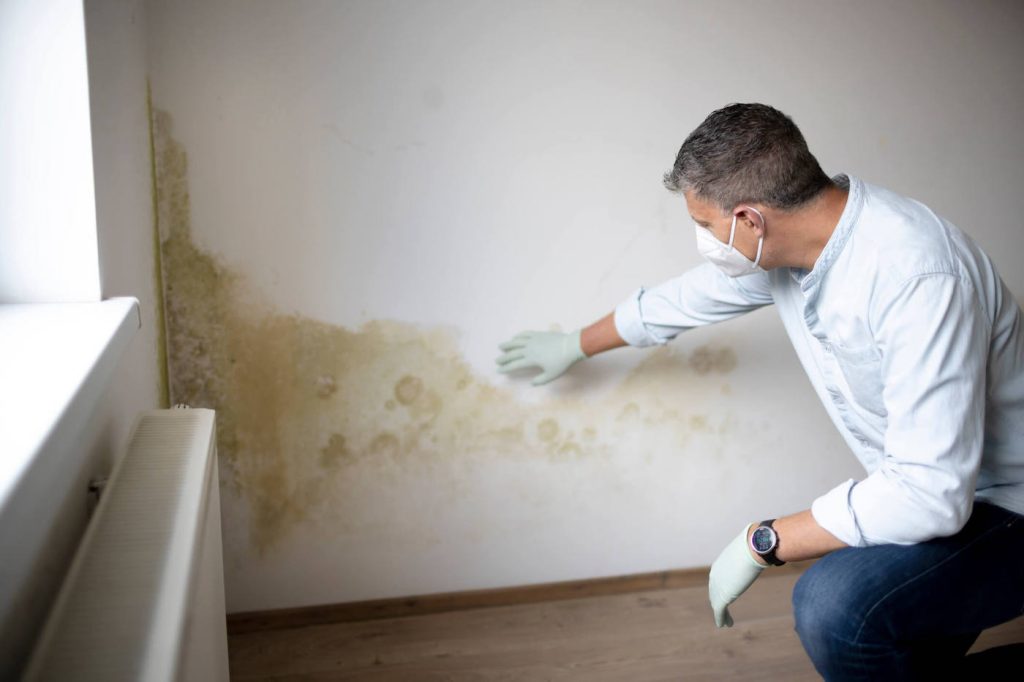
- Musty or earthy odour, especially in basements, crawl spaces, and on the top floor — often the first sign of hidden growth. (See our guide on what a mold smell in a house actually indicates.)
- Fresh paint or new patches on basement walls or ceilings, particularly in an otherwise older, unfinished space — a classic sign of cosmetic cover-up.
- Water stains, tide marks, or efflorescence (white, chalky residue) on foundation walls and floors.
- A dehumidifier running in the basement during the showing — ask why.
- Warped flooring, bubbling paint, or swollen baseboards near exterior walls, windows, and plumbing.
- Visible speckling on attic sheathing, under sinks, around windows, or on bathroom ceilings (our mold on bathroom ceiling guide covers what those patterns mean).
Visible Signs to Identify Mold Growth
-
Basements & crawlspaces – stains, musty odors, efflorescence on walls.
-
Bathrooms & kitchens – black spots on tiles, grout, or caulking.
-
Attics – roof leaks, condensation, and discolored insulation.
-
HVAC systems – check ducts and vents for dust mixed with mold.
Hidden Signs of Mold
-
Strong air fresheners used to mask odors.
-
Recently painted walls (potential cover-up).
-
Dehumidifiers or fans running in odd areas.
When a Standard Home Inspection Is Not Enough
A general home inspection is a visual assessment of the home’s major systems; inspectors typically note visible signs of moisture or mold and recommend further evaluation, but they do not open walls, move insulation, or perform air sampling. If the inspector flags moisture, a smell, or staining — or if you simply want certainty before committing to a high-value purchase — a dedicated mold inspection with air and surface sampling goes much further. Our explainer on mold inspection vs. mold testing breaks down exactly what each one tells you.
Adding a Mold Condition to Your Offer
In Ontario, buyers can make an offer conditional on a satisfactory home inspection, and you can extend that to include a specific mold inspection or indoor air quality test. Work with your realtor to word the condition clearly — for example, conditional on a mold inspection at the seller’s or buyer’s expense, with the right to terminate if results exceed an agreed threshold. A conditional offer gives you a legal off-ramp if the inspection reveals a problem you’re not prepared to take on.
💡 Did You Know?
Professional mold inspections typically cost between $300–$600, but can save buyers tens of thousands in remediation costs later.
The bottom line: addressing mold early is always cheaper — financially, legally, and for your peace of mind.
Should You Walk Away, Renegotiate, or Remediate?
Finding mold doesn’t automatically mean walking away. In most cases you have three options, and the right one depends on the extent of the growth and the cause.
Using a Remediation Estimate in Negotiations
Get a written, itemized remediation estimate from a certified professional before you negotiate. A concrete number — covering containment, removal, moisture-source correction, and clearance testing — turns an emotional “there’s mold!” conversation into a factual one. Sellers are far more likely to engage constructively with a documented figure than with an open-ended demand.
Price Reduction vs. Seller Remediation vs. Conditional Offer
- Price reduction / credit: The seller reduces the price or credits you at closing, and you arrange remediation yourself. This gives you control over the quality of the work.
- Seller completes remediation before closing: The seller hires a certified firm and provides a remediation certificate and clearance test. Insist on post-remediation verification — don’t accept “we cleaned it” without proof.
- Extend or add a condition: If you need more time to assess, your realtor can seek an extension or amendment to the conditions.
When Mold Is a Deal-Breaker
Consider walking away — or renegotiating aggressively — when the growth is extensive, when it has damaged structural materials (rotted sheathing, joists, or framing), when the moisture source is unresolved or expensive to fix (chronic foundation leakage, a failing roof), or when a sensitive household member’s health is at risk. Our mold assessment vs. remediation guide can help you judge whether a problem is minor or major.
For Sellers: Handling Mold Before Listing
If you’re selling, your goal is to protect your sale price and shield yourself from post-closing liability. Hiding a known mold problem is the worst strategy — it’s both ethically wrong and, as the case law above shows, legally expensive.
Disclose vs. Remediate
You generally have two defensible paths. Remediate before listing: fix the moisture source, remove the mold professionally, and keep the documentation. This removes the issue from the transaction entirely and lets you market a clean inspection report. Disclose and price accordingly: if you choose not to remediate, disclose the known issue honestly and let the market price it in. Either way, never conceal.
Documentation Is Your Best Protection
Assemble a paper trail: the original inspection report, the remediation scope of work, photographs, the remediation certificate, and — critically — post-remediation clearance testing confirming spore levels are back to normal. This documentation does two jobs: it reassures buyers (protecting your price) and it demonstrates that you acted responsibly (protecting you from a future misrepresentation claim).
A Clean Report Can Preserve Your Sale Price
A pre-listing mold inspection and, where needed, remediation with clearance testing often pays for itself. Buyers pay a premium for certainty. A seller who hands over a clean, professional mold report removes the single biggest objection a buyer’s inspector could raise — and avoids the last-minute price renegotiation that so often follows a surprise mold finding.
The Role of Professional Mold Testing in a Transaction
Air and Surface Sampling for Due Diligence
Professional mold testing typically combines air sampling (spore trap analysis comparing indoor rooms against an outdoor baseline) with surface sampling of visible growth to identify the genera present and the concentration levels. For a buyer, this quantifies a problem that a visual inspection can only describe qualitatively. For context on what spore counts mean, see our guide to mold spore levels and our breakdown of air quality testing costs in Toronto.
Post-Remediation Clearance Testing as Proof
Clearance testing after remediation is the objective evidence that the work succeeded — that indoor spore counts are at or below the outdoor baseline. For buyers, it’s the difference between taking the seller’s word and having independent verification. For sellers, it’s the document that closes the file.
Turnaround Times for Tight Closing Deadlines
Ontario deals often move on 30-, 60-, or 90-day closings, and conditional periods can be as short as a few business days. Reputable firms can typically schedule an inspection quickly and return lab results within a few business days — but if you’re relying on a mold condition, build the testing timeline into your conditional period so you’re not forced to waive a condition you haven’t had time to satisfy.
New Builds and Renovated Homes Are Not Immune
A common and dangerous assumption is that “new” means “mold-free.” It doesn’t. New construction can trap significant moisture: lumber and concrete arrive wet, buildings are enclosed before they dry, and tight modern building envelopes leave little margin for error if ventilation or flashing details are imperfect. We’ve inspected brand-new Ontario homes with attic sheathing mold caused by construction-phase moisture that was sealed in before the house ever dried out.
Renovated homes carry their own risks — a new bathroom added without upgrading attic ventilation, or a finished basement that buries a damp foundation wall behind drywall. If you’re buying new or newly renovated, don’t skip the inspection just because the home is under warranty.
How Ultimate Mold Crew Helps Ontario Buyers and Sellers
Ultimate Mold Crew is an IICRC-certified mold inspection and remediation company serving Toronto and the wider GTA. We work with buyers, sellers, realtors, and real estate lawyers on transactions every week:
- Fast pre-purchase mold inspections with air and surface sampling, scheduled to fit your conditional period.
- Clear, documented reports you can use in negotiations or share with your lawyer.
- Remediation with post-remediation clearance testing, so sellers can prove the problem is resolved.
- Realtor and lawyer partnerships — we understand transaction timelines and the documentation the deal requires.
If mold has surfaced in your transaction, don’t guess and don’t gamble. Book a mold inspection or request a quote and get the facts before you sign.
Frequently Asked Questions
Do sellers have to disclose mold in Ontario?
It depends on the type of defect. Ontario follows caveat emptor (buyer beware) for patent defects — problems a buyer or inspector could reasonably discover. But sellers must disclose latent defects (hidden problems, such as mold concealed behind walls) that make the property dangerous or unfit for habitation, and active concealment of a known defect is treated as a form of fraud [^2]. If you’re unsure whether a known mold issue must be disclosed, get advice from an Ontario real estate lawyer.
Can you buy a house that has mold?
Yes — many homes with mold sell successfully. The key is knowing the extent and the cause before you commit. A contained, easily fixed problem is usually a negotiation point; widespread growth with an unresolved moisture source may justify a large price reduction or walking away. Get a professional inspection and remediation estimate so you can make an informed decision.
Should I get a mold inspection before buying a home?
If the home inspection flags moisture, staining, or a musty odour — or if the home is older, has a finished basement, a history of water issues, or you simply want certainty — a dedicated mold inspection with air and surface sampling is worthwhile. It quantifies the problem and gives you leverage in negotiations or a basis for a conditional offer.
Can mold kill a real estate deal?
It can, but it more often changes the terms. Mold rarely ends a deal outright; instead it triggers renegotiation — a price reduction, a seller-paid remediation, or an extended condition. It’s most likely to end a deal when the growth is extensive, structural materials are damaged, or the moisture source is costly and unresolved.
Who pays for mold remediation in a home sale?
This is negotiable. Common outcomes are a price reduction or closing credit (buyer arranges the work), seller-paid remediation before closing (with clearance testing as proof), or a split. The party who pays usually reflects who has the leverage and how the inspection findings are documented.
Does a home inspector check for mold?
A general home inspector reports visible signs of moisture and mold and may recommend further evaluation, but does not open walls, move insulation, or perform air sampling. For confirmation and quantification, you need a dedicated mold inspection with laboratory analysis.
This article provides general information only and is not legal advice. Consult an Ontario real estate lawyer for advice on your specific transaction.
Sources
- [^1]: Austin v. MacFarlane, 2026 ONSC 463 (Ontario Superior Court of Justice) — buyer awarded $119,595.75 in repair costs and $10,000 in general damages after discovering concealed water infiltration, mold, and foundation damage.
- [^2]: Real Estate Council of Ontario (RECO), Bulletin No. 7.4 — Facts a seller has a legal obligation to disclose — patent vs. latent defects and the duty to disclose; active concealment treated as fraud.
- [^7]: Health Canada, Residential Indoor Air Quality Guideline: Moulds — health effects of indoor mold and guidance on moisture control.
- [^12]: Real Estate Council of Ontario (RECO), Property information statements — voluntary nature of the SPIS and disclosure rules.
- [^13]: Larson Lawyers, SPIS (Seller Property Information Statement) and Real Estate Disclosures in Ontario — SPIS is voluntary; Ontario operates under buyer beware.
- [^14]: Slaw, Court Decision Expands Risks to Sellers Who Complete Seller Property Information Statements (discussing Ménard v. Parsons) — completing a SPIS can create liability for misrepresentation.
- [^15]: RealBlog, What is a Seller Property Information Statement (SPIS) in Ontario? — OREA Form 220; SPIS goes beyond the legal duty to disclose dangerous latent defects.
- [^16]: Bob Aaron (Toronto real estate lawyer), Busting the myths about the Seller Property Information Statement — risks of completing the SPIS.
- Vesper, S., & Haugland, R. (2011). Toxigenic and allergenic fungi in houses: recommendations for risk assessment and management strategies. Indoor air, 21(4), 279-288.
- CDC. (2021). Mold: Basic Facts. Retrieved from https://www.cdc.gov/mold/dampness_facts.htm
- EPA. (2021). A Brief Guide to Mold, Moisture, and Your Home. Retrieved from https://www.epa.gov/sites/production/files/2016-10/documents/moldguide12.pdf
