
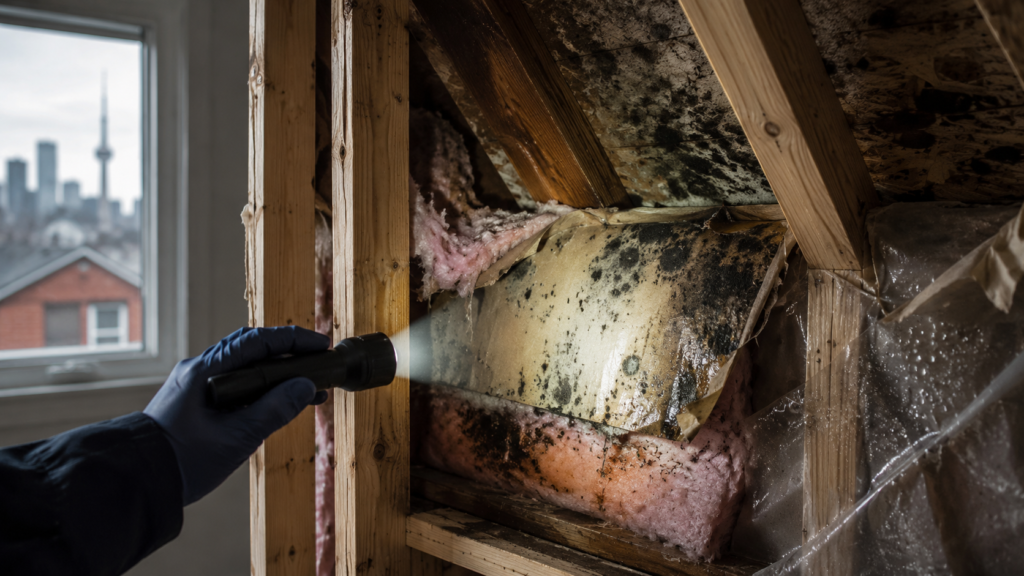
Updated on 11-Jun-2026
Moldy Insulation Toronto: Signs, Removal & Replacement – Learn how mold develops in attic, basement and wall insulation, which materials can be saved, when replacement is required and how Toronto homes should be assessed.
As a Toronto homeowner, you must be wondering,
Whether the insulation itself is contaminated?
Whether surrounding framing is the true source?
Finding mold near insulation raises a difficult question.
Is the insulation itself moldy, or is the growth actually on the wood, drywall or paper facing around it?
Can the insulation stay, or does it need to be removed and replaced?
The difference matters.
Some insulation materials do not provide much food for mold on their own. Yet they can trap water, collect dust and keep nearby wood or drywall damp. Other products contain paper, plant fibre or organic binders that become harder to restore once contaminated.
This is why mold in insulation should not be treated as a simple surface-cleaning job.
Before anything is removed, the moisture source, insulation type and condition of the surrounding building assembly need to be understood.
Table of Contents
Key Takeaways
- Mold near insulation usually points to a leak, condensation, air leakage or prolonged humidity.
- Fiberglass, cellulose, mineral wool, spray foam and rigid foam respond differently to water.
- The visible growth may be on the insulation facing, wood framing or accumulated dust rather than the insulation fibres.
- Wet insulation loses performance and may keep surrounding materials damp.
- Moldy, compressed, sewage-contaminated or deteriorated insulation often requires replacement.
- Cleaning insulation in place is rarely practical when contamination extends through a wall or attic cavity.
- Insulation should not be replaced until the moisture source has been corrected.
- Older Toronto homes may contain vermiculite or other materials that should be tested for asbestos before disturbance.
Can Insulation Grow Mold?
Mold needs moisture, oxygen and a source of nutrients.
Some insulation products, such as clean glass fibres or mineral wool, are largely inorganic. That does not mean they are immune to mold problems.
Dust, construction debris, paper facing, wood fibres and other organic material can collect on or around the insulation. Mold can then grow on that debris when the area remains damp.
The surrounding materials may be even more vulnerable.
Common growth surfaces include:
- Wood studs
- Roof sheathing
- Rafters and trusses
- Paper-faced drywall
- Kraft-paper insulation facing
- Cellulose insulation
- Dust on fiberglass batts
- Wood fibreboard
- Oriented strand board
- Plywood
- Cardboard ventilation baffles
- Fabric or paper vapour-retarder materials
In many cases, the insulation is part of the problem because it holds moisture against those surfaces or hides the damage from view.
What Causes Mold in Insulation?
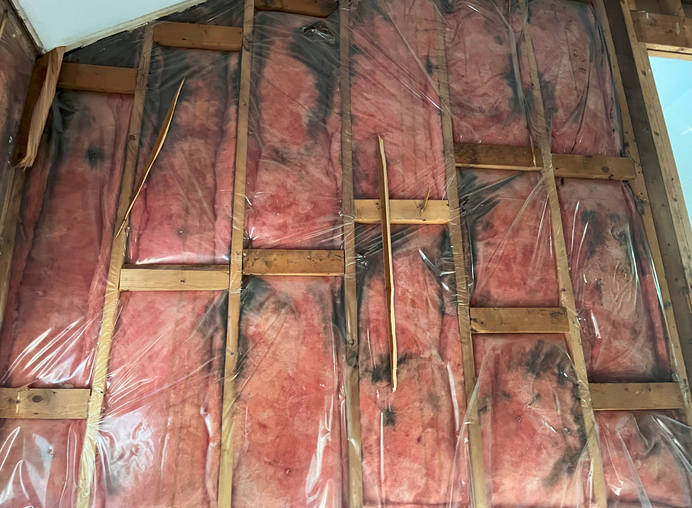
Insulation does not create moisture. It becomes affected when water or water vapour enters the building assembly.
Roof Leaks
A damaged shingle, flashing defect, plumbing vent leak or ice-dam problem can wet attic insulation.
The water may travel along a rafter before dripping into the insulation, so the visible wet area may not sit directly below the roof defect.
Plumbing Leaks
Pipes inside walls, ceilings and basement cavities can leak slowly.
The insulation absorbs or redirects the water while the drywall surface remains dry. By the time staining appears indoors, a larger concealed area may be affected.
Condensation in Attics
Warm indoor air carries moisture into the attic through gaps around:
- Ceiling lights
- Attic hatches
- Plumbing penetrations
- Wiring holes
- Exhaust fan housings
- Partition walls
- Duct openings
When that air reaches cold roof sheathing during a Toronto winter, condensation or frost can form.
The frost may melt during warmer weather and wet the insulation below.
Bathroom Fans Venting Into the Attic
A bathroom exhaust duct that terminates in the attic releases warm, humid air directly into a cold space.
This can wet roof sheathing, rafters and insulation.
The same problem can occur when a duct is disconnected, crushed, poorly sealed or covered by insulation.
Basement Foundation Moisture
Basement insulation may become wet because of:
- Foundation seepage
- Wall cracks
- Poor exterior drainage
- Plumbing leaks
- Condensation on cold concrete
- Flooding
- Water entering at the wall-to-floor joint
Fiberglass batts installed directly against damp foundation walls can conceal the problem.
Air Leakage Inside Walls
Moist indoor air can move through gaps in the air-barrier system and enter insulated wall cavities.
During cold weather, that moisture may condense on the colder side of the wall assembly.
The homeowner may notice only a musty smell, peeling paint or cold section of wall.
Flooding and Water Damage
Insulation affected by floodwater, sewage or contaminated groundwater usually cannot be treated as clean rainwater damage.
The contamination level, drying time and material type all affect whether replacement is required.
Poorly Designed Renovations
Adding insulation without understanding drainage, air sealing and vapour control can trap moisture.
Common examples include:
- Fiberglass installed against an unsealed basement wall
- Interior finishes covering an active leak
- Blocked attic soffit vents
- Multiple vapour barriers
- Spray foam applied over wet or moldy materials
- Finished cold rooms without proper moisture control
- Insulation packed tightly around wet plumbing
Signs of Mold in Insulation
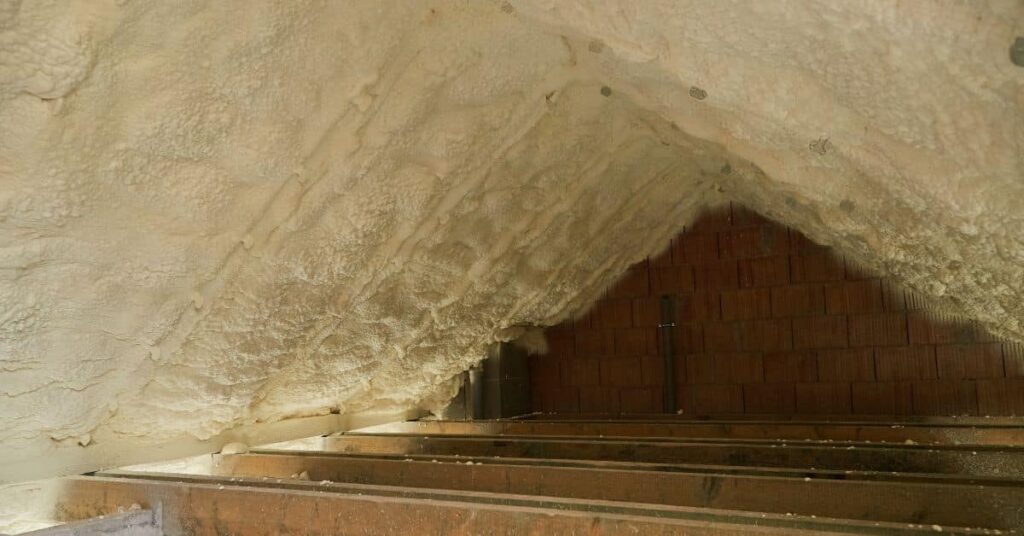
Insulation is often concealed, so the warning signs may appear elsewhere.
Look for:
- A persistent musty smell
- Dark spots on insulation facing
- Damp or matted batts
- Discoloured cellulose
- Water stains on rafters or studs
- Frost or condensation in the attic
- Rusted fasteners
- Staining on drywall
- Peeling or bubbling paint
- Soft drywall
- Sagging ceilings
- Warped baseboards
- Wet basement framing
- Mold around electrical outlets
- Uneven indoor temperatures
- A sudden increase in heating or cooling costs
- Insulation that has collapsed or compressed
- Dampness after rain or snowmelt
A clean-looking surface does not rule out concealed mold.
The back of the drywall or the side of the insulation facing the exterior wall may be affected while the room-facing side appears normal.
Does Moldy Insulation Always Look Black?
No.
Mold may appear:
- Black
- Grey
- Brown
- Green
- White
- Yellow
- Speckled
- Fuzzy
- Powdery
- Stain-like
Colour does not reliably identify the species or show whether the growth is hazardous.
Insulation can also become discoloured for reasons unrelated to mold.
Dark areas may come from:
- Dust filtration
- Soot
- Roof debris
- Rust
- Asphalt residue
- Animal activity
- Old water staining
- Air moving through gaps in the insulation
A moisture assessment and inspection of nearby materials are more useful than judging the colour alone.
Why Does Fiberglass Insulation Turn Black?
Black fiberglass is not always moldy.
Fiberglass can act like a filter. Air moving through gaps in a wall or attic deposits fine dust onto the fibres. Over time, this can leave dark streaks around:
- Electrical outlets
- Wall penetrations
- Attic hatches
- Floor joists
- Plumbing openings
- Gaps in the air barrier
This pattern may indicate air leakage rather than active mold.
Mold is more likely when the insulation is also damp, musty, matted or located beside visibly affected wood or drywall.
The cause should be verified before large amounts of insulation are removed.
Mold in Different Types of Insulation
The correct decision depends heavily on the material.
Fiberglass Insulation
Fiberglass batts and loose-fill glass fibre are common in Toronto attics, walls and basements.
The glass fibres themselves do not provide a strong food source for mold. However, fiberglass can:
- Hold dust and organic debris
- Trap water against wood or drywall
- Conceal mold behind the batt
- Lose effectiveness when compressed or wet
- Develop mold on kraft-paper facing
Can Wet Fiberglass Be Saved?
Clean fiberglass that became wet from a clean water source may sometimes be dried if:
- The water was discovered quickly
- The insulation has not collapsed
- No mold is visible
- No odour remains
- The surrounding materials are dry
- The water did not contain sewage or contaminants
In practice, heavily soaked batts are often easier and more reliable to replace.
Fiberglass that is moldy, dirty, matted, compressed or contaminated should generally be removed.
Cellulose Insulation
Cellulose is made largely from recycled paper fibre and is commonly treated with fire-retardant chemicals.
Because it is organic and loose, it can absorb and redistribute water.
Wet cellulose may:
- Settle
- Clump
- Lose thickness
- Become difficult to dry evenly
- Hide moisture against roof sheathing or drywall
- Develop odour or microbial growth
Water-damaged or visibly moldy cellulose usually requires removal and replacement.
Dry material outside the affected zone may be salvageable if the boundaries are clearly established.
Mineral Wool Insulation
Mineral wool, also called rock wool or slag wool, is made from mineral fibres.
It is more resistant to water absorption than some fibrous materials, but that does not mean a wet wall or attic assembly can be ignored.
Mineral wool can still:
- Collect dust
- Hold water between fibres
- Conceal mold on wood or drywall
- Stay damp when enclosed
- Become contaminated by sewage or debris
Clean mineral wool that was briefly exposed to clean water may sometimes be dried and reused. Material with visible growth, persistent odour, physical damage or contaminated water exposure should be replaced.
Spray Foam Insulation
Closed-cell and open-cell spray foam behave differently.
Closed-Cell Spray Foam
Closed-cell foam resists water absorption more effectively than open-cell foam.
Mold is more likely to grow on:
- Dust attached to the surface
- Wood behind the foam
- Missed gaps
- Damp sheathing
- Nearby drywall
- Adhesive or organic residue
A major concern is hidden moisture.
If spray foam was applied over damp or contaminated wood, the growth may be concealed behind the foam. Investigating it can require selective removal.
Open-Cell Spray Foam
Open-cell foam is more vapour-permeable and can absorb water.
A roof or plumbing leak may spread through the foam or remain hidden until staining and odour appear.
Wet open-cell foam can be difficult to dry while it remains inside an enclosed cavity. Replacement may be needed when it stays damp, smells musty or separates from the substrate.
Can Moldy Spray Foam Be Cleaned?
Surface dust on accessible foam may sometimes be cleaned carefully.
Deep contamination, water saturation or mold behind the foam is a different matter. Cutting out sections may be required to inspect and dry the underlying wood.
Spray foam should never be installed over active mold or wet materials.
Rigid Foam Board
Rigid insulation includes expanded polystyrene, extruded polystyrene and polyisocyanurate boards.
The foam core is not usually a strong food source for mold. Growth may still occur on:
- Dust
- Foil or paper facings
- Adhesives
- Wood furring
- Drywall finishes
- Debris trapped behind the board
Rigid foam can also conceal foundation seepage or damp wood.
Smooth, unfaced boards may sometimes be cleaned if the contamination is limited to the surface and the board remains intact. Paper-faced, damaged or extensively contaminated panels may require replacement.
Vermiculite Insulation
Vermiculite looks like lightweight, pebble-like granules. It may be grey, brown, gold or silver.
Some older vermiculite insulation may contain asbestos.
Do not rake, vacuum, sweep or remove vermiculite insulation until it has been assessed by a qualified asbestos professional.
This warning applies even when the immediate concern is mold.
Mold remediation and asbestos abatement are different services. The asbestos risk must be addressed before the material is disturbed.
Is the Mold on the Insulation or Behind It?
This is one of the most important questions during an inspection.
The visible insulation may be only the first layer.
For example:
- A fiberglass batt may look stained because the wood stud behind it is moldy.
- Cellulose may be damp because the roof deck above is leaking.
- Spray foam may look clean while wet roof sheathing remains concealed behind it.
- Basement batts may hide mold on foundation walls and wood framing.
- Insulation facing may be moldy while the fibres behind it remain dry.
- Dry insulation may sit beside a leaking plumbing line that has damaged drywall below.
Removing a small inspection section may be necessary to identify the true source and extent.
This should be done carefully to avoid spreading debris and to account for possible asbestos or other hazardous materials.
Can Mold Be Cleaned From Insulation?
Most insulation is not well suited to aggressive cleaning.
It is difficult to scrub, rinse and dry without damaging the material or spreading fibres and debris.
Cleaning may be reasonable only when:
- The affected area is minor
- Growth is limited to an accessible facing or smooth surface
- The material remains structurally intact
- The insulation is fully dry
- The moisture source has been corrected
- The surrounding cavity is clean
- The manufacturer permits the cleaning method
Replacement is usually more practical when mold extends into loose, fibrous or porous insulation.
When Does Insulation Need to Be Replaced?
Insulation should generally be removed when it is:
- Visibly moldy
- Wet for an extended period
- Musty after drying
- Matted or compressed
- Sagging
- Contaminated by sewage
- Contaminated by floodwater
- Mixed with animal waste
- Breaking apart
- Detached from the substrate
- Hiding moldy framing
- Preventing access to wet materials
- No longer providing consistent coverage
- Affected across a large or uncertain area
Replacement may also be needed when the insulation must be removed to remediate the materials behind it.
When Might Insulation Be Left in Place?
Insulation may sometimes remain when:
- It is dry
- No mold is visible
- No odour is present
- The moisture event was brief
- The water source was clean
- Its thickness and shape remain intact
- Nearby wood and drywall are dry
- Moisture readings are acceptable
- The source of water has been repaired
The decision should be based on actual condition, not simply on the fact that a leak occurred nearby.
Why Wet Insulation Should Not Be Covered
Installing drywall, vapour barrier or more insulation over damp material can trap moisture.
The enclosed area may then dry very slowly or not at all.
This can lead to:
- Hidden mold growth
- Wood decay
- Damaged drywall
- Odours
- Reduced insulation performance
- Corroded fasteners
- Repeated staining
- Larger repair costs later
The cavity should be inspected and allowed to dry before it is closed.
Mold in Attic Insulation
Attic insulation problems often involve more than the insulation itself.
The real source may be:
- Roof leakage
- Frost on roof sheathing
- Air leakage from the house
- Bathroom exhaust
- Blocked soffit vents
- Poorly sealed attic hatches
- Inadequate insulation coverage
- Gaps around ceiling penetrations
If the roof sheathing and rafters are moldy, removing only the insulation will not complete the remediation.
The wood must be assessed, the moisture source corrected and the attic ventilation and air-sealing conditions reviewed.
After remediation, damaged insulation can be replaced to the appropriate depth without blocking ventilation pathways.
Mold in Basement Insulation
Basement insulation can hide foundation problems for years.
A common older assembly includes:
- Concrete foundation wall
- Fiberglass batt
- Wood framing
- Polyethylene vapour barrier
- Drywall
If water enters through the concrete or warm indoor air reaches a cold surface, moisture can become trapped inside the wall.
Warning signs may include:
- Musty odours
- Mold along baseboards
- Staining near the floor
- Rusted fasteners
- Damp carpet
- Efflorescence on exposed concrete
- Peeling paint
- Cold walls
- Repeated mold after cleaning
Removing a small section of damaged drywall may reveal a much larger concealed area.
The foundation water issue must be corrected before the wall is reinsulated and closed.
Mold in Exterior Wall Insulation
Exterior wall cavities can become wet from:
- Window leaks
- Roof flashing defects
- Plumbing
- Exterior cladding failures
- Air leakage
- Condensation
- Missing flashing
- Damaged caulking
The wet area may be far from the original entry point.
Thermal imaging and moisture meters may help identify suspicious areas, but they do not prove that mold is present. Selective opening may still be necessary.
Mold in Crawl-Space Insulation
Crawl-space insulation can be affected by:
- Damp soil
- Plumbing leaks
- Groundwater
- Open vents during humid weather
- Poor drainage
- Condensation on ducts
- Missing ground covers
- Unconditioned outdoor air
Batts installed between floor joists may sag after becoming wet. Mold may then develop on the subfloor, joists or paper facing.
Fallen, wet or contaminated insulation should be removed so the structure can be cleaned and dried.
Should Moldy Insulation Be Tested?
Mold testing is not always needed.
If the insulation is visibly contaminated and the moisture source is known, testing may not change the removal decision.
Testing may be useful when:
- The material is discoloured but the cause is uncertain
- A musty smell is present without visible growth
- The affected area is concealed
- Documentation is needed
- A legal or insurance dispute exists
- Post-remediation verification is required
- Occupants need information about indoor conditions
Testing should not replace moisture assessment.
A laboratory result cannot repair a roof leak, dry a wall cavity or determine whether the insulation still performs properly.
Can You Remove Moldy Insulation Yourself?
A small, accessible amount of ordinary insulation may look manageable. The job becomes more complicated once mold, concealed cavities and old building materials are involved.
Do not begin removal without considering:
- The size of the affected area
- The insulation type
- Possible vermiculite
- Possible asbestos in adjacent materials
- Electrical wiring
- Recessed lights
- Animal waste
- Sewage contamination
- Attic access and fall risk
- Confined-space conditions
- The need for containment
- The possibility of hidden structural damage
Pulling out moldy batts can release dust and debris into the home.
Loose-fill insulation is even harder to control. Professional removal equipment and containment may be needed.
How Professional Moldy Insulation Removal Toronto Works
The exact process depends on the location and material, but it may include:
1. Moisture Investigation
The technician looks for:
- Roof leaks
- Plumbing leaks
- Foundation seepage
- Condensation
- Air leakage
- Ventilation problems
- Wet framing
- High indoor humidity
2. Hazard Review
Older insulation and surrounding materials may require asbestos testing before disturbance.
Electrical, structural and access risks are also reviewed.
3. Defining the Work Area
The visible damage may not show the complete boundary.
Moisture readings, inspection openings and material condition help define how much insulation needs to be removed.
4. Containment
The work area may be separated from occupied spaces using physical barriers and negative air pressure.
5. Insulation Removal
Affected material is removed carefully and bagged or contained before being carried through the property.
6. Inspection of Exposed Materials
Once the insulation is out, the wood, drywall, concrete, ductwork and other hidden surfaces can be assessed.
7. Cleaning and Remediation
Salvageable structural materials may be HEPA vacuumed and cleaned using methods appropriate for the surface.
Damaged porous materials may require further removal.
8. Drying
The cavity must be dry before repairs begin.
9. Moisture Correction
Leaks, drainage problems, ventilation defects and air-leakage pathways must be addressed.
10. Reinsulation
New insulation is installed only after the area is clean, dry and ready to be closed.
How Ultimate Mold Crew Handles Mold in Insulation
Ultimate Mold Crew assesses the insulation and the materials around it.
Our inspection may include:
- Identifying the insulation type
- Checking for visible contamination
- Measuring moisture in adjacent materials
- Looking for roof, plumbing and foundation leaks
- Inspecting attic and basement ventilation
- Reviewing air-leakage pathways
- Identifying damaged drywall or wood
- Determining whether selective opening is needed
- Reviewing possible asbestos concerns before disturbance
Where remediation is required, the work may involve containment, insulation removal, HEPA-filtered cleaning, porous-material removal and structural drying.
Reinsulation should be coordinated after the affected area has been remediated and the moisture source corrected.
How to Prevent Mold From Returning to Insulation
Repair Water Entry First
Do not replace insulation until roof, plumbing, drainage or foundation leaks are corrected.
Air-Seal Attic Penetrations
Seal gaps around ceiling penetrations using suitable materials and methods.
Do not cover heat-producing fixtures or create fire hazards.
Vent Bathroom and Kitchen Exhaust Outdoors
Exhaust ducts should terminate outside, not in an attic or wall cavity.
Keep Attic Vents Clear
Insulation should not block soffit ventilation.
Baffles may be required to maintain an airflow path.
Control Basement Moisture
Correct foundation seepage, manage drainage and maintain suitable indoor humidity.
Avoid Compressing Insulation
Compressed batts do not perform as intended and can leave gaps around the edges.
Inspect After Leaks
A repaired leak does not guarantee the insulation below it is dry.
Check the cavity before closing the ceiling or wall.
Do Not Insulate Over Mold
New insulation can conceal the problem and make later remediation more expensive.
Frequently Asked Questions
Does fiberglass insulation support mold growth?
Clean glass fibre is not a strong food source for mold.
However, mold can grow on dust, paper facing and nearby wood or drywall. Wet fiberglass can also trap moisture against those materials.
Can moldy insulation be sprayed and left in place?
Spraying insulation does not remove contamination inside or behind it.
Coatings may hide the visible surface while damp material and mold remain in the cavity.
Can wet insulation dry on its own?
Some clean insulation can dry if the water source is stopped and the cavity is open to controlled drying.
Insulation that remains enclosed, compressed or saturated may not dry evenly.
Should all insulation be removed after a roof leak?
Not always.
Dry, unaffected insulation outside the leak area may remain. Wet, damaged, moldy or collapsed material should be removed.
Does black fiberglass mean mold?
Not necessarily.
Black staining may come from dust carried by air leakage. Dampness, odour and growth on surrounding materials provide stronger evidence of a mold problem.
Can mold grow under spray foam?
Yes.
Moisture and mold can exist on the wood or sheathing behind spray foam, particularly if the foam was installed over damp material or a leak developed later.
Can moldy cellulose insulation be cleaned?
Loose cellulose is difficult to clean and dry once it becomes contaminated.
Affected material is usually removed and replaced.
Is mineral wool mold-proof?
No insulation should be treated as completely mold-proof.
Mineral wool is inorganic, but dust, facing materials and surrounding wood can support mold when moisture is present.
Should mold testing be completed before removing insulation?
Not in every case.
Visible mold, wet material and a known leak may already justify removal. Testing is more useful when the condition or extent is uncertain.
Is vermiculite insulation dangerous?
Some older vermiculite insulation may contain asbestos.
Do not disturb it. Have it assessed by a qualified asbestos professional before renovation or mold-remediation work begins.
Can insulation be replaced immediately after mold removal?
Only after the area is clean, dry and the moisture source has been corrected.
Closing a damp cavity can lead to another mold problem.
Get Moldy Insulation Assessed in Toronto
Mold in insulation is rarely just an insulation problem.
The material may be hiding a roof leak, foundation issue, plumbing defect, condensation problem or damaged framing.
Ultimate Mold Crew provides top-rated mold inspections and remediation in Toronto for affected attics, basements, crawl spaces, walls and ceilings.
Call 647-985-2739 if your insulation is wet, musty, discoloured or located beside visible mold.
