

Updated on 19-Jun-2026
Table of Contents
White Mold: Identification, Causes, Prevention, and Treatment
Have you ever stumbled upon a white, fuzzy substance lurking in the corners of your home and wondered,
Noticed white fuzzy patches or chalky buildup in your basement?
“What is this?”
While black mold often dominates discussions about household dangers, there’s another silent invader you should be wary of: white mold.
Why should you be concerned? And why is it crucial for you to understand this particular type of mold?
As it turns out, white mold can be just as harmful, if not more so, in certain situations.
Read on to discover the hidden threats of white mold and arm yourself with the knowledge to combat it.
Introduction to White Mold

White mold can appear as a white, grey, or green powdery fungus depending on the surface it’s growing on. It includes multiple fungal species like penicillium and aspergillus.
White mold, although less notorious than black mold, can be equally harmful. It’s a frequent issue in many homes, often overshadowed by the fears surrounding black molds like Stachybotrys.
Yet, several white molds can cause health problems and structural damage.
Also Read – Mold & Real Estate ; Mold Issues When Buying or Selling Home
What White Mold Usually Looks Like
White mold often appears:
- fuzzy or hairy
- cotton-like
- uneven in shape
- soft when touched
- slightly raised from the surface
As moisture conditions change, the mold may begin looking:
- dusty
- flaky
- grayish-white
- yellow-white
In humid basements, mold can spread across:
- wood framing
- drywall
- cardboard storage boxes
- ceiling joists
- carpeting
- insulation
White mold also tends to produce a noticeable musty odor over time.
Identifying White Mold
Common Locations for White Mold Growth
- Furniture: White mold on furniture often appears three-dimensional and fuzzy.
- Clothing & Textiles: Items like shoes, backpacks, and especially leather goods can show white or light green mold. Fortunately, white mold is easier to remove than black mold, which often leaves permanent stains.
- Attic Sheathing and Framing: White mold prefers high humidity environments, making attics a common location for its growth.
- Crawlspaces: White mold in crawlspaces can be found on exposed soil or the lower parts of floor joists, especially in wet climates.
Also Read – Is Mold Dangerous To Your Health – Exposure Risks & Dangers
White Mold vs Efflorescence: How to Tell the Difference
White mold usually looks fuzzy, soft, or cotton-like and may produce a musty odor. Efflorescence appears dry, chalky, and crystal-like with no smell. Mold grows on organic materials such as wood or drywall, while efflorescence forms on masonry surfaces like concrete or brick after moisture evaporates and leaves mineral deposits behind.
One of the biggest mistakes homeowners make is confusing white mold with efflorescence. At first glance, both can appear as white patches or powdery buildup on basement walls and concrete surfaces. But they are completely different problems.
White mold is a living fungal growth caused by moisture and organic material.
Efflorescence is a mineral salt deposit left behind when water moves through concrete, brick, or masonry surfaces.
Knowing the difference matters because treating efflorescence like mold wastes time, while ignoring real mold growth can allow contamination and moisture problems to spread deeper into the home.
White Mold vs Efflorescence Comparison
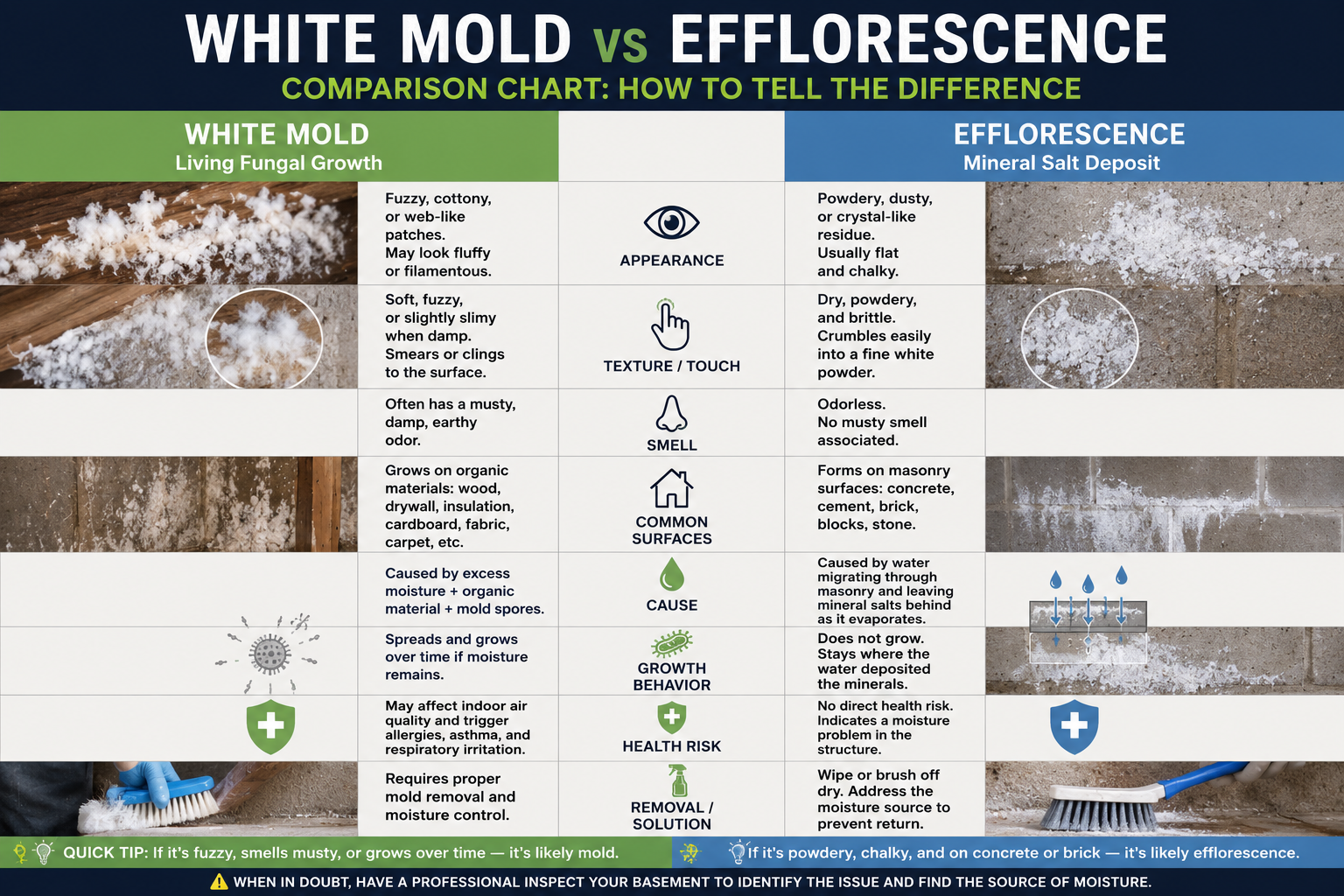
| Feature | White Mold | Efflorescence |
|---|---|---|
| What It Is | Living fungal growth | Mineral salt deposit |
| Texture | Fuzzy, soft, powdery | Dry, chalky, crusty |
| Smell | Musty or earthy odor | Usually odorless |
| Growth Pattern | Spreads and expands over time | Stays near moisture path |
| Common Surfaces | Wood, drywall, insulation, cardboard | Concrete, brick, masonry |
| Moisture Relationship | Thrives in damp organic material | Appears after water evaporates |
| Color | White, gray-white, yellow-white | Bright white or crystal-like |
| Health Concerns | May affect indoor air quality | No direct health risk |
| Returns After Cleaning | Often returns if moisture remains | Returns if moisture intrusion continues |
| Biological? | Yes | No |
What Efflorescence Usually Looks Like
Efflorescence typically appears:
- bright white
- powdery or crystal-like
- dry and brittle
- flat against the surface
- concentrated on concrete or brick
It forms when water moves through masonry materials and leaves mineral salts behind after evaporation.
Unlike mold, efflorescence:
- does not spread organically
- does not feed on materials
- does not smell musty
- does not grow on wood or drywall
Many homeowners notice efflorescence after:
- foundation seepage
- heavy rain
- basement flooding
- seasonal moisture changes
Common signs of white mold
White mold may appear:
- fuzzy or thread-like
- powdery and flaky
- soft and cotton-like
- slightly raised from the surface
- circular or patchy in growth pattern
- damp or slimy in humid conditions
Depending on the material and moisture level, the color may range from:
- bright white
- off-white
- grayish-white
- pale greenish-white
- yellow-white
One reason white mold becomes difficult to identify is that it changes appearance over time. Fresh growth may look soft and fuzzy, while older colonies can dry out and appear dusty or crusty.
Homeowners should take a closer look if the substance:
- grows larger over time
- appears fuzzy under light
- keeps returning after wiping
- develops near damp materials
- causes musty odors
- appears after flooding or leaks
- spreads onto wood or drywall
- triggers allergy-like symptoms indoors
In many cases, proper identification requires a moisture-focused inspection rather than just a surface cleaning.
The Touch Test Homeowners Often Use
A basic touch test may help identify the substance, although it is not always definitive.
Efflorescence usually:
- crumbles easily
- feels dry and gritty
- wipes into powder
White mold may:
- smear slightly
- feel soft or fuzzy
- cling to the surface
- appear fibrous under light
Homeowners should avoid disturbing large suspicious growth areas because mold spores can become airborne during cleaning or scraping.
The Smell Difference
Odor is another strong clue.
White mold often produces:
- musty smells
- damp earthy odors
- stale air smells
Efflorescence usually has no odor at all.
If the basement smells persistently musty, active mold growth or hidden moisture problems may already exist behind walls or under flooring materials.
Causes of White Mold Growth

White mold thrives in specific conditions:
- Water Damage: Persistent leaks or flooding can create the perfect environment for mold.
- Poor Ventilation: Areas with limited airflow, such as basements or attics, can become breeding grounds.
- Organic Material: Materials like wood, paper, and textiles can provide the necessary nutrients for mold growth.
Scenarios:
- Attic Renovation: Disturbing old insulation can release mold spores.
- Home Decor: Drilling into mold-infested drywall can spread spores.
- Basement Upgrades: Cutting moldy insulation can release spores.
Also Read – Pink Mold In Shower – Dangers, Causes & Removal [GUIDE]
What Causes White Mold in Basements?
White mold in basements is usually caused by excess humidity, water intrusion, condensation, flooding, or poor airflow. Mold spores thrive when damp conditions persist on organic materials such as wood framing, drywall, insulation, carpet, or stored items. Even minor moisture problems can eventually lead to mold growth if the basement stays humid for long periods.
White mold does not appear randomly. In almost every case, it develops because excess moisture becomes trapped in a poorly ventilated area over time. Basements naturally create the perfect environment for fungal growth because they are cooler, darker, and more humid than the upper levels of a home.
Once moisture combines with organic materials like wood, drywall, cardboard, dust, or insulation, mold spores can begin colonizing surfaces quickly.
In many Ontario homes, the issue starts with a small humidity or seepage problem that goes unnoticed for months.
Is White Mold in a Basement Dangerous?
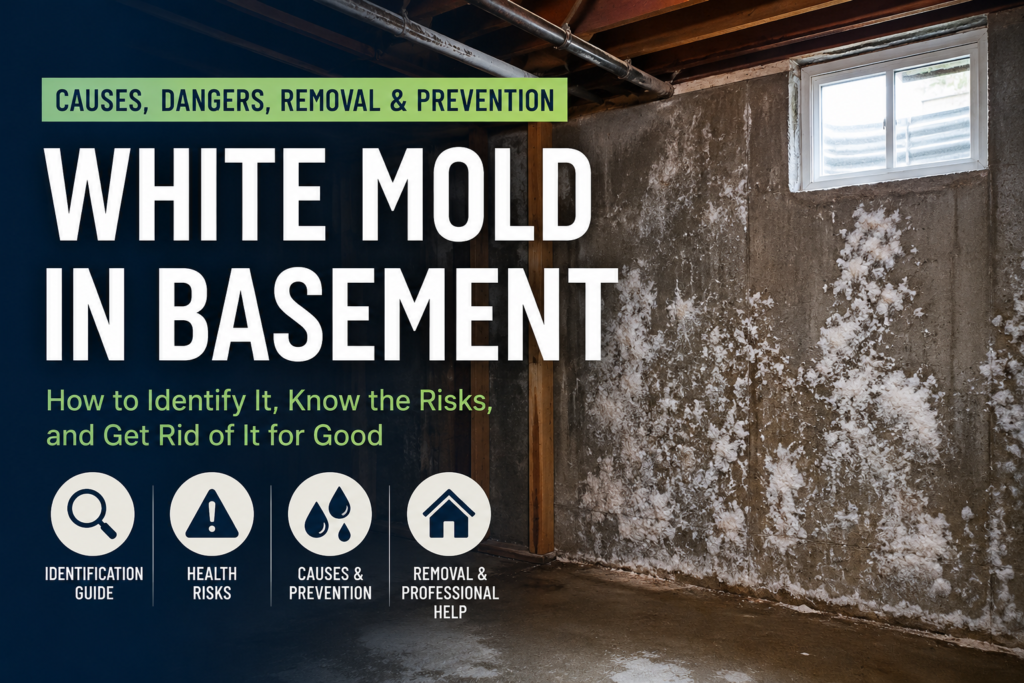
White mold in a basement can be dangerous, especially when it continues spreading in an enclosed indoor environment. While many homeowners focus only on black mold, white mold can also release airborne mold spores that affect indoor air quality and trigger health symptoms over time.
The level of risk usually depends on:
- the type of mold present
- how long the exposure has been occurring
- the amount of mold growth
- moisture conditions in the basement
- individual sensitivity to mold exposure
In many Ontario homes, basement mold problems develop slowly behind stored items, finished walls, insulation, or flooring. By the time visible white mold appears, elevated moisture and hidden microbial growth may already exist underneath surrounding materials.
In a snapshot,
White mold in a basement is not something homeowners should ignore. Although some species are less toxic than black mold, white mold can still spread through damp materials and negatively affect indoor air quality. Exposure may trigger allergies, respiratory irritation, coughing, headaches, sinus symptoms, or asthma flare-ups, especially in children, seniors, or people with existing respiratory conditions.
White Mold Symptoms
Exposure to white mold can lead to a range of health issues. Common symptoms include respiratory problems like sneezing, watery eyes, dizziness, and asthma attacks. Direct contact might result in dry, itchy skin patches or burning sensations. Recognizing these symptoms early and identifying their source is crucial for health and well-being.
Common Health Symptoms Linked to White Mold Exposure
Not everyone reacts to mold the same way. Some people notice symptoms immediately, while others experience gradual irritation after long-term exposure.
Common symptoms may include:
- sneezing
- coughing
- sinus congestion
- itchy eyes
- throat irritation
- headaches
- wheezing
- skin irritation
- musty-smelling indoor air
- worsening asthma symptoms
People with allergies, asthma, weakened immune systems, or chronic respiratory conditions are usually more sensitive to airborne mold spores.
White Mold vs. Other Substances
White Mold and Wood Rot
While white mold doesn’t cause wood rot, prolonged exposure to moisture can lead to wood decay fungi, which does cause rot.
White Mold vs. Efflorescence
Efflorescence, often mistaken for white mold, is a crystalline growth on concrete and masonry. It’s caused by water bringing salts to the surface. Unlike mold, efflorescence is harmless and dissolves under water mist
Also Read – Mold in Toilet – Prevention and Removal Guide
Can Color Determine Mold Type?

Color can sometimes rule out certain mold types, it’s not a definitive identification method. For instance, Stachybotrys is always black, but many molds like Cladosporium and Penicillium/Aspergillus can vary in color. Proper mold testing is required for accurate identification.
Health Implications of White Mold
Many molds, including white ones, can trigger allergic reactions. Symptoms can range from mild, like sneezing or skin irritation, to severe, like respiratory issues.
Also Read – What Happens If You Inhale Black Mold Spores? – What Happens If You Inhale Black Mold Spores?
Is White Mold Worse Than Black Mold?
This is one of the most common questions homeowners ask.
The truth is that mold color alone does not determine how dangerous it is.
Some white molds are relatively mild. Others may still contribute to poor indoor air quality and respiratory irritation. Certain dark molds may produce stronger mycotoxins, but any active mold growth indoors signals an underlying moisture problem that should be addressed properly.
Focusing only on color often causes homeowners to underestimate widespread white mold contamination.
When White Mold Becomes More Serious
White mold should be taken more seriously when:
- the affected area continues expanding
- mold keeps returning after cleaning
- materials feel damp or soft
- the basement smells musty constantly
- family members develop symptoms indoors
- there was previous flooding or water damage
- mold appears inside HVAC or insulation areas
- growth spreads across wood framing or drywall
Persistent mold growth almost always indicates unresolved moisture conditions somewhere in the basement structure.
Where White Mold Usually Appears in a Basement
White mold grows wherever moisture and organic material combine. Basements naturally create ideal conditions because they are cooler, darker, and often more humid than upper floors.
The most common locations include:
- basement walls
- wood framing and support beams
- ceiling joists
- drywall
- insulation
- cardboard boxes
- carpet edges
- stored furniture
- concrete surfaces near leaks
- areas around sump pumps or floor drains
In Toronto homes, white mold is especially common in unfinished basements where humidity levels stay elevated during summer months.
White Mold on Concrete Basement Walls
Many homeowners first notice white buildup on concrete walls or floors. This is where confusion begins.
Sometimes the substance is actually mold. Other times, it is efflorescence, a mineral salt deposit left behind by moisture moving through concrete.
A quick visual mold inspection is not always enough to tell the difference.
White mold on concrete may:
- look fuzzy or hairy
- spread unevenly
- appear near damp organic debris
- produce a musty smell
- return quickly after cleaning
Efflorescence usually appears:
- dry and chalky
- crystal-like
- odorless
- only on masonry surfaces
This distinction matters because mold indicates active microbial growth, while efflorescence points to a moisture problem inside the foundation.
What White Mold Smells Like
White mold often produces a damp, earthy, or musty odor. Some homeowners describe it as:
- wet cardboard
- old basement smell
- damp wood
- stale air after rain
If a basement smells musty even when no visible growth is present, hidden mold may already be growing behind drywall, under flooring, or inside insulation cavities.
How to Get Rid of White Mold
Small isolated patches of white mold on non-porous surfaces may sometimes be cleaned safely with proper protective equipment and moisture control. However, widespread mold growth, recurring contamination, musty odors, or mold inside walls, insulation, or HVAC systems should usually be handled by a professional mold remediation company.
If moisture remains behind walls, under flooring, or inside insulation, the mold usually returns.
The safest approach depends on:
- how much mold is present
- where it is growing
- the type of material affected
- whether moisture problems are ongoing
- whether health symptoms are already occurring indoors
Steps for removal include:
- Identifying the Mold: Ensure that the growth on your plants is indeed white mold.
- Pruning Affected Parts: Remove and properly dispose of infected plant parts.
- Improving Ventilation: Enhance air circulation around plants.
- Adjusting Watering Practices: Avoid overwatering and ensure proper drainage.
- Applying Organic Fungicide: Use solutions like neem oil or baking soda to control mold growth.
Also Read – Mold On Plant Soil – Causes, Types & How To Kill Plant Mold?
When to Call a Professional Mold Remediation Company
You should contact a professional mold remediation company in Toronto if white mold keeps returning, covers a large area, produces strong musty odors, follows flooding or water damage, or appears inside walls, ceilings, insulation, or HVAC systems. Professional remediation focuses on both mold removal and identifying the moisture source allowing the growth to continue.
Signs the Mold Problem May Be More Serious
Professional inspection is strongly recommended when:
- mold spreads across multiple surfaces
- growth keeps returning after cleaning
- the basement smells musty constantly
- drywall feels damp or soft
- there was previous flooding
- water damage is visible
- mold appears near HVAC systems
- allergy or respiratory symptoms worsen indoors
These signs often indicate hidden contamination beyond the visible surface growth.
A proper remediation process focuses on:
- identifying moisture sources
- containing contaminated areas
- preventing spore spread
- removing damaged materials
- drying affected structures
- improving humidity control
Simply spraying chemicals onto visible mold rarely solves the root problem.

How to Prevent White Mold from Returning
The best way to prevent white mold from returning is to control basement moisture and humidity. This includes reducing indoor humidity, fixing leaks quickly, improving airflow, drying damp materials, and addressing foundation or drainage issues before moisture becomes trapped indoors.
Keep Basement Humidity Below 50%
Humidity control is one of the most effective ways to prevent basement mold.
Indoor humidity should ideally remain below 50%.
Homeowners can reduce humidity by:
- using a basement dehumidifier
- running exhaust fans
- improving airflow
- keeping basement doors open periodically
- avoiding excess moisture buildup indoors
A hygrometer can help monitor basement humidity levels throughout the year.
Fix Water Intrusion Quickly
Even small leaks can create enough moisture for mold growth.
Water intrusion should never be ignored around:
- basement windows
- foundation walls
- plumbing connections
- sump pumps
- floor drains
- appliances
The longer materials stay damp, the greater the chance mold spores begin colonizing surfaces.
Improve Basement Ventilation
Poor airflow allows moisture to remain trapped near surfaces.
Ventilation improvements may include:
- opening enclosed storage spaces
- increasing air circulation
- using fans in humid areas
- improving HVAC airflow
- reducing clutter against walls
Finished basements with limited airflow are especially vulnerable to hidden moisture buildup.
Avoid Storing Damp or Organic Materials
Cardboard boxes, fabric, paper products, and stored furniture can all support mold growth if they absorb moisture.
To reduce risk:
- avoid storing items directly against basement walls
- keep belongings elevated off concrete floors
- discard water-damaged materials quickly
- use plastic storage bins instead of cardboard
Many recurring basement mold problems begin around long-term storage areas with poor airflow.
Address Exterior Drainage Problems
Moisture problems often begin outside the home.
Poor drainage can force water toward the foundation, increasing basement humidity and seepage risks.
Important prevention measures include:
- cleaning gutters
- extending downspouts away from the foundation
- correcting negative grading
- maintaining sump pump systems
- repairing foundation cracks
Watch for Early Warning Signs
Homeowners should monitor for:
- musty odors
- damp air
- condensation
- peeling paint
- recurring stains
- elevated humidity
- visible white buildup on walls or floors
Early intervention prevents small moisture issues from turning into widespread mold contamination.
FAQS – White Mold
How Do I Know If Something Is White Mold?:
White mold typically grows on wood or other building materials. If a white substance dissolves in water, it’s likely efflorescence, a salt deposit.
How is White Mold Different from Black Mold?:
While both thrive in high moisture areas, black mold is known for being particularly dangerous and can cause severe health issues.
Is White Mold on Wood Dangerous?:
White mold on wood can eat away at the material, causing structural damage.
Also Read Mold With Mushrooms Growing in Home – How To Identify and Remove Mold on Your Carpet & Furniture?
How Can You Tell If Mold is Toxic?:
Any mold, including white and black, can be toxic. If you’re experiencing symptoms like coughing, fatigue, or rashes, consult a doctor and consider professional mold removal.
Also Read Mold Testing – The Role of Mold Testing And Its Benefits [GUIDE]
Further Reading
- https://www.ecofmr.com/articles/understanding-white-mold-types-causes-prevention-treatment/
- https://www.epa.gov/mold/brief-guide-mold-moisture-and-your-home
- https://www.cdph.ca.gov/Programs/CCDPHP/DEODC/EHLB/IAQ/CDPH%20Document%20Library/MMIMH_112017_ADA.pdf
- “White mold, caused by Paecilomyces penicillatus, has been identified as the causative agent of white mold on cultivated Morchella, which is a serious threat to morel production in China.”
https://consensus.app/details/white-mold-caused-paecilomyces-penicillatus-identified-he/68fcb824630057c394a6ca419ec400f2/ - “White mold resistance screening can be improved by knowledge of isolate genotypic and phenotypic characteristics.”
https://consensus.app/details/white-mold-resistance-screening-improved-knowledge-ottohanson/8ce0d7ec836c5d11aa77bf420a6aaea0/
Peer Reviewed References
- Centers for Disease Control and Prevention. (2024). Mold: Basic Facts – health effects, susceptible populations, and cleanup guidance. Retrieved from https://www.cdc.gov/mold
- U.S. Environmental Protection Agency. (2024). A Brief Guide to Mold, Moisture, and Your Home (EPA 402-K-02-003). Retrieved from https://www.epa.gov/mold/brief-guide-mold-moisture-and-your-home
- U.S. Environmental Protection Agency. (2024). Mold Remediation in Schools and Commercial Buildings (EPA 402-K-01-001). Retrieved from https://www.epa.gov/mold/mold-remediation-schools-and-commercial-buildings-guide
- Health Canada. (2023). Residential Indoor Air Quality Guidelines: Mould. Retrieved from https://www.canada.ca/en/health-canada/services/publications/healthy-living/residential-indoor-air-quality-guidelines-mould.html
- Canada Mortgage and Housing Corporation. (2024). Moisture and Mold in Housing. Retrieved from https://www.cmhc-schl.gc.ca
- National Institute for Occupational Safety and Health. (2024). Mold in the Workplace. Retrieved from https://www.cdc.gov/niosh/topics/mold
- Institute of Inspection, Cleaning and Restoration Certification (IICRC). (2015). IICRC S520 Standard and Reference Guide for Professional Mold Remediation (3rd ed.). Las Vegas, NV: IICRC.
- American Industrial Hygiene Association (AIHA). (2016). Field Guide for the Determination of Biological Contaminants in Environmental Samples (2nd ed.). Fairfax, VA: AIHA.
- New York City Department of Health and Mental Hygiene. (2008). Guidelines on Assessment and Remediation of Fungi in Indoor Environments. Retrieved from https://www.nyc.gov/site/doh/health/health-topics/mold.page
- World Health Organization. (2009). WHO Guidelines for Indoor Air Quality: Dampness and Mould. Copenhagen: WHO Regional Office for Europe. ISBN 978-92-890-4168-3. https://www.who.int/publications/i/item/9789289041683
- National Research Council. (2004). Damp Indoor Spaces and Health. Washington, DC: The National Academies Press. https://doi.org/10.17226/11011
- Portland Cement Association. (2024). Efflorescence: Causes, Prevention, and Repair. Retrieved from https://www.cement.org
- American Lung Association. (2024). Mold and Your Health. Retrieved from https://www.lung.org/clean-air/at-home/indoor-air-pollutants/mold-and-dampness
