
Updated on 10-Jul-2026
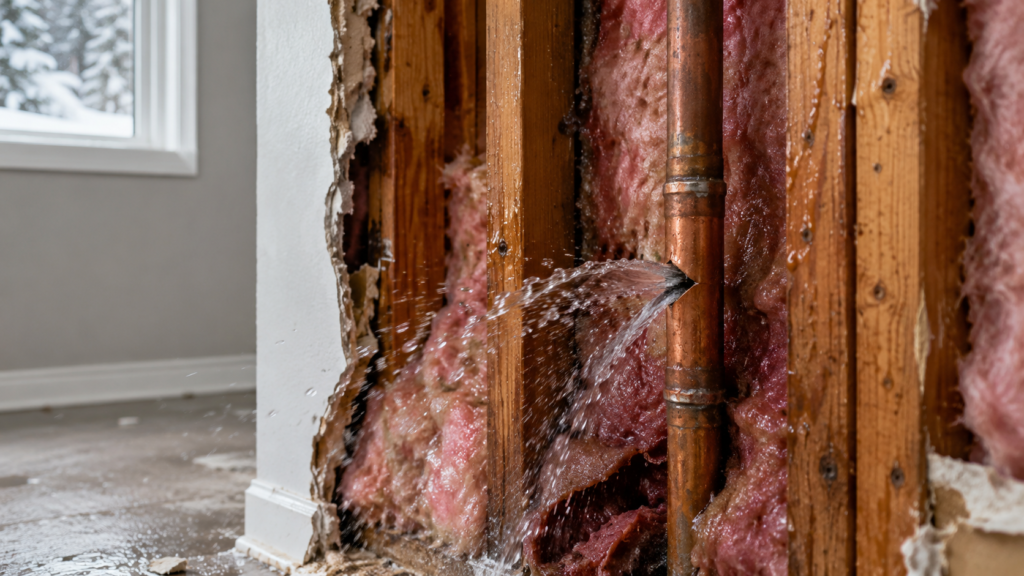
A frozen pipe can produce several different insurance decisions inside one claim.
The insurer may accept the sudden water discharge but reject the cost of replacing the failed pipe. It may cover wet drywall and flooring but question mold discovered weeks later. It may pay for emergency drying while disputing whether long-term moisture, vacancy, or inadequate heating contributed to the loss.
That distinction matters because a frozen-pipe claim is rarely one simple yes-or-no decision.
Standard home policies typically cover resulting damage from frozen and burst pipes when the pipes are inside the heated portion of the home and reasonable steps were taken to maintain heat. Coverage can change when the home was vacant, the owner was away during heating season, or policy-specific inspection and winterization conditions were not followed.
The mold portion creates another question:
Did the mold result directly from the sudden pipe failure, or did it develop from a separate, gradual, pre-existing, or insufficiently addressed moisture problem?
A remediation company can document the building conditions. It cannot guarantee that an insurer will accept coverage.
A frozen-pipe loss contains several separate coverage questions
| Part of the loss | What the insurer may examine |
|---|---|
| Failed pipe | Why it froze, its location, its condition, and whether replacing the pipe itself is covered |
| Furnace or heating equipment | Whether equipment failure caused the freeze and whether the equipment repair is a maintenance cost |
| Resulting water damage | Whether the discharge was sudden and accidental |
| Emergency mitigation | Whether reasonable drying and damage-control work was completed |
| Mold remediation | Whether mold resulted from the covered event and whether exclusions or limits apply |
| Damaged contents | Whether the items are insured, documented, repairable, or replaceable |
| Temporary accommodation | Whether the home became unfit to occupy and whether the policy includes applicable coverage |
For example, Insurance Bureau of Canada explains that a home policy may cover damage caused when failed heating equipment leads to frozen pipes, while excluding the cost of repairing the furnace or heat pump itself because that equipment failure may be treated as maintenance.
This produces an outcome that can feel inconsistent to a homeowner:
Heating equipment fails → pipes freeze → water damages the home
The resulting water damage may receive one coverage decision. The equipment repair may receive another.
Mold discovered after the event can receive a third.
The insurer is examining a chain of events
A stronger way to understand a disputed mold claim is to map the full loss.
1. What caused the pipe to freeze?
The adjuster may examine:
- Where the pipe was located
- Whether the area was normally heated
- Indoor temperature records
- Furnace or heat-pump failure
- Power outages
- Open windows or doors
- Insulation around the pipe
- Whether the property was occupied
- Whether the owner was away
- Whether the water had been shut off
- Whether the plumbing had been drained
- Whether someone had been checking the property
UMC advises homeowners who plan to be away during heating season to review their exact policy requirements. Some policies require a competent person to check the property at set intervals, while others may require the water supply to be shut off and the plumbing drained. The required interval and precautions vary by insurer and policy.
The relevant question is not simply whether the homeowner acted “negligently.”
The practical question is:
Which policy condition or exclusion is the insurer relying on, and what facts does it say triggered that provision?
Using broad terms such as negligence without identifying the actual policy wording makes the article less accurate and less useful.
2. Was the water release sudden or gradual?
A pipe can split during a freeze and release water once it thaws. That is different from a fitting that has leaked slowly for months.
The resulting damage can look similar after the wall is opened:
- Stained drywall
- Wet insulation
- Swollen baseboards
- Damaged flooring
- Mold on framing
- Rusted fasteners
- Deteriorated cabinet material
The condition of those materials may help establish whether the loss was recent, prolonged, or a combination of both.
A burst pipe can also expose an older moisture problem. For example, fresh water may wet a wall cavity that already had condensation, an earlier plumbing leak, foundation seepage, or previous mold growth.
The insurer may then dispute which portion of the damage belongs to the reported frozen-pipe event.
That is why photographs of the broken pipe alone are not enough.
3. Where did the water travel?
Water rarely stays directly below a failed pipe.
It can move:
- Along the bottom plate of a wall
- Behind baseboards
- Through fibreglass insulation
- Across subfloor seams
- Under laminate or vinyl flooring
- Into ceiling cavities below
- Around pipe penetrations
- Through framing connections
- Into adjacent rooms
A finished surface may appear dry while the back of the drywall, insulation, wood plate, or floor assembly remains damp.
A claim file should therefore show the water pathway, not just the point where the pipe failed.
4. What was done to stop further damage?
Home insurance policies generally require the policyholder to take reasonable action to limit additional damage after a loss.
For a frozen-pipe event, reasonable immediate action may include:
- Shutting off the water supply.
- Addressing electrical hazards.
- Contacting an emergency plumber.
- Reporting the loss to the insurer or broker.
- Photographing the affected area before major removal.
- Extracting standing water.
- Removing water that continues to migrate.
- Measuring moisture in affected materials.
- Beginning controlled drying.
- Retaining invoices, readings, photographs, and communications.
The homeowner should not leave wet materials in place while waiting for a final coverage decision.
At the same time, uncontrolled demolition can destroy useful evidence and spread contamination. Emergency work should protect the property while preserving a clear record of what was found and removed.
Professional water-damage restoration after a burst pipe should record affected rooms, material conditions, moisture locations, equipment use, demolition limits, and drying progress.
5. When was mold first suspected or confirmed?
This is where the original article becomes too simplistic.
It says delay is the primary reason mold claims are denied. Delay can weaken the connection between a sudden loss and later mold, but it is not the only issue.
A mold-related decision may also involve:
- The exact policy wording
- A mold or fungi exclusion
- A coverage sublimit
- A gradual-damage exclusion
- An unoccupied or vacant-property condition
- Failure to maintain heat
- Evidence of an earlier leak
- Pre-existing mold
- An incomplete moisture assessment
- Disagreement about which materials were affected
- Disagreement about the necessary remediation scope
- Missing documentation
- A dispute over whether the mold resulted from the reported event
The stronger question is not:
Was there a delay?
It is:
Can the available evidence connect the mold to the reported frozen-pipe loss while accounting for the property’s prior condition, the water pathway, and the mitigation work?
The 48-hour window is building-science guidance, not an automatic insurance deadline
Health Canada states that mold can begin growing in an area with excessive moisture within 48 hours. It recommends immediate action after water damage and advises homeowners to consider hidden mold when musty odours are present but no growth is visible.
That 48-hour period is important, but it is often explained incorrectly.
It does not mean:
- Mold will appear visibly at exactly 48 hours
- Every material becomes contaminated after two days
- Drying completed after 48 hours is automatically ineffective
- An insurance claim is automatically denied after 48 hours
- A homeowner has only 48 hours to complete the entire claim process
It means prolonged moisture increases the risk that mold will begin to establish on suitable materials.
The actual outcome depends on:
- Material type
- Temperature
- Moisture availability
- Existing spores
- Air movement
- Surface condition
- How deeply water penetrated
- Whether drying reached the full assembly
Paper-faced drywall, insulation, carpet backing, ceiling tiles, wood products, and settled dust can respond differently to the same leak.
A wall can also contain both dry and wet zones. A moisture reading taken on one visible surface does not prove the entire cavity has dried.
The drying clock and the insurance clock are different
The drying clock begins when the building materials become wet.
The claim process includes reporting, adjustment, documentation, estimates, proof of loss, coverage review, repair approval, and settlement.
These processes can overlap, but they are not the same.
A homeowner should not postpone emergency water control while waiting for an adjuster. They should also avoid removing every affected material without recording the condition and discussing the scope with the insurer where reasonably possible.
IBC’s home-claim guidance states that an insurer may request a signed proof-of-loss form that lists damaged property and the value or cost of the loss. It notes that the form is typically returned within the period set by the insurer, commonly 30 days, and that the adjuster should answer questions about the required processv
Hidden moisture is more important than whether the room “looks dry”
Cold weather, indoor heating, air leakage, insulation, vapour control, and wall construction can affect how an assembly dries. They do not make properly collected moisture data meaningless.
After a frozen-pipe loss, the visible wall surface may dry before:
- The back of the drywall
- Fibreglass insulation
- A wood bottom plate
- The subfloor
- Flooring underlayment
- Cabinet toe-kicks
- Ceiling insulation
- The sill or rim-joist area
This can happen because water follows gravity and material connections. Heat may dry exposed paint or flooring while moisture remains in a less ventilated layer.
A moisture assessment should therefore answer four questions:
Where did the water enter?
How far did it move?
Which materials absorbed it?
What evidence confirms that those materials reached an acceptable dry condition?
A single reading or thermal image cannot answer every question on its own. The inspection should combine visual findings, moisture measurements, material knowledge, event history, photographs, and selective access where justified.
The most useful evidence is a connected timeline
A folder full of photographs is not automatically a strong claim file.
The evidence needs to explain the sequence.
| Evidence | Question it helps answer |
|---|---|
| Date-and-time photographs | What did the area look like when the loss was discovered? |
| Plumber’s report | Where did the pipe fail, and what condition caused the release? |
| Thermostat or monitoring records | Was heat being maintained? |
| Property-check records | Was the home inspected while the owner was away? |
| Water-shutoff record | When was the discharge stopped? |
| Moisture map | Which walls, floors, ceilings, or contents became wet? |
| Initial moisture readings | How extensive was the material saturation? |
| Equipment logs | What drying steps were taken and for how long? |
| Demolition photographs | What was found behind finished surfaces? |
| Earlier property photographs | Was staining or mold visible before the loss? |
| Contractor invoices | What emergency and remediation work was completed? |
| Emails and call notes | When were the insurer, plumber, and contractors contacted? |
| Final moisture readings | What evidence supports completion of drying? |
The most valuable evidence connects:
- Pipe failure → water pathway → affected materials → emergency response → drying → mold discovery
What a mold inspection can establish, and what it cannot
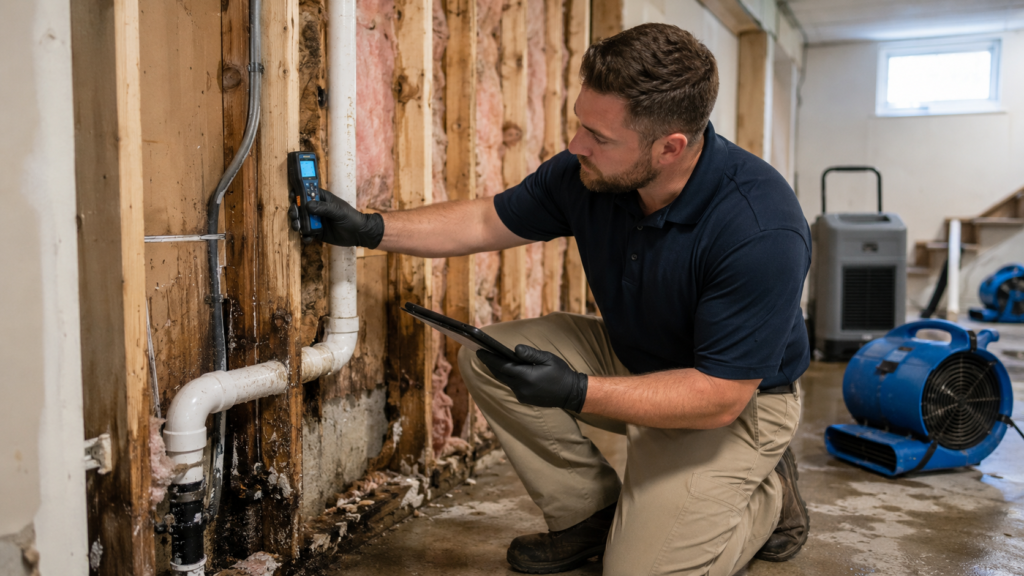
A professional mold assessment can provide useful building evidence after a frozen-pipe loss.
It may document:
- Visible growth
- Water staining
- Current moisture conditions
- Affected building materials
- Suspected concealed damage
- The likely water pathway
- Conditions that support mold growth
- Remediation boundaries
- Materials that may require removal
- Areas that need further access
- Photographs and field notes
A Toronto mold contractor should not promise that this evidence will make the insurer approve the claim.
A contractor also should not:
- Interpret policy wording as legal advice
- Decide whether an exclusion applies
- Guarantee reimbursement
- State the exact age of mold based only on colour or appearance
- Assume all discovered mold came from the latest leak
- Describe a denial as improper without reviewing the insurer’s written reasons
- Tell the homeowner to delay reporting the loss
The inspection supports the factual record.
The insurer interprets the contract and makes the initial coverage decision. A broker, insurer complaint officer, ombudservice, public adjuster where applicable, or lawyer may become involved when coverage remains disputed.
The best project record would include:
- Property type and GTA location
- Occupied, vacant, or temporarily unattended status
- Where the pipe froze
- When the water was discovered
- Materials affected
- Initial moisture readings
- What was visible before demolition
- What was found inside the wall or ceiling
- Drying or remediation work completed
- Documents supplied to the owner or adjuster
- Whether mold was present
A denial letter should explain more than “mold is not covered”
A claim denial is easier to assess when the insurer identifies both:
- The policy clause being applied
- The facts used to support that decision
A letter that refers broadly to “mold,” “wear and tear,” “gradual damage,” or “failure to maintain heat” may not answer the full question.
The homeowner should ask for the exact wording from the policy, including any endorsement, exclusion, condition, deductible, or coverage limit that affected the decision.
The request should also clarify whether the insurer denied:
- The entire frozen-pipe claim
- The failed pipe only
- The resulting water damage
- Mold remediation costs
- Part of the reconstruction
- Damaged contents
- Additional living expenses
- A contractor’s proposed scope or price
These are different outcomes.
A disagreement about the remediation estimate is not the same as a finding that no coverage exists. A limitation on mold-related costs is not the same as denial of the original water loss.
Four insurance outcomes that homeowners often confuse

A frozen-pipe claim can produce several decisions inside the same file.
The water damage is covered, but the broken pipe is not
A policy may respond to sudden water damage caused by a burst pipe without paying to replace the section of pipe that failed.
The pipe repair may be treated as a maintenance or mechanical cost. The resulting damage to drywall, flooring, insulation, cabinetry, or ceilings may be handled separately.
The water damage is covered, but mold is disputed
The insurer may accept that the pipe suddenly released water but question whether later mold resulted from that event.
The decision may turn on:
- How quickly the leak was discovered
- Where the water travelled
- Whether hidden materials remained wet
- What drying work was completed
- Whether earlier moisture damage existed
- When mold was first documented
- Whether the policy contains a fungi exclusion or limit
This is a causation dispute, not necessarily a denial of the original water claim.
Coverage is accepted, but the remediation scope is disputed
The adjuster may agree that mold remediation is related to the covered loss while disagreeing with the amount of material that must be removed.
Common scope disputes involve:
- Whether drywall can be cleaned or must be removed
- How far removal should extend beyond visible growth
- Whether insulation was affected
- Whether flooring must be lifted
- Whether cabinetry can be salvaged
- Whether containment is needed
- How many air scrubbers are required
- Whether post-remediation verification is justified
- Whether the contractor’s rates are reasonable
A written remediation protocol can help separate technical requirements from pricing disagreements.
The complete claim is denied under a policy condition
The insurer may take the position that the homeowner failed to comply with a heating-season, vacancy, inspection, or water-shutoff condition.
Standard home policies commonly cover resulting damage from frozen pipes in heated parts of a home when reasonable steps were taken to maintain heat. Coverage can narrow when a property is vacant or left unattended during the heating season and the policy’s precautions were not followed. The exact inspection interval and winterization requirements depend on the contract.
In this situation, the evidence must address the policy condition directly.
Photographs of mold damage will not resolve a dispute about whether someone checked the home or whether the heating system was operating.
Read the denial by separating the insurer’s facts from its conclusion
A useful review starts with a simple comparison.
| Insurer’s position | Evidence that may help test it |
|---|---|
| The property was not adequately heated | Thermostat history, smart-home records, heating bills, furnace service records and witness statements |
| The home was left unattended contrary to the policy | Property-check logs, messages, security records, neighbour statements and dated photographs |
| The leak was gradual | Plumber’s findings, condition of the pipe, earlier photographs, water staining patterns and material deterioration |
| Mold existed before the frozen pipe | Earlier inspection reports, renovation photographs, maintenance records and evidence showing the prior condition |
| The owner failed to limit further damage | Call records, emergency invoices, water extraction records, equipment logs and moisture readings |
| The proposed mold scope is excessive | A room-by-room moisture map, removal rationale, material assessment and independent remediation protocol |
| Mold is excluded or limited | The full policy wording, endorsements, limits and the insurer’s calculation |
| Some damaged materials are unrelated | Water-pathway documentation, demolition photographs and contractor observations |
The goal is not to overwhelm the insurer with hundreds of unorganized images.
The goal is to identify each disputed statement and respond with evidence that addresses it.
A mold exclusion does not always answer every part of the claim
Some policies contain exclusions, limitations, or special wording for fungi, spores, rot, contamination, or repeated moisture.
That wording can affect mold remediation costs. It does not automatically explain how the insurer handled:
- Sudden water extraction
- Emergency drying
- Removal of wet materials
- Damage caused before mold developed
- Plumbing access
- Covered contents
- Temporary accommodation
- Reconstruction unrelated to mold growth
The denial should make clear which costs fall outside coverage and which portions of the loss remain accepted.
For example, wet drywall may need immediate removal because it cannot be dried safely or because access is required to reach saturated insulation. That emergency removal may have occurred before visible mold was found.
The homeowner should request an itemized decision rather than accepting one broad statement that “mold is excluded.”
Gradual damage and sudden damage can exist in the same wall
A frozen-pipe event can expose an older building problem.
Fresh water may enter a cavity that already contains:
- Condensation staining
- An earlier plumbing leak
- Foundation seepage
- Deteriorated window flashing
- Previous mold growth
- Damaged insulation
- Rot around framing
The presence of an older condition does not prove that all current damage predates the pipe failure.
The opposite is also true. A recent burst pipe does not prove that every stain, damaged material, or mold colony resulted from that event.
The affected assembly should be divided into findings that can be supported:
- Recent water saturation
- Older staining or deterioration
- Active visible mold
- Suspected concealed mold
- Materials affected by both old and new moisture
- Areas where the cause cannot be confirmed
A reliable report should state uncertainty where the evidence is incomplete. Overstating causation can weaken the file if later photographs or contractor findings show a mixed history.
The appearance of mold cannot provide an exact growth date
Mold colour, colony size, texture, or odour cannot establish an exact start date by visual inspection alone.
Dark growth is not automatically old. Light growth is not automatically recent.
The condition must be interpreted with the event history and building evidence, including:
- Date of the pipe failure
- Date the water was discovered
- Initial moisture levels
- Material type
- Indoor temperature
- Water pathway
- Drying records
- Earlier photographs
- Condition behind removed materials
- Signs of repeated moisture
Laboratory analysis can identify organisms in a collected sample. It generally cannot determine the exact date when growth began or prove by itself that a particular insurance event caused it.
Testing should answer a defined question. It should not be ordered simply because the claim has been denied.
A detailed mold inspection in Toronto can document current building conditions, but the findings still need to be interpreted alongside the pipe failure, drying history, and prior condition of the property.
Build a reconsideration package around the reason for denial
A strong reconsideration request should be easy to follow.
Start with a one-page event summary
State:
- When the property was last known to be dry
- When the pipe likely froze
- When the water was discovered
- When the water supply was stopped
- When the insurer was notified
- When emergency drying began
- When mold was first observed
- When walls, ceilings, or flooring were opened
- What concealed conditions were found
Use dates and times where possible.
Do not mix assumptions with confirmed facts.
Include the applicable policy documents
Attach:
- The policy declarations
- The full policy wording
- Water-damage endorsements
- Fungi or mold endorsements
- Vacancy or unoccupancy conditions
- Relevant exclusions
- The denial letter
- Earlier adjuster correspondence
- The insurer’s scope or estimate
This makes it easier to compare the decision with the actual contract.
Organize photographs by location and date
File names such as IMG_4812.jpg provide little context.
Use names that explain what the image shows:
2026-01-14-basement-north-wall-before-removal.jpg2026-01-15-wet-insulation-behind-drywall.jpg2026-01-15-bottom-plate-moisture-reading.jpg2026-01-17-wall-cavity-after-cleaning.jpg
Include wide photographs that establish the room and close photographs that document the condition.
Add independent trade findings
A reconsideration package may include:
- Plumber’s report
- Heating contractor’s findings
- Leak-detection report
- Moisture assessment
- Remediation protocol
- Structural assessment
- Laboratory results where relevant
- Drying logs
- Waste records
- Post-remediation verification
The documents should describe observed conditions. Contractors should avoid making legal conclusions about insurance coverage.
Respond to each denial point separately
A short response is often stronger than a long emotional narrative.
For example:
The denial letter states that the property was not inspected during the period of absence. Attached records show that the property was checked on January 10, January 12, and January 14. The water damage was discovered during the January 14 visit.
Or:
The denial letter states that mold resulted from a long-term leak. The plumber’s report identifies a split copper pipe in the exterior wall. Earlier renovation photographs dated December 18 do not show staining or damage in that area. Demolition photographs show fresh saturation extending from the failed pipe into the insulation and bottom plate.
The evidence may or may not change the outcome. It gives the insurer a specific record to reconsider.
Sample request for a written claim review
Subject: Request for Reconsideration of Frozen-Pipe and Mold Claim
I am requesting a written review of the coverage decision for claim number [claim number] concerning the frozen-pipe loss discovered on 2026.
The denial letter refers to [policy condition, exclusion, or stated reason]. Please provide:
- The complete policy wording and endorsement relied upon.
- The facts used to determine that the provision applies.
- A breakdown showing which parts of the claim are denied, accepted, limited, or still under review.
- Copies of reports, photographs, estimates, or expert opinions used to make the decision, where available.
- The insurer’s internal complaint escalation process and contact information for the Complaint Officer.
I have attached a chronological summary, photographs, contractor reports, moisture records, invoices, and other documents relevant to the disputed findings.
Please confirm receipt and advise whether any additional information is required.
Sincerely,
[Name]
[Policy number]
[Claim number]
[Property address]
[Telephone and email]
What to request from the remediation contractor
The contractor’s file should explain what was found and what work was completed.
Useful records include:
- Inspection date
- Rooms assessed
- Moisture source reported by the owner
- Visible mold locations
- Moisture readings
- Affected materials
- Containment boundaries
- Removal limits
- Equipment used
- Drying duration
- Conditions found after demolition
- Before-and-after photographs
- Cleaning procedures
- Final moisture readings
- Remaining limitations
- Recommendations for reconstruction or further assessment
A report that only states “mold removed” provides little help during a coverage dispute.
The scope should also distinguish between:
Emergency mitigation: stopping water movement and reducing further damage.
Mold remediation: containing and removing contaminated materials.
Reconstruction: replacing finishes and repairing the building.
Each phase may involve different contractors, invoices, and coverage decisions.
The same documentation can support a clearer mold damage insurance claim record before damaged materials are discarded or concealed.
What Ultimate Mold Crew can document
Ultimate Mold Crew can assess and record physical conditions related to a frozen-pipe loss, including:
- Visible mold growth
- Moisture patterns
- Affected materials
- Suspected concealed damage
- The apparent path of water movement
- Conditions found after controlled removal
- Remediation boundaries
- Cleaning and containment procedures
- Moisture conditions at the end of the work
- Areas that require another qualified trade
What to do when the adjuster maintains the denial
The first escalation should remain within the insurance company.
Ask the adjuster to identify the disputed facts and provide the specific policy wording. If the matter remains unresolved, request review by a supervisor or manager.
The next step is the insurer’s formal complaint process.
Ontario insurers have designated complaint contacts. The Complaint Officer reviews the dispute and provides the company’s final position. That final position letter is normally required before an external complaint can move forward.
External review through the General Insurance OmbudService
The General Insurance OmbudService provides free and impartial assistance for disputes involving home, automobile, and business insurance.
After the insurer’s internal complaint process is complete, the homeowner can submit the final position letter and supporting documents for review. The service first determines whether the dispute falls within its mandate and whether the file has enough merit to proceed to conciliation or mediation.
A complete submission should include:
- Final position letter
- Policy wording
- Denial letter
- Timeline
- Photographs
- Contractor reports
- Invoices
- Moisture records
- Written communications
- A concise explanation of the disputed findings
Regulatory complaints through FSRA
The Financial Services Regulatory Authority of Ontario oversees licensed insurers and insurance conduct.
FSRA generally expects the consumer to complete the insurer’s internal complaint process and obtain a final position letter before submitting a complaint.
FSRA can review regulatory conduct and compliance concerns. It does not settle private contract disputes, order reimbursement, or award compensation to resolve a property claim.
A homeowner may therefore use different routes for different problems:
- A coverage dispute may proceed through the insurer and GIO.
- A concern about insurer conduct or regulatory compliance may be submitted to FSRA.
- A dispute requiring a binding legal remedy may require legal advice.
Do not assume that a complaint pauses every legal deadline
Insurance policies and Ontario law can contain deadlines for giving notice, submitting proof of loss, starting legal action, or taking other steps.
Where a limitation period may become an issue, the insurer and consumer may need a written agreement to suspend it during dispute resolution. A homeowner facing a large denial should obtain legal advice promptly rather than waiting for every complaint stage to finish.
When the damaged materials have already been removed
A claim can still be documented after emergency demolition, but the available evidence may be weaker.
Collect:
- Photographs taken before and during removal
- Videos
- Contractor notes
- Moisture readings
- Disposal records
- Plumber’s report
- Material quantities
- Equipment logs
- Invoices
- Samples or laboratory reports already collected
- Emails describing what was found
- Statements from people who saw the damage
Ask the contractor to identify which observations were made directly and which conclusions are based on the reported history.
Do not ask a contractor to recreate readings or claim that undocumented conditions were confirmed.
Where the area has already been rebuilt, further destructive inspection may cause more damage without resolving the dispute. The value of reopening the assembly should be assessed against the specific evidence gap.
A practical decision path after a frozen-pipe mold denial
Begin with the insurer’s stated reason.
If the dispute concerns heating or absence from the home, gather heating records and property-check evidence.
If the dispute concerns gradual damage, focus on the pipe condition, earlier property records, water pathway, and signs of old versus recent deterioration.
If the dispute concerns mold causation, document the saturation, hidden materials, drying process, date of discovery, and prior condition.
If the dispute concerns the remediation scope, obtain a detailed material-by-material explanation for removal, containment, cleaning, and verification.
If the dispute concerns policy wording, request the complete clause and a written breakdown of how it applies to each claimed cost.
Then decide whether the next step is:
- Additional technical evidence
- Internal reconsideration
- Formal complaint review
- Ombudservice assistance
- Regulatory complaint
- Legal advice
A frozen-pipe mold claim is strongest when the evidence forms one connected sequence:
- Property condition before the loss → pipe failure → water movement → emergency response → hidden findings → mold assessment → remediation scope
Ultimate Mold Crew can inspect the affected area, document moisture and mold conditions, define the remediation scope, and provide a factual record of the work. Property owners dealing with concealed contamination can arrange professional mold removal in Toronto before damaged materials are rebuilt or important evidence is lost.
Verified Sources
Insurance Bureau of Canada, Does My Insurance Cover Damage Caused by Extreme Cold?
https://www.ibc.ca/news-insights/in-focus/does-my-insurance-cover-damage-caused-by-extreme-cold
Financial Services Regulatory Authority of Ontario, Submit a Complaint to FSRA
https://www.fsrao.ca/submit-complaint-fsra
Financial Services Regulatory Authority of Ontario, Property and Other Insurance
https://www.fsrao.ca/consumers/property-and-other-insurance
Financial Services Regulatory Authority of Ontario, Insurance Company Complaint Officers
https://www.fsrao.ca/about-fsra/corporate-reporting/open-data/insurance-company-complaint-officers-0
General Insurance OmbudService, How the Process Works
https://giocanada.org/how-the-process-works/
General Insurance OmbudService, What GIO Can and Cannot Help With
https://giocanada.org/what-gio-can-and-cant-help-with/
General Insurance OmbudService, Water Damage and Insurance
https://giocanada.org/water-damage-insurance-what-will-my-insurance-cover/
Government of Ontario, Insurance Act
https://www.ontario.ca/laws/statute/90i08
