
Updated on 10-Mar-2026
Mold in a house usually smells musty, earthy, or damp. Many homeowners describe it as similar to wet newspaper, rotting leaves, or an old basement after rain. The odor often lingers in the air and becomes stronger in enclosed or humid areas of the home.
That smell comes from microbial volatile organic compounds (mVOCs). These are tiny gases released as mold grows on damp building materials like drywall, wood, insulation, or carpet. Even when mold is hidden behind walls or under flooring, these compounds can travel through indoor air and create the familiar musty odor people associate with mold.
For many homeowners, the smell is actually the first sign of a mold problem.
You may notice it when entering a room that normally smells neutral. The air can feel stale or slightly sour, especially in areas where moisture tends to collect. Basements, bathrooms, crawl spaces, and laundry rooms are common places where mold odors begin to appear.
In some toronto homes, the odor becomes more noticeable after rainfall , mold growth also increases during winter season or during humid summer weather when moisture levels inside the house rise.
Understanding what mold actually smells like is the first step in identifying whether a musty odor in your home could be a sign of hidden mold growth. Around 60% of indoor mold reports come from areas with insufficient ventilation or hidden moisture.
Table of Contents
Why mold smells musty, earthy, or damp?

The musty smell associated with mold is not random. It is produced during the biological process of mold growth.
As mold colonies develop on damp surfaces, they release small gases known as microbial volatile organic compounds, often shortened to mVOCs. These compounds are byproducts of the metabolic activity of fungi as they break down organic materials such as wood, drywall, dust, or fabric.
Even though mold itself may be hidden inside walls or under flooring, these gases easily move through indoor air. This is why homeowners often notice the smell before they ever see visible mold.
What mVOCs Are
Microbial volatile organic compounds are lightweight molecules produced by many microorganisms, including mold and bacteria. When mold grows on building materials, it feeds on organic matter and releases these compounds into the surrounding air.
These gases are responsible for the characteristic odor commonly described as:
- musty odor
- earthy
- damp
- stale
Some people also describe mold odors as resembling:
- wet newspaper
- rotting leaves
- damp soil
- old wood
In certain cases, especially when mold is growing actively in enclosed spaces, the odor may even have a slightly sour or fermenting quality.
Why Mold Smell Is Stronger in Damp Areas
Moisture plays a critical role in both mold growth and odor production.
When building materials remain damp for extended periods, mold colonies can expand rapidly. As the colonies grow larger, the amount of mVOCs released into the air increases.
This is why mold odors tend to be strongest in places where moisture accumulates, such as:
- • basements with poor ventilation
- • bathrooms with persistent humidity
- • areas under sinks where leaks may occur
- • crawl spaces and attic insulation
- • rooms affected by flooding or water damage
Poor airflow can also intensify the smell. When air circulation is limited, odor compounds accumulate rather than dissipating.
Understanding the connection between mold odor and moisture helps explain why a persistent musty smell indoors often signals an underlying moisture issue somewhere in the home.
If moisture remains unresolved, mold growth — and the smell that comes with it — will often continue to return.
Can a house smell musty without visible mold?
Yes. In many homes, a persistent musty smell appears before any visible mold is discovered.
This happens because mold colonies often grow in places that are hidden from view. The mold may be developing inside building materials or in areas of the home that are rarely inspected.
Even though the mold itself is concealed, the gases produced during mold growth can travel through air and become noticeable elsewhere in the house.
For homeowners, this can be confusing. The room may smell stale or damp, yet walls and ceilings look completely normal.
Why Mold Can Stay Hidden
Mold does not always grow on exposed surfaces. It often develops in places where moisture becomes trapped and airflow is limited.
Common hidden locations include:
- • behind drywall after a plumbing leak
- • under harwood flooring following water damage
- • inside wall cavities where condensation occurs
- • beneath kitchen or bathroom cabinets
- • inside HVAC ducts or air handling units
- • attic insulation affected by roof leaks and shingles
In these situations, mold colonies may remain out of sight while the odor they produce continues to circulate through the home.
Because odor compounds can move through air currents, the smell may appear strongest in a completely different room from where the mold is actually growing.
For example, mold inside a wall cavity may release odors that travel through electrical openings or ventilation pathways into nearby rooms.
A Musty Smell Is Often an Early Warning Sign
Many mold investigations begin after occupants notice a persistent musty odor that cannot be explained by normal household conditions.
If the smell remains even after cleaning, airing out the room, or removing obvious sources of moisture, it may indicate hidden mold growth somewhere in the building.
A consistent mold odor should not be ignored. It often signals that moisture has been present long enough for mold to develop in concealed areas.
Identifying and correcting the moisture source is usually the first step toward resolving the problem.
Where Mold Smell Usually Comes From in a House
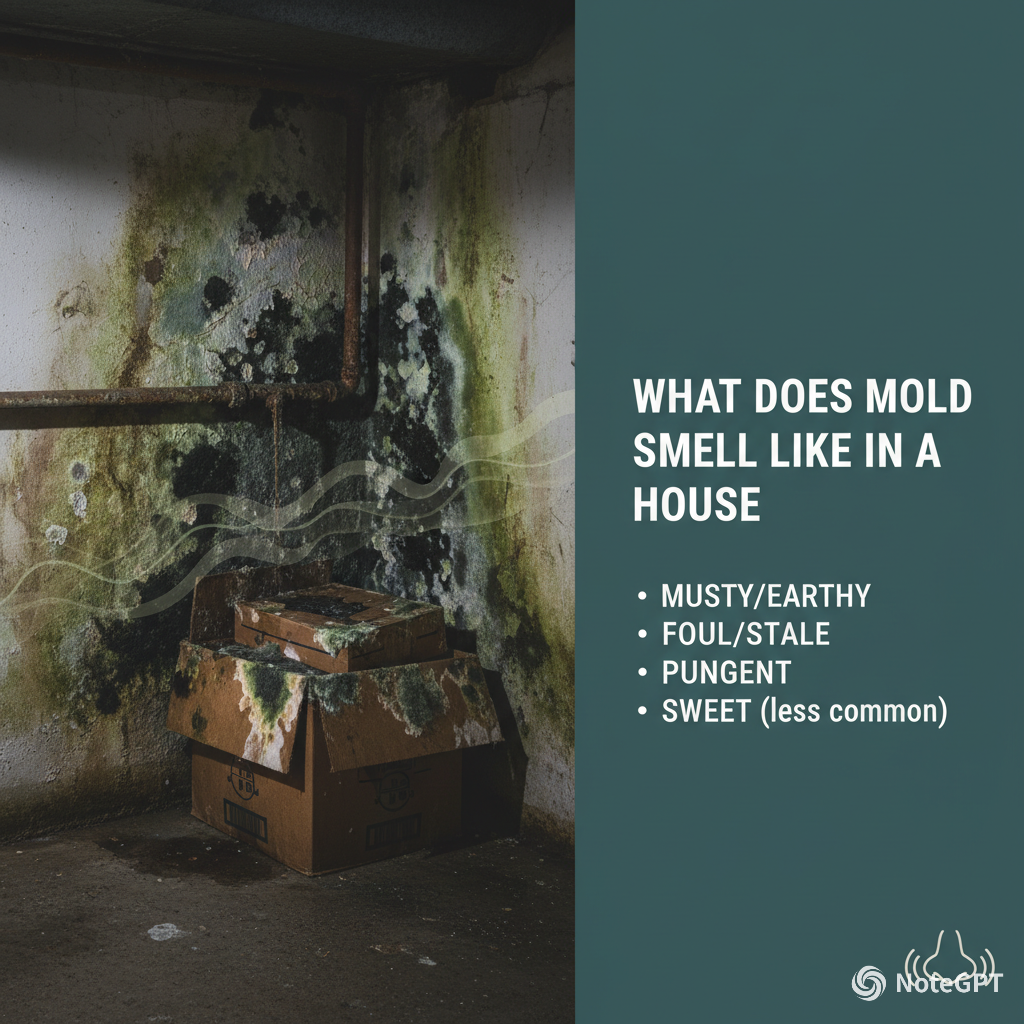
When a home develops a persistent musty odor, the source is often tied to areas where moisture collects or ventilation is limited. Mold does not grow randomly. It typically develops where water or humidity remains long enough for fungal spores to settle and multiply.
Certain areas of a house are more likely to produce mold odors because they experience higher moisture levels or hidden water intrusion.
Common Areas Where Mold Odor Starts
Basements are one of the most common places where mold smells develop. These areas tend to stay cooler and more humid than the rest of the home. Moisture from soil surrounding the foundation can slowly enter through concrete walls or floors, creating damp conditions that encourage mold growth.
Bathrooms regularly produce humidity from showers and baths. If ventilation fans are weak or rarely used, moisture can accumulate on ceilings, behind tiles, or inside wall cavities.
Small leaks under kitchen or bathroom sinks can go unnoticed for long periods. Even slow drips can dampen wood cabinets or drywall, allowing mold to develop in enclosed spaces.
Washing machines, water supply lines, and floor drains can all create moisture sources that lead to mold odors if ventilation is poor.
Attics sometimes develop mold due to roof leaks or condensation during winter months. Warm air rising from the home can meet cold roof surfaces and create moisture on the underside of roof decking.
If moisture enters air ducts or cooling coils, mold can grow inside ventilation systems. In these cases, the smell may travel throughout the house whenever the HVAC system runs.
Why Mold Odor Can Travel Through a House
Unlike visible mold, odor compounds move easily through air.
When mold releases microbial gases, those compounds can travel through:
- • ventilation ducts
- • wall cavities
- • gaps around electrical outlets
- • open stairways between floors
Because of this, homeowners sometimes notice the smell in a bedroom or living room even though the mold source is somewhere else entirely.
Tracking down the origin of a mold odor often requires inspecting areas where moisture problems are most likely to occur.
How to Tell the Difference Between Mold Smell & Stale Air?
Key Differences Between Mold Odor and Stale Air
| Feature | Mold Smell | Stale Air |
|---|---|---|
| Typical description | Musty, earthy, damp | Stuffy or stagnant |
| Cause | Mold growth in damp materials | Poor airflow or ventilation |
| Does ventilation remove it? | Often returns quickly | Usually improves with fresh air |
| Common locations | Basements, bathrooms, hidden wall spaces | Closed rooms or poorly ventilated areas |
A Simple Test Homeowners Can Try
If a room smells stale, try opening windows or increasing airflow for 20 to 30 minutes. If the odor fades quickly, the issue may simply be stagnant air.
If the smell returns shortly after the room is closed again, or if it becomes stronger near damp areas, mold growth may be present somewhere in the home.
In many cases, a persistent musty odor that does not disappear with ventilation is one of the earliest signs that moisture and mold may be present in hidden areas of the building.
Mold Smell vs. Mildew Smell: What’s the Difference?
Homeowners often use the words mold and mildew interchangeably. While both are types of fungi and both thrive in damp environments, the odors they produce can feel slightly different.
Understanding that difference can sometimes help narrow down what may be happening inside a house.
How Mold Smell Is Usually Described
Mold odors are typically deeper and heavier. The smell often reminds people of spaces where moisture has been present for a long time.
Many people compare mold odor to wet newspaper, rotting leaves, or damp wood. These comparisons come up frequently because mold grows by breaking down organic materials, which naturally produces those kinds of earthy smells.
How Mildew Smell Is Usually Described
Mildew is a type of fungus that tends to grow on surfaces such as bathroom grout, window frames, shower curtains, and damp fabrics.
Its smell is usually lighter and slightly sharper than mold odor. Instead of the deep earthy smell associated with mold colonies, mildew can smell more like:
- • stale cloth
- • damp towels and pillows
- • slightly sour or stale air
Mildew often develops in areas where moisture appears regularly but does not remain trapped long enough for deeper mold growth inside building materials.
Why the Two Smells Can Be Confusing
In many homes, both mold and mildew may be present at the same time. A damp basement, for example, may contain mildew on exposed surfaces while hidden mold grows inside drywall or wood framing.
Because of this overlap, homeowners frequently notice a general musty odor rather than being able to distinguish the exact source.
From a practical standpoint, the key takeaway is simple:
a persistent musty smell indoors usually indicates excess moisture somewhere in the home.
Whether the odor comes from mildew or deeper mold growth, addressing the moisture source is essential to prevent the problem from spreading.
Why Mold Smell Can Appear Before You See Mold
One of the more confusing things for homeowners is noticing a musty smell even though no mold is visible anywhere in the room.
In many cases, this happens because mold can grow out of sight long before it becomes visible on surfaces.
When mold begins developing inside damp building materials, the colonies may remain hidden for weeks or even months. During this time, the mold is already producing odor compounds that move through the surrounding air.
These compounds are known as microbial volatile organic compounds (mVOCs). They are released as mold feeds on organic materials such as wood, drywall, insulation, and dust.
Because these gases are extremely small, they travel easily through indoor air and ventilation pathways.
Why the Smell Appears First
Several conditions allow mold odor to become noticeable before visible growth appears.
• Hidden growth inside walls
Mold often develops behind drywall after plumbing leaks or condensation inside wall cavities.
• Moisture trapped under flooring
Water from spills or flooding can soak into subfloors where mold grows underneath the surface.
• Insulation contamination
Attic or wall insulation can hold moisture and support mold growth without showing clear surface signs.
• Air movement through small openings
Electrical outlets, light fixtures, and ventilation gaps can allow odor compounds to escape from concealed areas.
Because of these factors, the smell may reach living spaces even when the mold itself is hidden inside building materials.
Why Mold Odor Sometimes Gets Stronger After Rain
Homeowners often notice that musty smells become more noticeable after rainy weather or during humid summer months.
Higher humidity increases moisture levels in materials and can stimulate mold activity. As mold metabolism increases, the release of odor compounds may also increase.
This is why a house that smells normal during dry conditions may suddenly develop a strong musty odor during periods of high humidity.
When a persistent mold smell appears without a visible source, it often signals that moisture and mold growth may be present somewhere behind walls, under flooring, or in other concealed spaces.
Do Different Types of Mold Smell Different?
Most people describe mold with the same general words: musty, earthy, damp, or stale. However, different types of mold can produce slightly different odor characteristics depending on how they grow and what materials they are feeding on.
This variation happens because different fungi release different combinations of microbial volatile organic compounds (mVOCs) during growth.
In everyday situations, the differences are subtle. Most homeowners will simply notice a persistent musty smell. But environmental professionals sometimes observe slight differences depending on the mold species and the environment where it is growing.
Common Indoor Molds and Their Typical Odor Descriptions
| Mold Type | Where It Commonly Grows | Typical Odor Description |
|---|---|---|
| Penicillium | Damp walls, carpets, insulation | Strong musty or stale smell |
| Aspergillus | Air ducts, walls, insulation | Earthy or dusty odor |
| Cladosporium | Window frames, fabrics, wood | Damp organic smell |
| Stachybotrys (black mold) | Water-damaged drywall and wood | Heavy musty or earthy odor |
These descriptions are general patterns rather than exact rules. The odor a homeowner notices can also depend on the materials the mold is growing on and how long moisture has been present.
For example, mold growing on damp wood or drywall may produce a deeper earthy smell, while mold growing on fabrics or dust may produce a lighter stale odor.
Why Mold Odor Changes Over Time
The smell of mold can also change as colonies grow.
In the early stages of growth, the odor may be faint and only noticeable in enclosed areas. As mold colonies expand and produce more spores and metabolic gases, the smell often becomes stronger and more persistent.
In some cases, especially when mold grows in stagnant or poorly ventilated areas, the odor may even develop a slightly sour or fermenting quality.
These variations explain why homeowners sometimes describe mold smells differently, even though the underlying cause is the same: mold growing in a damp environment.
Understanding that different molds can produce slightly different odors can help homeowners recognize that a persistent musty smell is often worth investigating further.
What To Do If Your House Smells Like Mold
If a room in your home consistently smells musty, it is worth investigating the source rather than trying to mask the odor. Air fresheners, candles, or cleaning sprays may temporarily cover the smell, but they do not address the underlying moisture or mold growth that may be causing it.
The first step is to determine whether the smell is linked to excess moisture somewhere in the home.
Start by Checking Common Moisture Sources
Look for areas where water may be entering or collecting. Mold needs moisture to grow, so identifying the source of dampness is often the key to solving the problem.
Check for:
- • plumbing leaks under sinks or behind appliances
- • water stains on ceilings or walls
- • damp carpeting or flooring
- • condensation around windows or exterior walls
- • musty smells coming from basements or crawl spaces
In many homes, the odor originates in areas where moisture has been present for a long time without proper ventilation.
Improve Airflow and Humidity Control
Humidity inside a home should ideally remain below 50 percent. When indoor humidity rises above that level, mold growth becomes much more likely.
Better air circulation helps prevent moisture from lingering on surfaces where mold can develop.
Inspect Hidden Areas If the Smell Persists
If the odor continues even after cleaning and improving ventilation, the source may be hidden inside building materials.
Persistent musty odors that cannot be traced to a visible source often indicate hidden mold growth somewhere inside the structure of the home.
When a Mold Smell Means You Should Investigate Further
Not every musty smell automatically means a serious mold problem. However, certain patterns can signal that mold growth may be developing somewhere in the house.
Homeowners should pay closer attention when the smell has specific characteristics.
Signs the Odor May Be Coming From Mold
- • the smell returns quickly after cleaning
- • the odor becomes stronger after rainfall or humid weather
- • certain rooms consistently smell musty while others do not
- • the smell seems to come from vents, walls, or flooring
- • occupants experience irritation such as coughing or congestion indoors
In many cases, these patterns suggest that moisture is present somewhere inside the building.
Because mold often grows in hidden areas, the smell may be the earliest warning sign that moisture problems need to be addressed.
If the odor persists for long periods or becomes stronger over time, investigating the source can help prevent mold from spreading further inside the home.
Professional mold removal and inspection is recommended to identify hidden moisture and determine whether mold contamination is present so that effective remediation can be carried out.
Sources
-
Are Some Fungal Volatile Organic Compounds (VOCs) Mycotoxins?
-
WHO Guidelines for Indoor Air Quality: Dampness and Mould
https://www.who.int/publications/i/item/9789289041683 -
Mold Exposure and Health
https://www.niehs.nih.gov/health/topics/agents/mold -
ResearchGate: Detection of moulds by volatile organic compounds: Application to heritage conservation
-
nih.gov: Visually observed mold and moldy odor versus quantitatively measured microbial exposure in homes
-
lbl.gov: Does dampness and mold in schools affect health? Results of a meta‐analysis
Scientific Citations for Mold Odor – peer-reviewed research and studies
| # | Citation | Key Focus |
|---|---|---|
| 1 | Zhao, L., et al. (2025). Profiling Specific Volatile Organic Compounds for Mold Detection and Species Identification. | Peer-reviewed research in Indoor Air confirming that MVOC emissions are reliable indicators of hidden microbial growth, even in the absence of visible mold. |
| 2 | Lorentzen, J. C., et al. (2024). Mold Odor from Wood Treated with Chlorophenols despite Microbial Methylation. | Technical study explaining how chloroanisoles (CAs) produced from legacy wood preservatives (chlorophenols) contribute to persistent musty odors in older buildings. |
| 3 | Lappalainen, V., et al. (2026). Multivariate analysis on simulated moisture damage emission to indoor air. | Recent study in Science of the Total Environment identifying critical MVOCs as primary sources of unpleasant odors and health-related indoor air problems. |
| 4 | Schrantz, M. (2025). Built Environment as a Dangerous Ecosystem. | Research highlighting the long-standing clinical link between musty buildings and human illness, emphasizing the need for proactive moisture management. |
| 5 | Lee, S., et al. (2024). Association of exposure to indoor molds and dampness with environmental pollutants. | Study characterizing the relationship between indoor dampness, mold odors, and the accumulation of environmental pollutants in residential spaces. |
| 6 | Fu, X., et al. (2016). Indoor Microbial Volatile Organic Compound (MVOC) Exposure and Health. | Comprehensive review linking prolonged MVOC exposure to sick building syndrome (SBS), respiratory irritation, and asthma-like symptoms. |
| 7 | AIHA (2024). Mold and Dampness in the Built Environment: White Paper. | Authoritative industry guideline discussing the progression of respiratory diseases in individuals exposed to dampness and mold in non-industrial workplaces. |
