
![Mold Growth From Plumbing Water Leaks Inside Walls [GUIDE]](https://ultimatemoldcrew.ca/wp-content/uploads/2026/06/Mold-Growth-From-Plumbing-Water-Leaks-Inside-Walls.jpg)
Updated on 15-Jun-2026
A plumbing leak does not need to flood the entire room to cause trouble.
A loose fitting behind a sink, a cracked supply line, a leaking drain or a small pipe failure inside a ceiling can release water slowly for days before anyone notices. By then, the drywall may look stained, the paint may be bubbling and the insulation inside the cavity may already be wet.
The first concern is stopping the leak.
The next question is harder:
Can the affected wall or ceiling be dried, or does it need to be opened and removed?
That decision depends on how long the materials stayed wet, where the water travelled, what type of water was involved and whether mold or deterioration has already developed.
Table of Contents
Key Takeaways
- Mold risk increases when drywall, insulation and wood remain wet.
- Water should be removed and affected materials dried as quickly as possible.
- A wall can look dry on the room side while moisture remains inside the cavity.
- Clean water from a supply line is different from contaminated water from a drain or sewer.
- Drywall may sometimes be dried after a small, recent clean-water leak.
- Swollen, soft, crumbling, contaminated or moldy drywall usually needs removal.
- Painting over a stain does not confirm that the cavity is dry.
- Mold testing is not required in every case.
- Moisture inspection and selective opening are often more useful than waiting for visible mold.
How Quickly Can Mold Grow After a Pipe Leak?
There is no exact countdown that applies to every property.
Temperature, humidity, airflow, material type and the amount of water all affect what happens next. However, wet building materials should be treated as time-sensitive.
The U.S. Environmental Protection Agency recommends drying water-damaged areas and materials within 24 to 48 hours to help prevent mold growth.
That does not mean visible mold will always appear within two days. It means the opportunity to dry porous materials successfully becomes less certain as time passes.
Drywall paper, wood dust, insulation facing and debris inside a cavity can provide material for mold growth when moisture remains.
The safest approach is not to wait for spots or a musty smell.
Start drying and inspecting the affected assembly immediately.
Common Plumbing Leaks That Lead to Hidden Mold
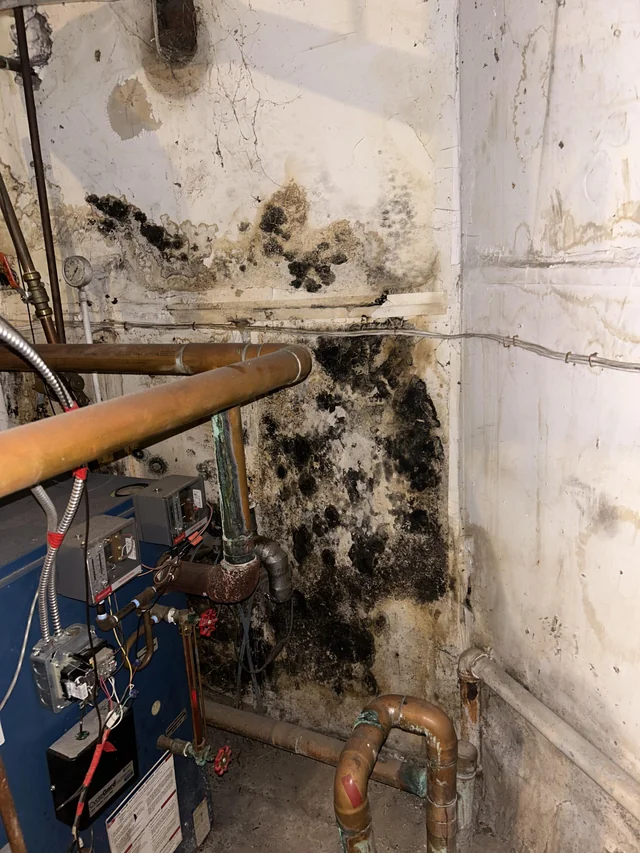
Burst or Frozen Pipes
A burst pipe may release a large amount of water quickly.
The visible water on the floor is only part of the problem. Water can also enter:
- Wall cavities
- Ceiling cavities
- Insulation
- Subflooring
- Flooring layers
- Cabinets
- Baseboards
- Electrical openings
- Rooms below the damaged pipe
Even after the standing water is removed, concealed materials may remain wet.
Slow Supply-Line Leaks
A pinhole leak or loose supply connection may release only a small amount of water at a time.
These leaks are often found behind:
- Bathroom vanities
- Kitchen cabinets
- Refrigerators
- Dishwashers
- Washing machines
- Toilets
- Finished basement walls
Because the leak is slow, there may be little standing water. Instead, the first clues may be staining, swelling or odour.
Drainpipe Leaks
Drainpipes carry used water.
A leaking sink, bathtub, shower or toilet drain can wet the cavity with water containing soap residue, food particles, hair, dirt or other contaminants.
Material decisions are usually more conservative when the water is not clean.
Leaks From Plumbing Above a Ceiling
A bathroom, laundry room or kitchen leak on an upper floor can travel through the floor assembly and appear on the ceiling below.
Water may spread along:
- Floor joists
- Pipes
- Ducts
- Electrical wiring
- Insulation
- Drywall seams
The ceiling stain may not sit directly below the leak.
Toilet Overflows
A toilet overflow may range from relatively clean tank water to heavily contaminated wastewater.
The source determines how the affected flooring, drywall and insulation should be handled.
Leaks Inside Finished Basement Walls
Basement plumbing is often concealed behind insulation, framing and drywall.
A small leak can remain unnoticed because the water collects behind the wall or runs toward the floor.
The homeowner may notice:
- A musty smell
- Damp baseboards
- Swollen drywall
- Peeling paint
- Wet carpet edges
- Mold near the bottom of the wall
Signs of Mold or Moisture Behind a Wall After a Leak
Hidden water damage does not always produce visible mold.
Watch for:
- Yellow or brown stains
- Bubbling paint
- Peeling wallpaper
- Soft drywall
- Crumbling gypsum
- Swollen baseboards
- Warped trim
- A musty or earthy smell
- Dark spots around seams
- Damp flooring near the wall
- Rusted fasteners
- Sagging ceiling drywall
- Recurring staining after repainting
- A wall that feels unusually cold
- Elevated humidity near the affected area
- Mold around an outlet or plumbing penetration
A strong musty smell with little visible damage may indicate that growth is concealed inside the assembly.
Can Drywall Be Saved After a Plumbing Leak?
Sometimes.
Drywall may be dried rather than removed when all of the following are true:
- The water came from a clean source
- The leak was discovered quickly
- The drywall remains firm
- The paper facing is intact
- There is no visible mold
- There is no persistent musty smell
- The insulation behind it is not saturated
- The cavity can be dried properly
- Moisture readings return to an acceptable level
- The water did not remain trapped for an extended period
A small, recent supply-line leak is different from a slow leak that went unnoticed for weeks.
Drywall should not be judged only by its appearance.
The painted surface may feel dry while the back paper and insulation remain damp.
When Should Wet Drywall Be Removed?
Removal is more likely when the drywall is:
- Soft
- Swollen
- Sagging
- Crumbling
- Delaminating
- Visibly moldy
- Musty after drying efforts
- Wet from contaminated water
- Wet for an unknown length of time
- Hiding saturated insulation
- Blocking access to damaged framing
- Stained repeatedly from the same leak
- Damaged through its full thickness
Drywall contains a gypsum core covered with paper.
The paper facing is porous and can support mold. Once the material loses its shape or remains contaminated, painting and surface cleaning will not restore it.
Should a Ceiling Be Opened After a Leak?
Not every ceiling leak requires extensive demolition.
However, opening may be necessary when:
- The ceiling is sagging
- Water is trapped above it
- The drywall is soft
- Insulation is wet
- A musty smell develops
- The leak continued for more than a short period
- The source was contaminated
- Moisture readings remain elevated
- The cavity cannot dry while closed
- Mold is visible around a light or seam
A swollen ceiling can release water or collapse.
Do not stand directly beneath a sagging area. Keep people away and have the ceiling assessed promptly.
Extra caution is needed around electrical fixtures. Water near lights, wiring or outlets should be handled by qualified professionals.
What Happens to Insulation After a Pipe Leak?
Insulation can absorb water, trap it against nearby materials or prevent the cavity from drying.
The correct decision depends on the insulation type and water source.
Fiberglass Batts
Clean fiberglass may sometimes be dried after a brief clean-water event if it remains in good condition.
Replacement is more likely when it is:
- Saturated
- Compressed
- Dirty
- Musty
- Moldy
- Contaminated
- Falling apart
Cellulose
Cellulose is made largely from paper fibre.
It can absorb water, settle and clump. Wet or contaminated cellulose is difficult to dry evenly and often needs removal.
Mineral Wool
Mineral wool is more resistant to water absorption than some materials, but it can still hold moisture between fibres and conceal wet framing.
It must be removed when contamination, odour or physical damage prevents reliable restoration.
Spray Foam
Water may travel behind spray foam or become trapped beside wood sheathing.
The foam can appear dry while the underlying wood remains wet. Selective removal may be necessary to inspect the hidden surface.
Can Wood Framing Be Saved?
Wood framing can often be retained if it remains structurally sound.
The wood must first be exposed, cleaned where necessary and dried.
The assessment should consider:
- Moisture content
- Visible mold
- Surface deterioration
- Softness
- Rot
- Splitting
- Fastener corrosion
- Duration of wetting
Surface mold does not automatically mean the stud or joist requires replacement.
Wood that is decayed or structurally weakened should be evaluated by an appropriate contractor or structural professional.
Clean Water Versus Contaminated Water
The water source changes the response.
Clean Supply Water
Water from a broken supply pipe begins as clean water.
It can still become contaminated after contacting:
- Dust
- Flooring
- Insulation
- Dirty cavities
- Stored materials
- Animal waste
- Moldy surfaces
Fast extraction and drying may allow more materials to be saved.
Drain Water
Water from sinks, showers, tubs and appliances may contain organic material and cleaning residue.
Porous materials affected by drain water may require removal rather than drying in place.
Sewage or Toilet Wastewater
Sewage-contaminated materials require a more controlled response.
Drywall, insulation, carpet padding and other porous materials touched by sewage are generally not treated like materials affected by a clean supply leak.
Do not use household fans to blow air across sewage-contaminated areas.
Why a Wall Can Stay Wet After the Leak Is Repaired
Repairing the pipe stops new water. It does not remove the water already inside the wall.
Moisture may remain in:
- Drywall
- Insulation
- Wood framing
- Bottom plates
- Subflooring
- Acoustic materials
- Flooring
- Vapour barriers
- Cabinet bases
A closed cavity dries slowly.
Plastic sheeting, vinyl wallpaper, tile, cabinets and impermeable paint can further limit evaporation.
This is why a wall may need selective opening even when the leak itself has been fixed.
How Professionals Check for Hidden Moisture
A moisture investigation may include:
Visual Inspection
The technician looks for staining, swelling, soft materials, damaged finishes and likely water paths.
Moisture Meter Readings
Moisture meters help compare affected materials with dry reference areas.
The reading must be interpreted according to the material and instrument.
Thermal Imaging
An infrared camera may show temperature patterns associated with moisture.
Thermal imaging does not see mold and does not prove that a wall is wet. It helps identify areas that may need closer inspection.
Inspection Openings
A small opening may be needed to inspect:
- The back of the drywall
- Insulation
- Studs
- Pipes
- Bottom plates
- The source of odour
Hygrometers
Humidity readings help determine whether the room and drying environment are suitable.
Does Mold Testing Need to Be Done After Every Leak?
No.
Testing is not automatically required when:
- The leak is known
- Wet materials are visible
- Mold is visible
- The required removal is already clear
The immediate priorities are:
- Stop the leak
- Remove standing water
- Identify wet materials
- Dry or remove them
- Correct contamination
Testing may be useful when:
- A musty smell remains without visible mold
- The cavity is difficult to access
- The source is uncertain
- Documentation is required
- A landlord, insurer or other party requests evidence
- Post-remediation verification is appropriate
A laboratory result does not replace moisture inspection.
What to Do Immediately After a Plumbing Leak
1. Stop the Water
Close the fixture valve, local shutoff or main water supply.
Call a plumber when the leak cannot be isolated safely.
2. Address Electrical Hazards
Do not touch wet fixtures, switches or outlets.
Have the power isolated when water has entered an electrical area.
3. Remove Standing Water
Extraction should begin promptly.
Use appropriate equipment and do not spread contaminated water into dry rooms.
4. Move Belongings
Remove dry contents from the affected area.
Do not carry wet, moldy or contaminated items through the house without containment.
5. Document the Damage
Take photographs and videos before removing materials when insurance may be involved.
Record:
- The source
- The affected rooms
- Wet contents
- Staining
- Flooring damage
- Ceiling damage
6. Start a Moisture Assessment
Visible water may be only part of the loss.
Walls, ceilings and floors should be checked before they are closed or repainted.
7. Begin Controlled Drying
Drying may involve:
- Water extraction
- Dehumidification
- Air movement
- Cavity drying
- Removal of unsalvageable materials
- Monitoring moisture levels
Fans should not be used indiscriminately where visible mold or contaminated water is present.
What Not to Do After a Leak
Avoid these common mistakes:
Do Not Paint Over the Stain Immediately
Paint can hide the warning sign while moisture remains inside.
Do Not Assume the Wall Is Dry Because the Surface Feels Dry
The back of the drywall and insulation may still be wet.
Do Not Close the Cavity Too Soon
New drywall or insulation should not be installed until the remaining materials are dry.
Do Not Aim Household Fans at Visible Mold
Air movement can disturb particles and spread contamination beyond the work area.
Do Not Remove Large Moldy Sections Without Containment
Demolition creates dust.
The work area may need to be isolated from the occupied space.
Do Not Ignore a Small Recurring Stain
A recurring stain means water is still entering or the original assembly never dried.
Mold After a Burst Pipe
A burst pipe usually causes a larger and more obvious loss.
The response may involve:
- Emergency water shutoff
- Plumbing repair
- Extraction
- Removal of wet flooring
- Ceiling opening
- Insulation removal
- Structural drying
- Mold assessment
- Reconstruction
Cold-weather pipe failures can affect several rooms or floors.
Water may travel vertically through ceilings and horizontally along framing before becoming visible.
Mold Behind a Wall After a Slow Leak
Slow leaks are often more likely to produce concealed mold because they remain unnoticed.
Examples include:
- A pinhole pipe leak
- A loose fitting
- A cracked drain connection
- A toilet seal failure
- A dripping refrigerator line
- A leaking shower valve
The wall may remain wet enough to support growth without ever producing a large puddle.
Once the leak is found, the cavity should be assessed rather than sealed immediately.
When Is Professional Mold Remediation Necessary?
Professional assessment should be considered when:
- Mold is visible inside the wall or ceiling
- The affected area is large
- Several rooms are involved
- The leak continued for an unknown period
- A strong musty smell remains
- Drywall or insulation must be removed
- Water reached an electrical system
- The water was contaminated
- Occupants may be especially vulnerable
- Mold returns after surface cleaning
- The cavity cannot be dried while closed
- Structural wood may be damaged
- Water travelled between floors
The work may require containment, negative air pressure and HEPA-filtered equipment.
How Ultimate Mold Crew Handles Mold After Plumbing Leaks
Ultimate Mold Crew assesses the water path, affected materials and potential mold growth after the plumbing source has been stopped.
The process may include:
- Reviewing where and when the leak occurred
- Inspecting walls, ceilings, flooring and adjacent rooms
- Taking moisture readings
- Identifying wet drywall, insulation and framing
- Opening concealed areas where necessary
- Establishing containment
- Removing contaminated porous materials
- HEPA vacuuming and cleaning salvageable surfaces
- Drying structural materials
- Confirming that the moisture source has been corrected
- Preparing the area for reconstruction
A plumber repairs the pipe.
UMC handles the mold, contaminated building materials and drying or remediation work within the agreed scope.
Can You Stay Home During the Work?
That depends on the size and location of the loss.
A small contained project may allow the rest of the house to remain occupied.
Temporary relocation may be recommended when:
- Several rooms are affected
- Essential bathrooms or kitchens are unusable
- Sewage is involved
- Extensive demolition is required
- The work cannot be isolated
- Vulnerable occupants are present
- Noise and equipment make occupancy impractical
The occupancy plan should be discussed before demolition begins.
Will Insurance Cover Mold After a Plumbing Leak?
Coverage depends on the policy, the cause of the leak and how quickly the damage was addressed.
Insurance may distinguish between:
- Sudden accidental water damage
- Slow deterioration
- Maintenance problems
- Repeated leakage
- Sewer backup
- Mold remediation limits
Document the damage and contact the insurer promptly.
Do not delay emergency water mitigation while waiting for cosmetic repair approval.
How to Prevent Mold After Future Plumbing Leaks
Know Where the Main Shutoff Is
Every household member should know how to stop the water.
Replace Aging Supply Lines
Inspect hoses and connections serving:
- Washing machines
- Dishwashers
- Refrigerators
- Toilets
- Faucets
Use Leak Detectors
Water sensors can provide early warning near appliances, water heaters and under sinks.
Inspect Cabinets and Vanities
Look for swelling, staining and dampness around pipes.
Do Not Ignore Pressure Changes
Low pressure, hissing sounds or unexplained water use can indicate a hidden plumbing problem.
Check Ceilings Below Bathrooms
Small stains should be investigated before repainting.
Monitor Basement Plumbing
Finished basement walls can hide leaks for long periods.
Frequently Asked Questions
How quickly does mold grow after a plumbing leak?
Mold growth depends on the conditions, but wet materials should be dried within 24 to 48 hours where possible.
Do not wait for visible mold before starting the response.
Does wet drywall always need to be removed?
No.
Recent clean-water damage may sometimes be dried if the drywall remains intact and the cavity can be monitored. Soft, swollen, contaminated, moldy or long-wet drywall usually requires removal.
Can mold grow behind a wall without showing on the front?
Yes.
The back paper of the drywall, insulation and framing can remain wet while the painted room surface appears normal.
Should drywall be removed after a burst pipe?
It depends on the amount of water, duration, material condition and whether insulation is wet.
Opening the wall may be necessary to remove saturated material and dry the framing.
Is a brown ceiling stain proof of mold?
No.
A stain confirms that water was present. Mold may or may not be growing behind it.
The area still needs to be checked for moisture and damage.
Can I dry a wall without opening it?
Sometimes.
Specialized cavity drying may work after a recent clean-water leak. Opening is more likely when insulation is saturated, materials are deteriorated or mold is suspected.
Will a dehumidifier dry a wet wall?
A dehumidifier can support drying by reducing moisture in the air.
It cannot remove saturated insulation, contaminated drywall or water trapped behind impermeable finishes.
Can I paint over a ceiling after the pipe is repaired?
Only after the area has been inspected and confirmed dry.
Primer and paint can hide staining but will not correct wet materials.
Is mold testing required after a pipe leak?
Not always.
Moisture inspection and material assessment are often enough to determine the work needed.
Who should I call first, a plumber or a mold company?
Call a plumber first when water is actively leaking.
Contact a water-damage or mold-remediation company to assess and manage wet or contaminated building materials.
What if the leak happened several weeks ago?
An older leak should be treated as a concealed moisture and mold concern, especially when odour, staining or soft materials are present.
Can mold return after the wall is repaired?
Yes, if the leak continues, materials were closed while damp or contaminated material was left behind.
Mold After a Plumbing Leak in Toronto?
A repaired pipe does not guarantee that the wall or ceiling is dry.
When drywall, insulation and framing remain wet, the damage can continue out of sight.
Ultimate Mold Crew provides moisture inspections, water-damage restoration and mold remediation throughout Toronto and the Greater Toronto Area.
Call 647-985-2739 if a plumbing leak has affected your walls, ceilings, insulation or flooring.
