
Updated on 18-Jun-2026
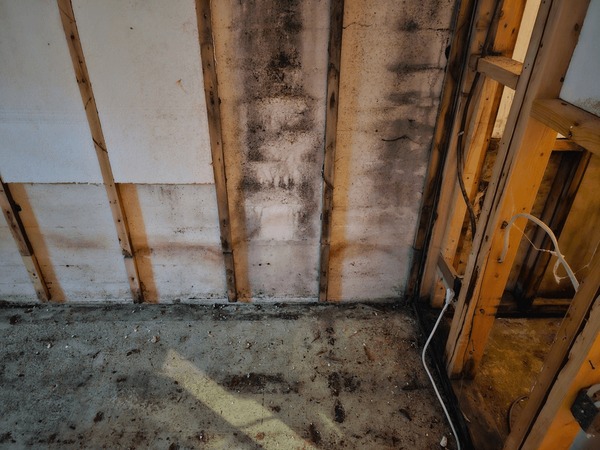
Learn the signs of mold and hidden moisture behind finished basement walls, including musty odours, swollen baseboards and stains.
A finished basement can look clean, dry and comfortable while moisture collects behind the walls.
Drywall hides the foundation. Baseboards cover the wall-floor joint. Insulation can hold dampness. Paint may delay visible staining. By the time mold appears on the room side, the concealed side of the wall may have been damp for weeks.
In Toronto homes, the first warning sign is often not visible mold. It may be a musty smell near one wall, a swollen baseboard, bubbling paint or a strip of carpet that feels cooler than the rest.
This article focuses on finished basement wall assemblies. For a broader overview of basement growth, visible colonies, health concerns and removal basics, read our guide to general signs and risks of basement mold.
Here, we are looking at a more specific problem: hidden moisture behind finished basement walls.
What Are the Signs of Mold Behind Finished Basement Walls?
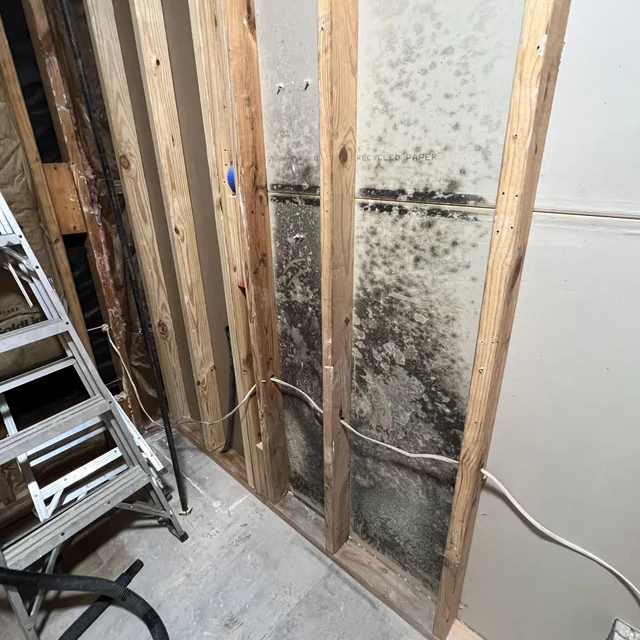
Common warning signs include:
- a recurring musty or earthy odour
- paint that bubbles, blisters or peels
- yellow, brown or grey wall staining
- soft or swollen drywall
- warped baseboards or trim
- damp carpet along an exterior wall
- raised laminate joints or loose vinyl flooring
- rust around drywall screws or metal corner bead
- condensation near outlets or cold wall sections
- visible mold returning after surface cleaning
- allergy or asthma symptoms that feel worse in the basement
- moisture-meter readings that stay elevated in one wall area
One sign alone does not prove there is mold.
Several signs in the same section of wall suggest that moisture is trapped behind the finish and should be investigated.
Why Finished Basement Walls Can Hide Mold
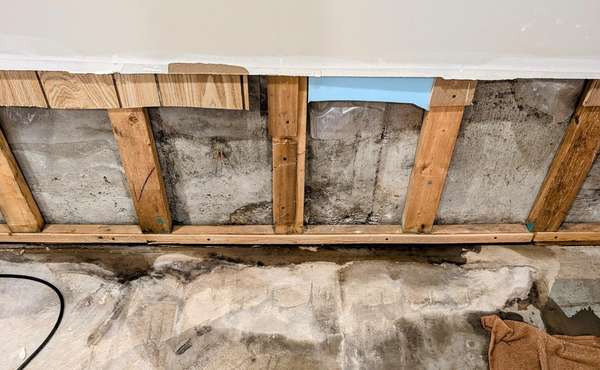
An unfinished basement gives you visual access to the foundation. You can often see cracks, damp concrete, efflorescence, seepage or staining.
A finished basement covers those clues.
A typical finished basement wall may include:
- concrete or block foundation
- damp-proofing or waterproofing material
- framing
- batt, rigid-board or spray-foam insulation
- vapour-control layers
- drywall
- paint, wallpaper or decorative panels
- baseboards and finished flooring
Moisture can enter or become trapped at several points in this wall system.
The room-facing drywall may look dry while the back of the drywall, paper facing, wood framing or insulation remains damp. This is why hidden wall mold can be difficult to confirm from appearance alone. For a broader look at wall-cavity warning signs throughout the home, see our guide to signs of mold behind drywall in other areas of the home.
Mold needs moisture and a food source. Drywall paper, dust, wood framing and some insulation facings can provide enough organic material for growth when the area stays damp.
The Most Important Warning Sign: A Persistent Musty Smell
A musty, earthy or damp-clothing smell often appears before visible mold.
Pay attention to where the smell is strongest.
If the odour is strongest near the baseboard
This may point to:
- moisture at the wall-floor joint
- a damp bottom plate
- wet carpet tack strips
- seepage at the foundation/slab joint
- water trapped under laminate, vinyl or carpet
If the odour is strongest near a corner
This may involve:
- a cold exterior corner
- missing or compressed insulation
- condensation behind furniture
- an exterior grading issue
- a foundation crack near the corner
If the odour gets worse after rain or snowmelt
This pattern suggests water entry from outside.
Possible sources include:
- poor grading
- short downspouts
- clogged eavestroughs
- saturated soil beside the home
- cracked foundation walls
- window-well leakage
- failed exterior waterproofing
If the odour gets stronger when the HVAC system runs
Air movement may be pulling smell from:
- an open wall cavity
- a damp return-air pathway
- a rim-joist area
- a mechanical room
- contaminated materials near ducts
A dehumidifier may reduce the smell temporarily. That does not mean the wall is dry. It may only mean the room air is drier.
Paint Bubbles, Blisters or Peels From the Wall
Paint failure is one of the clearest room-side signs of moisture movement.
Look for:
- small blisters under the paint film
- peeling near drywall seams
- flaking close to the floor
- wallpaper lifting at an edge
- paint that feels soft or rubbery
- repeated paint failure after repainting
Moisture behind paint weakens the bond between the coating and the drywall paper. It can also carry mineral salts from masonry into the finish layer.
Painting over the area is not a repair. It hides a symptom.
If paint keeps failing in the same spot, the wall should be checked for hidden dampness before cosmetic repairs continue.
Drywall Feels Soft, Swollen or Crumbly
Drywall should feel firm.
Warning signs include:
- a soft lower edge
- swollen seams
- paper separating from the gypsum core
- crumbling around baseboard nails
- dents from light pressure
- sagging between studs
- a wall surface that feels uneven or puffy
Damage near the floor often points to seepage, slab moisture or water travelling along the wall-floor joint.
Damage higher on the wall may suggest a plumbing leak, foundation crack, window leak or condensation zone.
Do not push hard into suspect drywall. Damaged material can release dust and fungal particles if disturbed.
Baseboards Begin to Warp or Pull Away
Baseboards often reveal basement wall moisture before the drywall does.
Watch for:
- swollen MDF trim
- joints that no longer meet
- paint cracking along the top edge
- dark staining on the bottom edge
- caulking that keeps splitting
- trim pulling away from the wall
- rusty finishing nails
MDF baseboard swells quickly when it absorbs moisture. Solid wood may cup, stain or separate at the joints.
The damaged trim may only be the visible end of the problem. Moisture may also be affecting the drywall edge, bottom plate, insulation or flooring behind it.
Carpet Feels Damp or Cool Along One Wall
A narrow damp strip along an exterior basement wall can be easy to miss.
Check for:
- carpet that feels cool near the perimeter
- darkened carpet backing
- deteriorated underpad
- rusted tack strips
- staining that follows the wall
- a musty smell when the carpet edge is lifted
Moisture may be entering at the foundation-wall joint, then moving into the underpad and base of the finished wall.
A cool surface does not always mean water is present. It can also be caused by air leakage or missing insulation. But a cool strip with odour, staining or elevated moisture readings deserves closer inspection.
Laminate, Vinyl or Engineered Flooring Starts to Move
Finished basement flooring can hide moisture that began beside or behind a wall.
Warning signs include:
- raised laminate joints
- curling vinyl edges
- loose adhesive
- darkened flooring near the perimeter
- hollow sounds under a floating floor
- repeated buckling or gaps
- moisture under underlayment
Flooring damage along one wall may not be a flooring issue. It may be a wall-cavity moisture issue showing up at the floor surface.
Stains Appear Without an Obvious Leak
Hidden basement wall moisture can cause:
- yellow or brown water marks
- grey shadowing
- black spotting
- irregular tide lines
- staining around fasteners
- discolouration near outlets
- a darker band above the baseboard
The shape of the stain matters.
A horizontal stain near the floor may suggest seepage, past flooding or moisture trapped behind the baseboard.
A vertical stain may follow a plumbing line, stud, foundation crack or window leak.
An isolated stain may relate to a pipe fitting, fastener, small condensation point or exterior defect.
Not every dark mark is mold. Dust, soot, adhesive bleed and mineral deposits can look similar. The moisture history matters.
Mold Keeps Returning After Surface Cleaning
Recurring growth is a moisture-source warning.
A homeowner may wipe a dark patch, repaint the wall and see the same pattern return weeks later.
That usually means one of these problems remains:
- the drywall is still damp
- growth exists on the back side of the board
- insulation is contaminated
- a plumbing leak continues
- foundation seepage is still active
- condensation is still forming inside the wall
- porous material cannot be cleaned properly
Surface cleaning cannot correct hidden moisture.
If mold returns after cleanup, the question should not be “what stronger product should I use?”
The better question is:
Where is the moisture coming from?
Electrical Outlets Feel Drafty, Damp or Musty
Outlets and switches create small openings into the wall cavity.
They may reveal:
- cold air movement
- musty odour
- condensation
- staining around the cover plate
- rust on metal components
- damp drywall nearby
Do not remove electrical devices or probe into a live box. Water and electrical components should be handled carefully.
A musty outlet does not always mean mold is centred at that outlet. It may simply be the place where cavity air is escaping into the room.
The Wall Feels Colder Than Nearby Areas
A cold wall section can indicate:
- missing insulation
- compressed batt insulation
- air leakage
- thermal bridging
- a cold foundation surface
- damp materials
- rim-joist gaps
Warm indoor air can release moisture when it touches a cold surface. In a basement, that cold surface may be the foundation wall, framing, vapour-control layer or back of the drywall.
This is especially common during Toronto winters. Heated indoor air meets cold below-grade surfaces, and hidden condensation can form without a visible leak. For more detail on this mechanism, read our article on how winter condensation develops inside wall cavities.
The Three Main Moisture Sources Behind Finished Basement Walls
Finding mold is only part of the job.
You also need to find the moisture pathway.
1. Foundation water entry
Common entry points include:
- foundation cracks
- form-tie holes
- porous concrete or masonry
- the cove joint where the wall meets the slab
- basement windows
- service penetrations
- failed waterproofing
- saturated soil beside the house
Clues include:
- damage that worsens after rain
- spring recurrence during snowmelt
- staining near the floor
- dampness on one exterior-facing wall
- efflorescence on exposed concrete
- peeling finishes near a foundation crack
Efflorescence is a white, powdery mineral deposit. It is not mold. But it can show that water has moved through masonry.
2. Plumbing or mechanical leakage
Possible sources include:
- water supply lines
- drain lines
- laundry connections
- bathroom plumbing
- hose bibs
- condensate lines
- water heaters
- boilers
- humidifiers
- air-conditioning components
Clues include:
- damage unrelated to weather
- one concentrated wet area
- staining below a bathroom or kitchen
- moisture after a fixture is used
- dripping sounds
- unexplained water use
A pipe leak may appear several feet from the actual failure point. Water follows framing, gravity and the path of least resistance.
3. Condensation inside the wall assembly
Condensation forms when humid air reaches a cold surface.
Risk factors include:
- insulation gaps
- air leakage
- poorly sealed rim joists
- damp indoor air
- furniture placed tightly against cold walls
- low airflow
- intermittent heating
- wall systems that cannot dry
Clues include:
- seasonal recurrence
- diffuse moisture rather than one wet point
- staining along studs or corners
- dampness without rain
- colder wall temperatures
- mold behind insulation or drywall
Condensation and seepage can also happen together. A damp foundation makes the wall cavity colder and wetter, which increases the chance of more condensation.
Why Toronto Finished Basements Are Vulnerable
Toronto basements face several moisture pressures at once.
Freeze-thaw cycles can enlarge small cracks or change drainage paths.
Spring snowmelt can saturate soil beside the foundation.
Summer humidity can enter a cool basement and condense on cold surfaces.
Older Toronto homes may have poured concrete, concrete block, stone or brick foundations. Previous repairs, older drainage systems and multiple renovations can make the moisture path harder to trace.
Many finished basements were renovated before the moisture problem was corrected. Once framing, insulation and drywall were installed, the foundation lost some of its ability to dry toward the interior.
This is why winter inspections often uncover moisture that did not look serious during a summer renovation. For seasonal context, see our guide to winter conditions that increase hidden basement mold risk.
How to Check for Hidden Moisture Without Opening the Wall
Start with the least invasive steps.
Record the pattern
Write down:
- when the odour appears
- whether rain makes it worse
- whether the problem changes by season
- where stains first appeared
- which plumbing fixtures are nearby
- whether the basement has flooded before
Photos with dates can help show whether the problem is spreading.
Measure indoor relative humidity
Use a reliable digital hygrometer.
Health Canada recommends keeping indoor relative humidity in a reasonable range, often around 30 to 50 percent. In winter, the safe level may need to be lower to reduce condensation on cold surfaces.
A normal room reading does not rule out hidden moisture. A wall cavity can remain damp after the room air has dried.
Inspect exterior drainage
Check:
- grading around the foundation
- downspout discharge
- eavestrough condition
- window wells
- exterior cracks
- hose bibs
- irrigation patterns
- snow storage areas
A finished basement inspection should not stop at the interior wall. The water often begins outside.
Scan with a moisture meter
Moisture meters can help compare suspect areas with dry reference areas.
They do not detect mold directly.
They show moisture patterns that may require closer investigation.
Use thermal imaging carefully
An infrared camera can show surface-temperature differences linked to:
- missing insulation
- air leakage
- wet materials
- thermal bridging
- cold foundation areas
Thermal imaging does not see mold. It shows temperature patterns that must be interpreted with moisture readings and building conditions.
Inspect accessible openings
A professional may review:
- removable baseboards
- unfinished utility-room walls
- dropped-ceiling edges
- pipe penetrations
- return-air openings
- sump areas
- adjacent storage rooms
Electrical boxes should not be opened casually.
Consider a targeted inspection opening
When evidence strongly suggests hidden damage, a small controlled opening may provide better information than guessing.
A targeted opening can answer questions such as:
- Is the back of the drywall contaminated?
- Is the bottom plate wet?
- Is insulation holding moisture?
- Is water entering through a foundation crack?
- How far does the affected material extend?
Opening a suspect wall without containment can spread dust and spores. If the odour is strong or the affected area is large, get the area assessed first.
Can Air Testing Confirm Mold Behind a Basement Wall?
Air testing can be useful in some cases, but it has limits.
A sample reflects conditions at one place and one time. Results can change with ventilation, weather, cleaning, HVAC activity and occupant movement.
A normal air sample does not prove every wall cavity is dry.
In many finished basement cases, a building investigation is more useful than testing alone. If you are unsure whether sampling is needed, our guide on whether you need a mold inspection or laboratory testing explains when testing helps and when it can distract from the real moisture source.
Testing may be considered when:
- symptoms are reported without visible growth
- the source cannot be located
- documentation is needed
- contamination may have spread beyond the cavity
- post-remediation verification is required
Even then, the inspection should still focus on moisture, materials and the wall assembly.
Should You Cut Open the Wall Yourself?
Avoid exploratory demolition when:
- the odour is strong across a large area
- drywall is soft or badly stained
- the basement has flooded
- sewage may be involved
- visible mold is already widespread
- occupants have asthma, severe allergies or weakened immune systems
- electrical equipment is involved
- asbestos-containing materials may be present
- contamination may extend into HVAC pathways
A small stain can hide a larger affected area.
Removing drywall without containment can move particles into finished rooms.
What Professional Investigation May Include
A finished-basement assessment may include:
- water-history review
- exterior drainage review
- visual inspection of walls, trim and floors
- humidity and temperature measurements
- moisture mapping
- infrared scanning
- plumbing and mechanical review
- controlled access to selected wall cavities
- evaluation of drywall, framing and insulation
- identification of the contamination boundary
- a moisture-correction and remediation plan
The goal is not just to find a dark patch.
The goal is to connect visible symptoms to the hidden moisture source.
What Happens When Mold Is Confirmed Behind the Wall?
The response depends on the source, extent and material condition.
A typical process may include the following steps.
1. Stop the moisture source
This may require:
- plumbing repair
- foundation crack repair
- drainage correction
- window-well repair
- waterproofing
- air sealing
- insulation correction
- humidity control
- mechanical-system repair
2. Isolate the work area
Containment helps reduce the movement of dust and mold particles into occupied areas.
3. Remove unsalvageable porous materials
Affected drywall, insulation, fibreboard trim, carpet backing and similar porous materials may require removal.
Insulation deserves special attention because some types can trap moisture and contamination inside the wall cavity. Our article on what happens when basement insulation becomes contaminated explains how insulation type, moisture exposure and adjacent materials affect removal decisions.
4. Clean remaining structural surfaces
Exposed framing and other retained materials may be cleaned using methods suited to the surface and contamination level.
5. Dry the assembly
The wall cavity, slab edge and structural materials must be dry before reconstruction.
Rebuilding too soon can trap the same problem behind new finishes.
6. Verify the result
Verification may include:
- visual cleanliness
- removal of affected materials
- acceptable moisture readings
- confirmed source correction
- absence of residual dust
- independent testing when appropriate
7. Rebuild with moisture in mind
The replacement wall system should suit the actual foundation, drainage conditions and basement use.
Reinstalling the same wall over the same moisture source often recreates the same problem.
Why Bleach, Paint and Deodorizers Do Not Fix Hidden Wall Mold
These products may change the look or smell of the room without correcting the problem.
Bleach does not repair wet drywall.
Mold-resistant paint does not stop foundation seepage.
Stain-blocking primer can hide a water mark while the cavity remains damp.
Fragrance can mask the smell that helps locate the source.
A dehumidifier can help control room humidity, but it cannot fix an active leak or dry saturated materials inside a closed wall.
Hidden wall mold is not a surface-cleaning problem.
It is a moisture-control problem.
Health Concerns Associated With Damp and Moldy Basements
People respond differently to damp indoor environments.
Some people may experience nasal congestion, coughing, wheezing, eye irritation, skin irritation or worsening asthma symptoms. People with asthma, mold allergies, chronic lung disease or weakened immune systems may be more sensitive.
Symptoms alone cannot prove that mold is present behind a wall. Dust, pets, pollen, combustion by-products and other indoor contaminants can cause similar reactions.
If health symptoms are a concern, speak with a qualified healthcare professional and have the building assessed for dampness, water damage and hidden mold conditions.
How to Prevent Mold When Finishing or Rebuilding a Basement
A durable basement renovation starts with water management.
Correct exterior drainage first
Make sure:
- soil slopes away from the house
- eavestroughs are clear
- downspouts discharge away from the foundation
- window wells drain properly
- exterior cracks and penetrations are repaired
Address bulk water before finishing
Do not cover active seepage with framing and drywall.
Choose a suitable wall system
The right wall assembly depends on:
- foundation material
- exterior waterproofing
- drainage conditions
- insulation strategy
- vapour-control requirements
- indoor humidity
- drying potential
- Ontario Building Code requirements
Air-seal vulnerable areas
Rim joists, penetrations and transitions need careful attention.
Keep moisture-sensitive materials away from recurring dampness
The wall-floor joint is a common risk area.
Maintain reasonable humidity
Use a hygrometer. Run a dehumidifier when needed. Improve airflow in closed rooms and corners.
For a broader prevention checklist, see our guide to basement mold prevention measures.
Leave space behind furniture
Furniture pressed tightly against exterior basement walls can reduce airflow and create cool, stagnant pockets.
Inspect after heavy rain and spring thaw
Early detection can reduce the amount of material that needs to be removed.
When to Call Ultimate Mold Crew
A professional basement mold inspection is appropriate when:
- the musty odour persists
- drywall or trim is deteriorating
- moisture returns after cleaning
- the affected area is concealed
- the basement has flooded
- the source is unclear
- multiple rooms are involved
- occupants are sensitive to mold
- you plan to renovate a previously damp basement
Ultimate Mold Crew serves Toronto and the Greater Toronto Area. Our work focuses on finding the moisture source, defining the affected area and planning safe remediation.
For help with professional mold removal in Toronto, call 647-985-2739 or request an inspection through the Ultimate Mold Crew website.
Final Takeaway
Mold behind a finished basement wall rarely begins with a dramatic black patch.
It usually begins with moisture.
A slight odour appears. A baseboard swells. Paint lifts near the floor. Carpet feels cool beside one wall.
Each clue tells you how water, humidity and building materials are interacting behind the finish.
The earlier you investigate that pattern, the more likely you are to limit material damage.
Do not begin with the question, “What kills the mold?”
Begin with the question that actually solves the problem:
Where is the moisture coming from, and why can’t the wall dry?
Once that answer is clear, the repair becomes safer, more accurate and more durable.
Frequently Asked Questions
Can mold grow behind finished basement walls without visible water?
Yes. Mold can grow when drywall, framing, dust or insulation stays damp, even if no liquid water is visible in the room.
What does mold behind a basement wall smell like?
It often smells musty, earthy, stale or like damp fabric. The smell may be strongest near baseboards, outlets, corners or after rainfall.
Does a musty basement always mean mold is behind the walls?
No. Drains, damp carpet, stored cardboard and soil gases can create similar odours. But a persistent earthy smell with staining, swelling or elevated moisture readings should be investigated.
Can a moisture meter detect mold behind drywall?
No. A moisture meter detects moisture conditions. It does not identify mold. Abnormal readings can help locate areas that need closer inspection.
Can thermal imaging see mold behind a wall?
No. Thermal imaging shows temperature differences. These patterns may suggest wet materials, missing insulation or air leakage, but they do not confirm mold.
Should I remove a baseboard to check for mold?
Sometimes it can reveal useful evidence. But if the odour is strong, damage is widespread or sensitive occupants are present, avoid disturbing the area without containment.
Is mold near the bottom of a basement wall usually caused by the foundation?
Foundation seepage is one possibility. Other causes include slab moisture, flooding, wet flooring, a plumbing leak or condensation near the lower wall.
Can a dehumidifier dry moisture trapped behind drywall?
It may help with minor moisture if the cavity can dry to the room. It will not reliably dry saturated insulation, stop seepage or repair a pipe leak.
Can I paint over a basement wall once the stain dries?
Only after the source has been corrected, damaged material has been addressed and the wall is fully dry. Painting too soon can hide continuing damage.
Does all moldy drywall need to be removed?
Not always. The decision depends on extent, depth, material condition and moisture source. Soft, deteriorated or moldy drywall backing often requires removal.
How quickly can mold grow after a basement wall gets wet?
Mold can begin growing quickly when moisture and suitable materials are present. Wet materials should be dried as soon as possible.
Is hidden basement mold dangerous?
Damp and moldy environments can affect indoor air quality and may worsen respiratory or allergy symptoms in some people. Risk varies by person and exposure.
Should mold behind a finished wall be tested before removal?
Not always. Visible damage, odour and confirmed moisture may be enough to plan corrective work. Testing is more useful when the source, extent or documentation requirements are unclear.
Will mold return after the basement wall is rebuilt?
It can return if the original moisture source remains. Successful rebuilding requires source correction, dry materials and a wall system suited to below-grade conditions.
Sources
- Health Canada, Guide to Addressing Moisture and Mould Indoors
https://www.canada.ca/en/health-canada/services/publications/healthy-living/addressing-moisture-mould-your-home.html - Health Canada, Mould
https://www.canada.ca/en/health-canada/services/air-quality/indoor-air-contaminants/reduce-humidity-moisture-mould.html - Health Canada, Improve Indoor Air Quality in Your Home
https://www.canada.ca/en/health-canada/services/air-quality/improve-indoor-air-quality-in-your-home.html - Health Canada, Residential Indoor Air Quality Guideline: Moulds
https://www.canada.ca/en/health-canada/services/publications/healthy-living/residential-indoor-air-quality-guideline-moulds.html - Canada Mortgage and Housing Corporation, Mould in Housing
https://www.cmhc-schl.gc.ca/professionals/industry-innovation-and-leadership/industry-expertise/indigenous-housing/develop-manage-indigenous-housing/maintenance-solutions/mould-in-housing - US Environmental Protection Agency, A Brief Guide to Mold, Moisture and Your Home
https://www.epa.gov/mold/brief-guide-mold-moisture-and-your-home - US Environmental Protection Agency, Mold Cleanup in Your Home
https://www.epa.gov/mold/mold-cleanup-your-home - Centers for Disease Control and Prevention, Mold
https://www.cdc.gov/mold-health/about/index.html - National Institute for Occupational Safety and Health, Mold
https://www.cdc.gov/niosh/mold/about/index.html
