
Updated on 15-Jun-2026
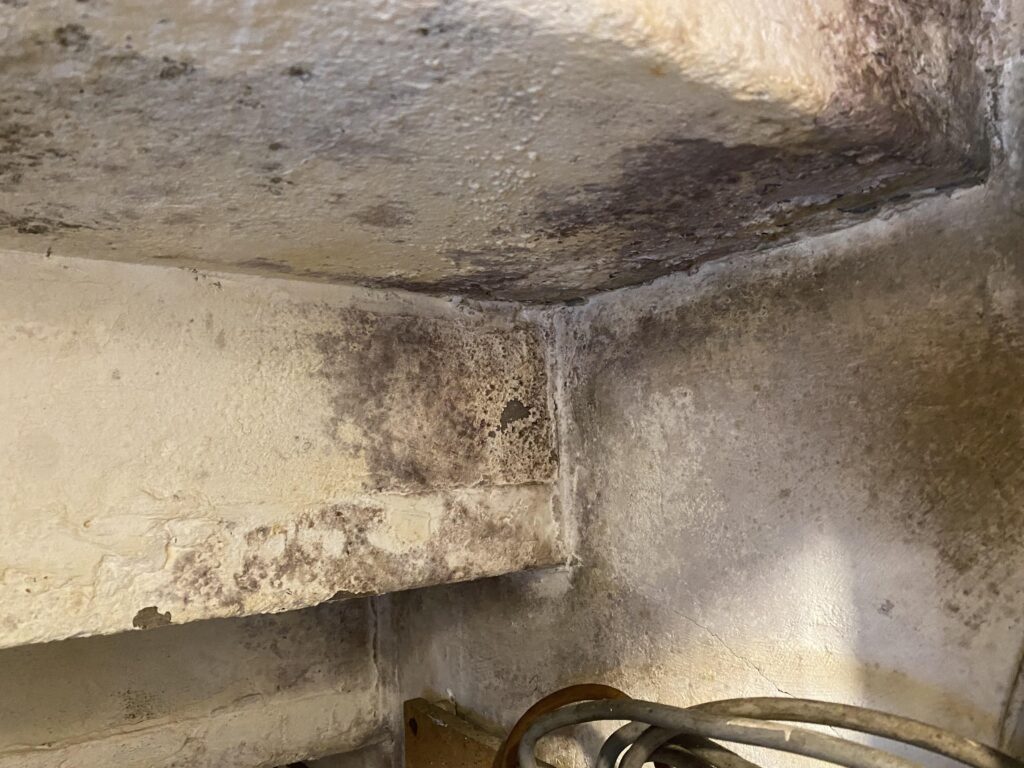
The space beneath a basement staircase often looks useful.
It may hold holiday decorations, tools, luggage, paint cans, old books or household supplies. A door closes. The contents disappear from view. The area may not be opened again for months.
That convenience can create a hidden moisture problem.
Enclosed under-stair storage often has little air movement. One side may sit against a cold foundation wall. Plumbing may run overhead. Cardboard boxes may rest directly on concrete. Finished walls can hide seepage, condensation or a small leak.
Mold can develop long before anyone sees it.
In many homes, the first warning is not a visible patch. It is a musty smell that becomes stronger when the storage door opens.
Table of Contents
Key Takeaways
- Mold beneath stairs is usually a moisture and airflow problem, not a housekeeping problem.
- Cool foundation walls can create condensation inside enclosed basement compartments.
- Cardboard, paper, fabric, drywall and unfinished wood provide surfaces on which mold can grow.
- Stored contents can conceal mold on walls, floors, stair stringers and the backs of shelves.
- A dry-looking room does not prove that the enclosed storage cavity is dry.
- Cleaning visible spots will not work if seepage, condensation or leakage continues.
- Moldy porous contents may be difficult or impossible to restore.
- Structural stair components can often be retained if they remain sound and can be cleaned and dried.
- Large, hidden or recurring contamination should be assessed before shelving or finishes are replaced.
Why Does Mold Grow Under Basement Stairs?
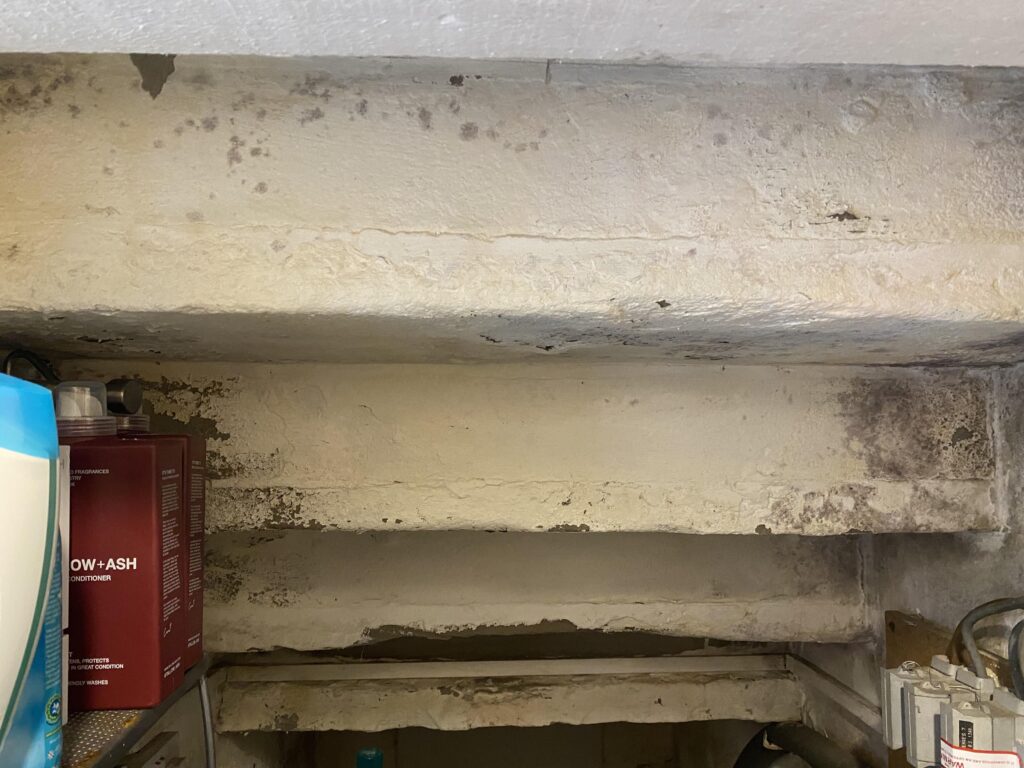
Mold requires moisture.
The area beneath a basement staircase can retain that moisture because several building conditions overlap in a small enclosure.
The Space Has Very Little Air Movement
Under-stair compartments are commonly built with:
- A solid door
- Drywall on both sides
- Plywood or drywall beneath the stair treads
- Built-in shelving
- No supply-air register
- No return-air opening
- No dedicated exhaust
- Few gaps through which air can circulate
Warm basement air may enter when the door opens. Once the door closes, the air inside becomes stagnant.
Any damp surface then dries more slowly.
The Canadian Centre for Occupational Health and Safety identifies excess humidity, plumbing leaks, basement leakage and sealed spaces that prevent moisture from escaping as common conditions associated with indoor mold.
A Foundation Wall May Form One Side of the Compartment
Below-grade concrete and masonry stay cooler than the indoor air during much of the year.
When warm, humid air reaches a cool wall, the surface temperature can fall below the air’s dew point. Water vapour then condenses into liquid moisture.
The problem may be worse behind:
- Stored boxes
- Shelving pressed against the wall
- Fibreglass insulation
- Wood framing
- Drywall
- Polyethylene sheeting
- Cabinets
- Fabric bins
The visible side of the room may feel comfortable while the air trapped behind the contents remains cool and damp.
Water Can Enter Through the Foundation
Moisture may move through or around a foundation because of:
- Cracks
- Porous masonry
- Failed exterior waterproofing
- Poor grading
- Blocked eavestroughs
- Downspouts discharging near the house
- Window-well leakage
- High groundwater
- Snowmelt
- Heavy rainfall
- A leaking basement window
A wet mark may appear only near the floor. The actual moisture path can extend behind the entire stair enclosure.
Plumbing May Be Hidden Above or Beside the Stairs
Basement stairwells are often located near:
- Bathrooms
- Kitchens
- Laundry rooms
- Mechanical spaces
- Water meters
- Supply pipes
- Drain stacks
- Hose connections
A minor plumbing leak can wet the underside of the stairs or the wall cavity without producing a visible puddle.
Pipe condensation can also drip onto wood, drywall or stored contents.
Concrete Floors Can Transfer Moisture to Stored Materials
Cardboard boxes placed directly on a basement slab can absorb moisture from:
- Condensation
- Minor seepage
- Floor washing
- Past flooding
- Capillary moisture
- Small plumbing leaks
The bottom of the box may become moldy while the top remains dry.
Health Canada specifically recommends using lidded plastic bins instead of cardboard for basement storage and advises against placing cardboard boxes directly on a basement floor.
Stored Contents Block Drying
A packed storage area creates many small, poorly ventilated pockets.
Air cannot circulate behind stacked containers or between shelves and walls. Dust, paper fibres, fabric and wood provide additional material that can support growth when dampness persists.
The more tightly the area is packed, the harder it becomes to notice staining, leaks or odours early.
Why Under-Stair Mold Is Easy to Miss
An enclosed staircase creates layers.
What appears to be one small closet may contain:
- Finished wall surfaces
- Framing cavities
- Stair stringers
- Tread undersides
- Risers
- Plywood
- Insulation
- Foundation masonry
- Plumbing penetrations
- Electrical wiring
- Shelves
- Stored contents
Mold may develop on a surface that cannot be seen from the doorway.
Common hidden locations include:
- Behind the lowest boxes
- Along the rear foundation wall
- Beneath plywood shelving
- On the back of drywall
- Inside the wall beside the staircase
- Under stair treads
- Along wooden stringers
- At the bottom wall plate
- Behind insulation
- Around pipe penetrations
- Beneath carpet or vinyl flooring
- Inside luggage and fabric bags
Health Canada notes that mold can grow on wood, paper, fabric, drywall and insulation. It may also remain concealed inside walls or above finished surfaces.
Signs of Mold Under Basement Stairs
Visible growth is only one clue.
Look for a combination of moisture, odour and material damage.
A Musty Smell
A stale, earthy or cellar-like smell is often the first sign.
The odour may:
- Become stronger when the door opens
- Remain on items removed from storage
- Return after air fresheners are used
- Seem worse during humid weather
- Spread into the stairwell or nearby room
A musty smell does not identify the mold species or the exact contaminated surface. It does justify a closer moisture investigation.
Spots or Discolouration
Mold may appear:
- Black
- White
- Grey
- Green
- Brown
- Yellow
- Powdery
- Fuzzy
- Speckled
- Irregularly stained
Colour alone cannot establish whether a substance is hazardous or determine which mold is present.
White residue on concrete may also be efflorescence, a mineral deposit left when moisture evaporates. The moisture source still requires attention even when the residue is not mold.
Damp or Soft Drywall
Check for:
- Swelling
- Crumbling edges
- Softness
- Peeling paint
- Bubbling
- Brown staining
- Loose tape
- Rusted fasteners
- Deteriorated baseboards
Damage near the bottom of the wall often suggests seepage, floor moisture or a previous water event.
Mold on Cardboard and Paper
Mold may first appear on stored contents rather than on the building.
Affected items can include:
- Moving boxes
- Books
- Documents
- Photographs
- Gift wrap
- Paper decorations
- Puzzles
- Board games
- Product packaging
Cardboard can also conceal growth on the floor or wall behind it.
Mold on Fabric and Leather
Inspect:
- Coats
- Shoes
- Luggage
- Upholstery
- Blankets
- Seasonal clothing
- Sports equipment
- Fabric storage cubes
A white or green surface bloom may form when these items absorb moisture from humid basement air.
Rust or Corrosion
Rust on tools, shelving brackets, fasteners or paint cans suggests that the compartment has experienced sustained humidity or condensation.
Corrosion does not prove mold is present, but it is a useful moisture indicator.
Insects or Deteriorated Wood
Moisture that supports mold may also contribute to:
- Wood decay
- Insect activity
- Delamination
- Soft plywood
- Splitting
- Loose stair components
Structural damage should be assessed separately from surface mold.
The Toronto Basement Moisture Pattern
Toronto homes experience large seasonal changes.
Summer air can carry significant moisture. When that humid air enters a cool basement, relative humidity rises. Condensation may develop on concrete, cold-water pipes and other cool surfaces.
Winter creates a different pattern.
Indoor air can condense inside poorly insulated foundation assemblies or around thermal bridges. Snow accumulation and spring thaw can also reveal drainage or waterproofing defects.
Older Toronto houses may have:
- Rubble, brick or concrete-block foundations
- Finished basements added long after construction
- Limited exterior waterproofing
- Narrow side yards
- Shared drainage constraints
- Older clay drains
- Stair enclosures built tightly against masonry
- Storage rooms without mechanical ventilation
These conditions do not guarantee mold. They do make moisture monitoring important.
The City of Toronto advises residents to avoid prolonged indoor dampness and excessive humidity as part of mold prevention. Health Canada recommends maintaining home relative humidity around 30 to 50 percent and correcting leaks, infiltration and flooding promptly.
Mold Beneath Finished Basement Stairs
Finished stairs can hide more damage than open wooden stairs.
The underside may be enclosed with drywall or plywood. The adjacent wall may contain insulation and a vapour-control layer. Carpet may cover the treads. Baseboards may conceal the floor-to-wall joint.
A small stain at the storage-room entrance may represent a larger concealed area.
Possible moisture paths include:
- Water enters through the foundation.
- Insulation or framing becomes damp.
- Drywall prevents the surface from drying inward.
- Stored boxes reduce air movement.
- Mold develops on the drywall backing, wood or paper-faced insulation.
- Odour escapes through gaps around the door or trim.
Painting the visible surface does not correct this sequence.
Wet or mold-affected materials should not be enclosed, sealed or painted before the moisture condition has been corrected and the material has been evaluated.
Mold on Stair Stringers, Treads and Risers
A staircase normally contains several wooden components:
- Stringers: inclined structural boards that support the steps
- Treads: horizontal walking surfaces
- Risers: vertical boards between treads
- Posts and blocking: supporting members
- Plywood or drywall soffit: finish beneath the staircase
Mold on structural wood does not automatically mean the stairs require replacement.
Wood can often remain when it is:
- Structurally sound
- Free from advanced decay
- Accessible for cleaning
- Capable of being dried
- Not permanently contaminated by sewage or another hazardous source
Replacement may be necessary when the wood is:
- Soft
- Rotted
- Delaminated
- Structurally weakened
- Cracked because of prolonged deterioration
- Inaccessible without disassembly
- Contaminated beyond reliable cleaning
A carpenter or structural professional may need to assess load-bearing damage. Mold remediation and structural repair are related tasks, but they are not the same service.
Can Belongings Stored Under the Stairs Be Saved?
Salvage depends on the material, extent of growth, water source and value of the item.
Non-Porous Items
Items made from glass, hard plastic or metal may often be cleaned when they remain physically intact.
Examples include:
- Plastic storage bins
- Glassware
- Metal tools
- Sealed containers
- Some household appliances
Contents must be cleaned without spreading spores into unaffected rooms.
Semi-Porous Items
Finished wood, sealed leather and some coated surfaces may be restorable after careful assessment.
The result depends on whether mold has entered:
- Joints
- Cracks
- Unfinished edges
- Linings
- Padding
- Hidden cavities
Porous Items
Porous materials are more difficult to restore because growth can penetrate below the surface.
These include:
- Cardboard
- Paper
- Carpet
- Upholstery
- Unfinished particleboard
- Fibreboard
- Ceiling tile
- Insulation
- Some fabrics
- Stuffed toys
- Mattresses
The EPA notes that mold can fill the crevices and internal spaces of porous materials, making complete cleaning difficult or impossible in some cases.
Important or Irreplaceable Items
Do not automatically discard:
- Family photographs
- Legal documents
- Archival records
- Artwork
- Antiques
- Sentimental objects
Conservators and specialized contents-restoration providers may be able to stabilize valuable materials.
Store affected items away from clean contents until a salvage plan is established.
Should Everything Be Removed From the Storage Area?
The space usually needs to be emptied before a complete inspection.
Do not carry visibly moldy boxes through the home while open.
A controlled contents-removal process may involve:
- Photographing the area before disturbance
- Wearing suitable protective equipment
- Closing or wrapping affected boxes
- Separating clean, questionable and unsalvageable items
- Moving contents through a planned route
- Cleaning reusable containers
- Discarding contaminated porous packaging
- Inspecting the floor and wall after each layer is removed
When significant mold is visible, casual sorting can release dust and spores into nearby living spaces.
Is Mold Testing Necessary?
Not every under-stair mold problem requires laboratory testing.
Testing may add little value when:
- Mold is already visible
- The moisture source is known
- The contaminated materials clearly require removal
- The remediation scope will not change based on species
The practical priorities are to:
- Find the moisture source.
- Determine how far the damage extends.
- Remove or clean affected materials.
- Dry the remaining assembly.
- Prevent recurrence.
Testing may be useful when:
- A persistent odour has no visible source
- Occupants report concerns in multiple rooms
- The extent of hidden contamination is uncertain
- Documentation is required
- A property transaction is involved
- A landlord, insurer or consultant requests evidence
- Post-remediation verification is appropriate
No single air sample can prove that a concealed stair cavity is free from mold. Inspection and moisture assessment remain essential.
How the Area Should Be Inspected
A useful inspection moves from the least invasive step to more targeted access.
1. Inspect the Contents
Look at the bottoms, backs and undersides of boxes, shelves and stored items.
This can reveal the direction from which moisture entered.
2. Inspect the Floor-to-Wall Joint
Pay close attention to:
- Dampness
- Efflorescence
- Cracks
- Peeling coatings
- Darkened wood
- Swollen baseboards
- Insect debris
- Musty odour
3. Check the Foundation Wall
Visible concrete should be assessed for:
- Water staining
- Active seepage
- Condensation
- Cracks
- Mineral deposits
- Previous patching
- Damp insulation
4. Check Plumbing and Mechanical Lines
Inspect:
- Cold-water pipes
- Drain connections
- Shutoff valves
- Condensate lines
- Laundry connections
- Bathroom plumbing above
- Water-meter assemblies
Wet pipe insulation can hide condensation or leakage.
5. Take Moisture Readings
Moisture meters can help compare suspect materials with dry reference areas.
Readings require interpretation. Metal fasteners, material density and meter settings can influence results.
6. Use Thermal Imaging as a Screening Tool
An infrared camera can identify temperature differences that may suggest:
- Missing insulation
- Cool foundation sections
- Potential moisture
- Air leakage
- Plumbing anomalies
Thermal imaging does not detect mold directly. A suspected anomaly should be checked with another method.
7. Create a Controlled Inspection Opening
A small opening may be required when:
- Odour persists
- Moisture readings remain high
- The wall is visibly damaged
- Growth appears along trim or seams
- Insulation is suspected to be wet
- A plumbing or foundation leak is concealed
The opening should be planned to avoid wiring, pipes and unnecessary contamination.
Can a Homeowner Clean Mold Under the Stairs?
A small, accessible patch on a cleanable surface may sometimes be handled by the homeowner after the moisture source has been corrected.
DIY cleaning becomes less appropriate when:
- The mold is behind drywall or insulation
- Several surfaces are affected
- Stored contents are extensively contaminated
- The area is difficult to ventilate
- Demolition is required
- Mold is growing on the stair structure
- Sewage or contaminated water was involved
- The growth returns after cleaning
- Occupants have asthma, significant allergies or weakened immunity
- The affected area connects to the HVAC system
- The source remains unknown
The physical size of the visible patch can be misleading.
A small spot at the edge of drywall may be the accessible part of a larger concealed colony.
What Not to Do
Do Not Spray Bleach Into the Enclosure
Bleach is not a substitute for moisture correction, material removal or proper cleaning.
Applying liquid to porous drywall, wood or cardboard may add moisture without reaching growth beneath the surface.
Do Not Dry-Brush Mold Indoors
Dry brushing can release spores and contaminated dust.
Do Not Place a Fan Directly in Front of Visible Growth
Uncontrolled air movement can distribute particles into the basement and stairwell.
Do Not Cover the Area With New Shelving
Shelving can conceal the warning signs and reduce access for future inspection.
Do Not Repaint Before the Wall Is Dry
Stain-blocking primer hides marks. It does not resolve wet drywall, contaminated backing paper or damp insulation.
Do Not Rely on Charcoal or Odour Absorbers
Activated carbon may reduce some odours temporarily. It does not remove colonies or stop water entry.
Do Not Seal Moldy Belongings in the Same Compartment
A closed plastic bin can protect clean, dry contents from basement air. It should not be used to hide damp or moldy items without cleaning and drying them first.
How Professional Remediation Is Performed
The exact scope depends on the stair construction and moisture source.
A typical project may include the following stages.
Moisture-Source Investigation
The contractor identifies whether the moisture came from:
- Foundation seepage
- Condensation
- Plumbing leakage
- Flooding
- Floor moisture
- An exterior drainage defect
- A combination of conditions
The source may need to be corrected by a plumber, waterproofing contractor, HVAC technician, roofer or drainage specialist.
Contents Management
Items are classified as:
- Unaffected
- Cleanable
- Restorable by a specialist
- Unsalvageable
Clean contents are protected from the work area.
Containment
Containment helps separate the under-stair work zone from the occupied basement.
The scope may use:
- Polyethylene barriers
- Sealed access
- Negative air pressure
- HEPA-filtered air filtration
- Covered floor paths
The EPA describes limited and full containment approaches based on the extent and circumstances of contamination.
Selective Demolition
Affected porous materials may include:
- Drywall
- Insulation
- Particleboard shelving
- Carpet
- Underpad
- Fibreboard
- Damaged trim
- Contaminated cardboard
Removal should expose enough of the assembly to clean and dry the remaining materials.
Cleaning Structural Surfaces
Sound framing, stair components and masonry may be cleaned using methods appropriate to the material and contamination.
The process may involve:
- HEPA vacuuming
- Controlled surface cleaning
- Mechanical abrasion where justified
- Detailed dust removal
- Drying
Simply staining or coating dirty wood is not remediation.
Structural Drying
The area must be dry before reconstruction.
Drying may require:
- Dehumidification
- Controlled air movement
- Heating
- Pipe insulation
- Additional access
- Moisture monitoring
Water-damaged materials should be dried quickly, ideally within 24 to 48 hours, to reduce the likelihood of mold development.
Final Inspection
The final review should confirm that:
- The moisture source was addressed
- Unsalvageable materials were removed
- Remaining surfaces were cleaned
- Dust and debris were removed
- Materials reached acceptable drying conditions
- The area is ready for reconstruction
- Storage practices will not recreate the original problem
Post-remediation sampling may be included when it forms part of the project plan or verification criteria.
When Drywall Must Be Removed
Drywall beneath or beside the stairs is more likely to require removal when it is:
- Soft
- Swollen
- Crumbling
- Delaminated
- Visibly moldy
- Musty after attempted drying
- Wet for an unknown period
- Contaminated by dirty water
- Concealing wet insulation
- Preventing the framing from drying
A small, recent clean-water event may not require wholesale demolition if the material remains intact and can be dried reliably.
The decision should be based on material condition, contamination and moisture, not on staining alone.
When Insulation Must Be Removed
Insulation may need to come out when it is:
- Saturated
- Moldy
- Compressed
- Dirty
- Musty
- Contaminated by sewage or drain water
- Blocking access to wet framing
- Trapping moisture against the foundation
- Installed in a way that prevents the assembly from drying
Fibreglass itself does not provide much food for mold, but dust, binders, paper facings and adjacent building materials can become contaminated.
Cellulose and other paper-based insulation are more difficult to restore after prolonged wetting.
Preventing Mold From Returning
Remediation will not last unless the under-stair microclimate changes.
Keep Relative Humidity Under Control
Use a hygrometer near the storage area.
Health Canada recommends maintaining indoor relative humidity around 30 to 50 percent. A dehumidifier may be needed during humid months. Keep basement windows closed while the machine is operating so it treats indoor air rather than continuously drawing in humid outdoor air.
Improve Air Exchange
Depending on the construction, improvements may include:
- A louvred door
- Transfer grilles
- Gaps beneath the door
- Connection to the conditioned basement
- A small circulation strategy designed for the space
- Removal of unnecessary wall enclosures
Ventilation should not be added blindly when the enclosure contains an unresolved foundation leak or contaminated materials.
Leave Space Around Stored Contents
Maintain clearance:
- Between bins and exterior walls
- Beneath shelving
- Around plumbing
- Near floor drains
- Around inspection points
- Between stacked containers
The goal is to permit inspection and airflow.
Use Plastic Bins With Lids
Plastic bins protect clean contents better than cardboard.
They should still be:
- Dry before closing
- Raised slightly off the slab
- Labelled
- Inspected periodically
- Kept away from damp foundation walls
Install Raised Shelving
Shelving should not trap materials directly against concrete.
Choose a layout that permits:
- Floor inspection
- Wall inspection
- Air circulation
- Access to plumbing
- Cleaning after minor water events
Correct Exterior Drainage
Check that:
- Eavestroughs are clear
- Downspouts discharge away from the foundation
- Soil slopes away from the house
- Window wells drain
- Foundation cracks are assessed
- Snow is not piled against vulnerable walls
Insulate Cold-Water Pipes
Pipe insulation can reduce surface condensation.
Wet, damaged or poorly fitted pipe insulation should be replaced after the pipe has been checked for leaks.
Inspect the Area Seasonally
Open and empty sections of the compartment at least a few times each year.
Good inspection times include:
- After spring thaw
- After major rain
- During humid summer weather
- Before placing seasonal items into storage
- After any plumbing repair
- After a basement flood or sewer backup
Do Not Store Damp Items
Never place wet footwear, damp camping equipment, recently washed textiles or moist cleaning supplies into an enclosed storage compartment.
Dry them completely first.
A Practical Under-Stair Storage Layout
A lower-risk setup includes:
- A humidity monitor
- A clean, visible floor
- Plastic bins with secure lids
- Raised metal or moisture-tolerant shelving
- Clearance from foundation walls
- Access to valves and plumbing
- A door or grille that permits appropriate air exchange
- No carpet on a moisture-prone slab
- No loose cardboard
- No dense stacks reaching the underside of the stairs
- Enough lighting to inspect corners
- A regular cleaning schedule
A storage room should remain inspectable.
Once every surface disappears behind belongings, a minor leak can become a major hidden problem.
When to Call a Professional
Arrange an assessment when:
- The musty smell returns after the space is emptied
- Mold covers several surfaces
- Growth is visible behind drywall or insulation
- The stairs or stringers are affected
- Water is entering through the foundation
- Plumbing leakage is suspected
- Stored belongings are extensively contaminated
- The source is uncertain
- The area was affected by sewage or flooding
- Mold returns after cleaning
- Drywall is soft or damaged
- Occupants experience symptoms that improve away from the area
- The project requires demolition in a confined space
A professional toronto mold inspection should focus on moisture pathways and material condition, not only on naming the mold colour.
How Ultimate Mold Crew Handles Mold Beneath Basement Stairs
Ultimate Mold Crew assesses both the visible storage space and the concealed construction around it.
A project may involve:
- Reviewing the history of odours, leaks and basement dampness
- Emptying or coordinating the movement of stored contents
- Inspecting foundation walls, flooring and plumbing
- Taking moisture readings
- Identifying concealed areas that require access
- Establishing containment
- Removing contaminated porous materials
- Cleaning salvageable stair framing and structural surfaces
- Using HEPA-filtered equipment to control dust
- Drying the enclosure
- Confirming that the moisture source has been corrected
- Providing recommendations for reconstruction and future storage
The goal is not to make a visible patch disappear.
The goal is to correct the relationship between moisture, building materials and the enclosed space so the problem is less likely to return.
Frequently Asked Questions
Why does the area under my basement stairs smell musty?
The compartment may contain elevated humidity, damp cardboard, condensation, a foundation leak, a plumbing leak or concealed mold.
Emptying the space and inspecting the walls, floor, stair structure and stored contents can help locate the source.
Can mold grow under stairs without a leak?
Yes.
A plumbing or foundation leak is not always required. Prolonged humidity and condensation on a cool foundation wall can provide enough moisture for growth.
Is mold under basement stairs dangerous?
Indoor mold should be removed and the moisture source corrected.
Health effects vary by person. Mold exposure may contribute to irritation, allergic reactions and respiratory symptoms, particularly among people with asthma, allergies or other sensitivities. Health Canada considers indoor mold growth a significant health concern rather than defining a universal safe exposure level.
Can I keep cardboard boxes in a basement storage room?
Plastic bins with lids are a better choice.
Cardboard absorbs moisture, supports mold when damp and can hide floor or wall contamination.
Why is mold only growing behind the boxes?
The boxes restrict airflow and create a cooler, more humid pocket beside the wall.
Their paper fibres can also absorb moisture and provide a surface for growth.
Should I install a vent in the under-stair door?
A vent or louvred door may improve air exchange, but it will not fix active seepage, plumbing leakage or contaminated materials.
Correct the moisture source before modifying ventilation.
Can I paint the concrete wall to stop mold?
Coating a damp foundation wall may trap or redirect moisture.
The wall should first be evaluated for condensation, seepage, cracks and exterior drainage problems.
Can moldy stair wood be saved?
Often, yes.
Sound structural wood may be cleaned and dried. Wood that is rotten, soft, delaminated or structurally weakened may require repair or replacement.
Do I need to remove the entire staircase?
Usually not.
Selective access can often expose the affected surfaces. Complete stair removal is generally reserved for severe structural damage, inaccessible contamination or reconstruction needs.
Will a dehumidifier solve the problem?
A dehumidifier can control airborne moisture.
It cannot repair a leak, dry a sealed wet wall automatically or remove existing mold from materials.
Is air testing needed for a musty storage area?
Not in every case.
A moisture inspection and controlled opening may provide more useful information when the suspected growth is hidden within the enclosure.
What humidity should I maintain in a Toronto basement?
Health Canada recommends maintaining indoor relative humidity around 30 to 50 percent.
Conditions near a cold foundation wall can differ from readings taken in the centre of the room, so monitor the actual storage area where possible.
What should I do with moldy Christmas decorations?
Hard plastic or glass decorations may be cleanable.
Paper, fabric, flocked or porous decorations require individual assessment. Heavily affected low-value items may be safer to discard.
Can mold spread from the storage area into the rest of the basement?
Particles and contaminated dust can move when the door opens, contents are disturbed or uncontrolled fans are used.
Proper containment becomes more important when removal or demolition is required.
Mold Under Your Basement Stairs in Toronto?
A closed storage door can hide a persistent moisture problem.
When a musty smell, damaged boxes or visible growth appears, inspect more than the front wall. The source may be behind the stairs, inside the foundation assembly, beneath the floor covering or above the enclosure.
Ultimate Mold Crew provides professional mold inspection and remediation throughout Toronto and the Greater Toronto Area.
Call 647-985-2739 to arrange an assessment of mold beneath basement stairs or inside an enclosed storage space.
Suggested Reads
- White Mold in Basement: Causes, Identification and Removal
- Mold on Wood: When Framing Can Be Cleaned or Must Be Replaced
- Mold on Clothes and Fabric: What Can Be Saved?
- Mold in Rental Properties: Tenant and Landlord Responsibilities
Sources
- Health Canada. Guide to Addressing Moisture and Mould Indoors
https://www.canada.ca/en/health-canada/services/publications/healthy-living/addressing-moisture-mould-your-home.html - Health Canada. Mould
https://www.canada.ca/en/health-canada/services/air-quality/indoor-air-contaminants/reduce-humidity-moisture-mould.html - Health Canada. Improve Indoor Air Quality in Your Home
https://www.canada.ca/en/health-canada/services/air-quality/improve-indoor-air-quality-in-your-home.html - Health Canada. Guidance for Indoor Air Quality Professionals
https://www.canada.ca/en/health-canada/services/publications/healthy-living/guidance-indoor-air-quality-professionals.html - Canadian Centre for Occupational Health and Safety. Indoor Air Quality: Moulds and Fungi
https://www.ccohs.ca/oshanswers/chemicals/iaq/iaq_mould.html - Canadian Conservation Institute. Guidelines for Heritage Collections: Mould Prevention and Collection Recovery
https://www.canada.ca/en/conservation-institute/services/conservation-preservation-publications/technical-bulletins/mould-prevention-collection-recovery.html - City of Toronto. Mould
https://www.toronto.ca/community-people/health-wellness-care/health-programs-advice/mould/ - United States Environmental Protection Agency
- EPA. A Brief Guide to Mold, Moisture and Your Home
https://www.epa.gov/mold/brief-guide-mold-moisture-and-your-home - EPA. What Are the Basic Mold Cleanup Steps?
https://www.epa.gov/mold/what-are-basic-mold-cleanup-steps - EPA. Mold Course, Chapter 2: Moisture, Humidity and Ventilation
https://www.epa.gov/mold/mold-course-chapter-2 - EPA. Mold Course, Chapter 6: Containment
https://www.epa.gov/mold/mold-course-chapter-6 - EPA. Biological Contaminants and Indoor Air Quality
https://www.epa.gov/indoor-air-quality-iaq/biological-contaminants-and-indoor-air-quality
