
Updated on 10-Jul-2026
Most homeowners ask this question right after the inspection:
Can we stay in the house while the mold is being removed?
The honest answer is: sometimes.
A small contained project in one basement room is very different from mold removal involving several rooms, attic sheathing, wet insulation, drywall demolition, sewage-contaminated material, or an HVAC system.
In many Toronto homes, families can stay in unaffected areas while the work zone is sealed off. In other cases, leaving the property for part of the project is the smarter choice.
The decision should be based on the scope of work, the location of the mold, the health of the people living in the home, and how well the work area can be isolated.
This guide explains when staying home may be reasonable, when temporary relocation is recommended, and what to ask before remediation begins. If you are still learning how the process works, read this guide together with what to expect during mold remediation.
Key Takeaways
- You may be able to stay home during a small, well-contained mold remediation project.
- Temporary relocation may be safer when mold affects multiple rooms, HVAC systems, large attic areas, or heavily contaminated materials.
- Children, seniors, people with asthma, people with severe allergies, and immune-compromised occupants may need extra caution.
- Containment, negative air pressure and HEPA filtration reduce cross-contamination risk, but they do not make every project suitable for normal occupancy.
- Pets should usually be kept away from the work area because equipment, barriers, noise and dust can create safety concerns.
- The decision is not based only on mold colour. It depends on exposure risk, work scope, material disturbance and occupant sensitivity.
- A good mold remediation plan should explain where people can safely go, which rooms are off-limits, and whether the home’s HVAC system needs to be isolated.
- If you are unsure, ask for the occupancy recommendation in writing before work begins.
Why This Question Is Not a Simple Yes or No
Mold remediation is not one single type of job.
Some projects involve cleaning a small area of surface growth on concrete. Others involve removing drywall, pulling insulation, opening ceiling cavities, cleaning framing, running air scrubbers, and drying materials for several days.
The same house can have two very different risk levels.
For example:
- Mold on a small section of basement concrete may be isolated from the rest of the home.
- Mold behind finished basement walls may require demolition and drying equipment.
- Mold in attic sheathing may involve overhead work, insulation disturbance and difficult access.
- Mold caused by a sewage backup requires a more cautious occupancy plan.
- Mold inside a central HVAC system can affect air movement throughout the property.
The safer question is not only, “Is mold remediation dangerous?”
The better question is:
Can the work area be isolated well enough that the rest of the home remains usable without exposing occupants to unnecessary dust, odours, noise or contamination?
When You May Be Able to Stay Home
Staying home may be reasonable when the project is small, contained and separated from daily living areas.
This is more likely when:
- The affected area is limited to one room or one part of a room
- The mold is not near the main sleeping area
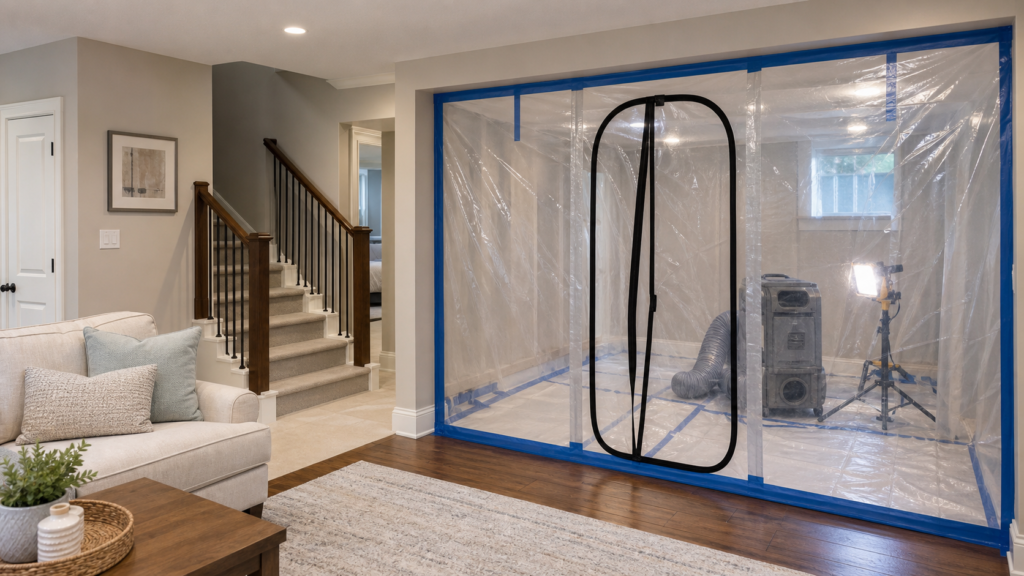
- The work zone can be sealed with containment barriers
- The HVAC system is not affected
- No major demolition is required
- The water source has been fixed
- Occupants can avoid the work area completely
- The contractor uses HEPA-filtered equipment where needed
- There are no highly sensitive occupants in the home
- The project does not involve sewage, heavy dust or extensive material removal
If the issue is basement-specific, see the related guide on basement mold removal to understand how basement moisture, finished walls, flooring, and hidden cavities can affect scope.
Another example is a small attic project where the attic hatch can be contained and the living space below remains separated.
Even then, the work area should stay off-limits.
Do not enter containment to “check progress,” take photos, move items, or speak with technicians. Ask for updates from outside the work zone.
When Leaving the Home Is the Better Choice
Temporary relocation may be recommended when the project creates a higher chance of exposure, disruption or cross-contamination.
This is more likely when:
- Mold affects multiple rooms
- Large sections of drywall or insulation are being removed
- The affected area is near bedrooms or a nursery
- The kitchen or only bathroom is inside the work zone
- The HVAC system may be contaminated
- The work involves heavy demolition
- There is a strong musty odour throughout the home
- Sewage or contaminated water was involved
- The project requires full containment for several days
- Equipment noise will make sleep or remote work unrealistic
- Occupants have asthma, severe allergies, chronic lung disease or weakened immune systems
- Infants, seniors or medically vulnerable people live in the home
- Pets cannot be safely separated from the work area
Leaving does not always mean moving out for the entire project.
In some cases, the family may only need to be away during demolition, heavy cleaning or the most disruptive phase. In other cases, temporary relocation may be recommended until final cleaning and drying are complete.
High-Risk Occupants Need a More Cautious Plan
Some people are more sensitive to dampness and mold exposure than others.
A project that is manageable for a healthy adult may be less suitable for someone with asthma, severe allergies, chronic lung disease or a weakened immune system.
Extra caution is also reasonable for:
- Babies
- Young children
- Seniors
- Pregnant occupants
- People recovering from illness
- People with immune suppression
- People with chronic respiratory conditions
- People with strong mold sensitivity
- Anyone whose symptoms worsen inside the affected property
A remediation contractor should not give medical advice.
However, the contractor can explain the work scope, containment plan, likely disturbance level and whether the affected areas can be avoided. Occupants with health concerns should speak with a qualified healthcare provider and use the remediation scope to make a safer occupancy decision.
Children and Mold Remediation
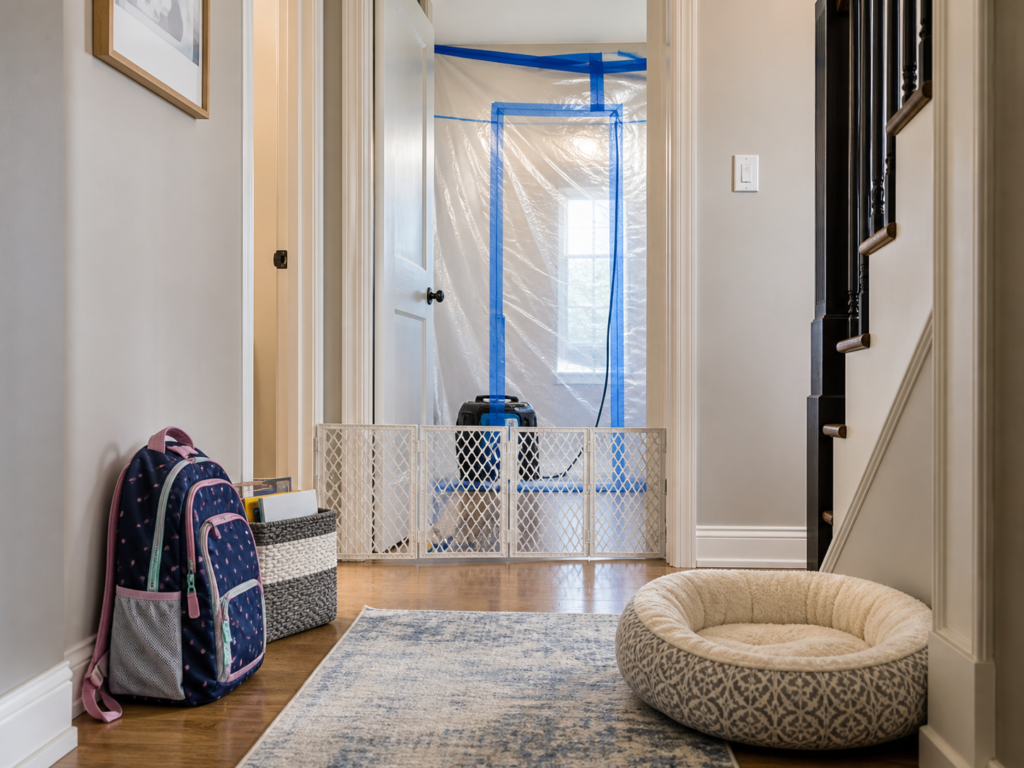
Children are curious, fast and not always easy to keep out of restricted areas.
That matters during remediation.
Containment barriers, tools, cords, ladders, air scrubbers, dehumidifiers and demolition areas are not safe play spaces. Even if the mold exposure risk is controlled, the work zone can still create a physical safety risk.
If children remain home during the project:
- Keep them away from the work area
- Explain that plastic barriers cannot be opened
- Create a separate play or sleeping area
- Avoid using rooms beside the containment if noise or odour is strong
- Keep toys, bedding and clothing away from the remediation zone
- Ask whether any access route will be blocked
- Plan school pickup, naps and meals around the work schedule
For larger projects, especially those near bedrooms or common areas, staying elsewhere may be easier and safer.
Pets During Mold Remediation
Pets should not be allowed near the work zone.
Dogs, cats and other animals can damage containment, step on debris, chew cords, knock into equipment or carry dust into clean areas.
Some pets also become stressed by:
- Loud fans
- New smells
- Technicians entering the home
- Plastic barriers
- Closed doors
- Changed routines
Birds and small animals may be especially sensitive to indoor air changes.
For small projects, pets may be kept in a closed, unaffected room away from the work path. For larger projects, temporary pet care is often the better option.
Before remediation begins, tell the contractor what animals are in the home and where they will be kept.
The Role of Containment
Containment is one of the main reasons some homeowners can stay in the property during remediation.
A containment system may include:
- Plastic barriers
- Sealed doorways
- Zipper access points
- Covered vents
- Floor protection
- Negative air pressure
- HEPA-filtered air scrubbing
- Controlled waste removal routes
The purpose is to separate the contaminated work area from clean parts of the home.
Containment is not decoration. It should not be opened casually.
Once the work zone is active, avoid:
- Walking through containment
- Moving barriers
- Opening sealed doors
- Turning off equipment
- Letting pets into the zone
- Asking workers to leave barriers open for convenience
A good containment plan makes everyday life less disrupted because the rest of the home has clearer boundaries.
Negative Air Pressure and HEPA Filtration
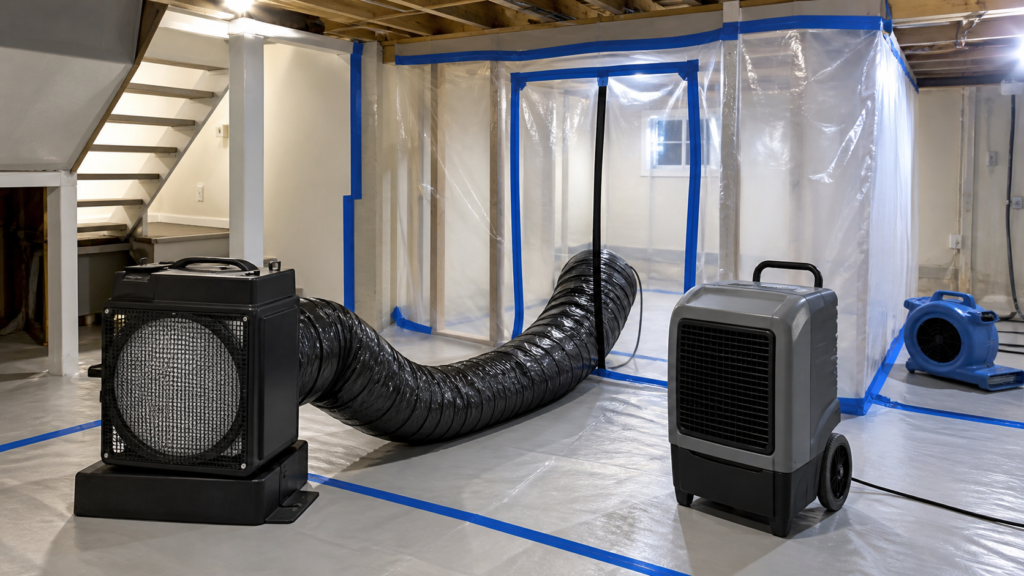
During many remediation projects, technicians use equipment that creates negative air pressure inside the work area.
This means air is pulled into the contained zone rather than drifting out into clean areas.
HEPA-filtered air scrubbers may also be used to capture fine airborne particles during and after removal work.
You may hear equipment running for long periods. That noise can be annoying, but it is often part of the control strategy.
Ask the contractor:
- Which machines will be used?
- Will they run overnight?
- Can they be turned off at any point?
- Which rooms will be noisy?
- Will any air be exhausted outdoors?
- Are windows or doors required for venting?
Do not unplug remediation equipment unless the contractor says it is safe to do so.
HVAC Considerations
The home’s heating and cooling system can change the occupancy decision.
If the mold problem is isolated and the HVAC system is not affected, the contractor may simply seal nearby vents or temporarily shut down airflow to the work zone.
If contamination involves ducts, air returns, fan coils, central air equipment or air movement between rooms, the situation becomes more complex.
HVAC concerns may require:
- Shutting down the system during active work
- Covering supply and return vents
- Inspecting accessible ductwork
- Coordinating with an HVAC professional
- Using temporary heating, cooling or ventilation plans
Do not run the HVAC system through an active contaminated work area unless the remediation plan specifically allows it.
Air movement can carry dust and particles into parts of the home that were not originally affected.
Noise, Odours and Daily Disruption
Even when staying home is technically possible, it may not be comfortable.
Professional remediation can involve:
- Fans
- Air scrubbers
- Dehumidifiers
- Drills
- Utility knives
- Removal of drywall or insulation
- Bagging of debris
- Workers moving in and out
- Temporary room closures
People who work from home may find the noise disruptive.
Families may also lose access to storage rooms, laundry areas, basements, bathrooms or kitchens depending on the project.
Before choosing to stay, ask:
- Which rooms will be blocked?
- Will there be demolition?
- What hours will crews be working?
- Will equipment run after crews leave?
- Will the washroom, kitchen or laundry area be accessible?
- Will the main entrance be used for debris removal?
- Will there be strong odours from cleaning products or damp materials?
Sometimes leaving for one or two days is not about danger. It is simply about making the project less stressful.
Can You Sleep at Home During Mold Remediation?
Sleeping at home depends on where the project is located and how the home is set up.
It may be reasonable when:
- The bedrooms are far from the work zone
- The contained area is sealed
- Equipment noise does not affect sleep
- The HVAC plan is clear
- No vulnerable occupants are present
- The contractor confirms that sleeping areas are outside the affected zone
It may be better to sleep elsewhere when:
- The work is near bedrooms
- A hallway to the bedrooms is inside the work path
- The project affects the only bathroom
- Equipment noise runs overnight beside sleeping areas
- Odours are strong
- Containment blocks normal movement
- Children or pets may disturb barriers
- Occupants have respiratory concerns
A small basement job may allow normal sleep upstairs.
If the mold came from a roof issue near attic or ceiling areas, read more about mold after roof leaks because roof leaks can affect insulation, sheathing, ceilings, and sleeping areas differently than a small isolated room leak.
Can You Work From Home During Mold Remediation?
Working from home may be possible for small, contained jobs.
It is less realistic when the project includes demolition, drilling, scraping, drying equipment or frequent movement through the house.
Before planning a normal workday, consider:
- Noise from equipment
- Wi-Fi or power interruptions
- Access to your office
- Privacy during calls
- Air scrubbers running nearby
- Contractors using the same entrance
- Pets reacting to workers
- Strong smells from damp materials
- Whether furniture or desks must be moved
If you have important calls or deadlines, plan a backup workspace for the active removal phase.
Room-by-Room Occupancy Guide During Mold Remediation
Every remediation project is different, but the location of the work often gives homeowners a good starting point.
The table below can help you understand when staying home may be reasonable and when leaving may be the better option.
| Remediation Area | Staying Home May Be Reasonable When | Temporary Relocation May Be Better When |
|---|---|---|
| Basement | Work is contained, basement is not needed daily, HVAC is not affected | Basement is finished, multiple rooms are affected, strong odours reach upstairs |
| Attic | Access is isolated, no major ceiling removal is needed | Attic hatch is near bedrooms, insulation is heavily disturbed, ceiling areas are opened |
| Bathroom | Another bathroom is available and work is contained | It is the only bathroom, plumbing leaks affected walls or floors, demolition is extensive |
| Kitchen | Work is small and temporary access can be managed | Cabinets, walls or flooring are being removed and the kitchen cannot be used safely |
| Bedroom | Occupants can sleep elsewhere in the home | The bedroom itself or nearby hallway is inside the work zone |
| Living room | The area can be sealed and avoided | It is a main traffic area or equipment noise disrupts normal use |
| Condo unit | Building access is coordinated and the work zone is isolated | Shared HVAC, neighbouring units or property-management rules complicate the work |
| Crawl space | Access is exterior or isolated | Odour, dust or debris affects the main living area |
| Whole-home issue | Rarely | Multiple rooms, HVAC movement or widespread contamination is involved |
This table is not a substitute for a project-specific recommendation.
A remediation contractor should explain the containment plan, access route, equipment setup and expected disruption before work begins.
Stay-Home Versus Leave-Home Decision Checklist
Use this checklist before deciding whether to stay in the property.
Staying home may be reasonable if:
- The mold is limited to one area
- The work zone can be fully contained
- The project does not affect bedrooms, kitchens or bathrooms
- No vulnerable occupants are present
- Pets can be safely kept away
- The HVAC system is not involved
- No sewage or contaminated water is present
- Demolition is limited
- Equipment noise will not disrupt sleep or work
- The contractor confirms that unaffected areas can remain occupied
Leaving temporarily may be safer or easier if:
- Mold affects several rooms
- Demolition will be extensive
- Insulation, drywall or flooring will be removed
- The work zone is near sleeping areas
- The only bathroom or kitchen is unavailable
- A child, senior or medically vulnerable person lives in the home
- Pets cannot be separated from the work area
- The HVAC system may spread particles
- Strong odours are present
- The project involves sewage or contaminated water
- You cannot avoid the containment zone
- Equipment must run near bedrooms overnight
The best decision is the one that reduces exposure, avoids disruption and allows the remediation crew to work without interruptions.
Questions to Ask Before Mold Remediation Starts
A good contractor should be able to answer these questions clearly.
Occupancy Questions
Ask:
- Can we stay home during this project?
- Which rooms are safe to use?
- Which rooms are off-limits?
- Can we sleep in the home?
- Can children stay in the home?
- What should we do with pets?
- Will equipment run overnight?
- Will there be strong odours?
- Will we have access to the bathroom, kitchen and laundry area?
Containment Questions
Ask:
- Where will containment be installed?
- Will negative air pressure be used?
- Will HEPA air scrubbers be used?
- Which doorway will technicians use?
- How will debris leave the home?
- Will vents be sealed?
- Can we pass through the containment area?
- How long will barriers stay up?
HVAC Questions
Ask:
- Should the furnace or air conditioner be turned off?
- Are any supply or return vents inside the work zone?
- Could air movement spread dust?
- Does the HVAC system need inspection?
- Will temporary heating or cooling be needed?
Health and Safety Questions
Ask:
- Should sensitive occupants leave during the work?
- What personal protective equipment will technicians use?
- How will dust be controlled?
- What happens if more mold is found?
- What should we do if odours remain?
- How will the area be cleaned before containment is removed?
Project Completion Questions
Ask:
- How will you confirm the work area is clean?
- Will moisture readings be taken?
- Is post-remediation testing recommended?
- Will we receive photos or documentation?
- When can the area be rebuilt?
- What must be repaired to prevent the mold from returning?
These questions protect both the homeowner and the contractor.
They also reduce confusion once the work has started.
What Homeowners Should Not Do During the Project
Once remediation begins, avoid actions that can compromise the work area.
Do not:
- Enter containment without permission
- Open plastic barriers
- Turn off air scrubbers or dehumidifiers
- Move equipment
- Sweep or vacuum debris yourself
- Run household fans near the work area
- Let pets inside the containment zone
- Carry items out of the work area without approval
- Use the HVAC system against contractor instructions
- Remove masks, filters or seals from equipment
- Ask workers to leave barriers open for convenience
Containment only works when the controlled space stays controlled.
Even a quick entry can move dust, debris or particles into clean parts of the home.
What Belongings Can Stay in the Home?
Not everything needs to leave the property.
Belongings outside the affected area can often remain in place. Items near the work zone may need to be moved, covered, cleaned or assessed.
Items usually safe to leave outside the work zone
- Furniture in unaffected rooms
- Clothing in closed closets away from the area
- Dishes in closed cabinets away from the work path
- Electronics in unaffected rooms
- Books and paper stored away from the affected area
- Bedding in rooms outside the containment zone
Items that may need attention
- Belongings inside the affected room
- Items with visible mold
- Cardboard boxes stored near damp walls
- Upholstered furniture exposed to moisture
- Clothing with a musty smell
- Rugs or carpets near water damage
- Items stored in a moldy basement or attic
- Contents that block access to the work area
Do not move visibly moldy items through clean rooms without guidance.
If contents need to be removed, the contractor should explain whether they can be cleaned, bagged, discarded or handled by a contents-restoration specialist.
Condo Considerations in Toronto
Condo remediation often involves more coordination than a detached home.
Before work begins, the owner or tenant may need to coordinate with:
- Property management
- The condominium board
- Building security
- Maintenance staff
- Neighbouring units
- Insurance adjusters
- Elevator booking staff
Condo-specific issues may include:
- Service elevator reservations
- Contractor sign-in rules
- Parking restrictions
- Noise bylaws or building quiet hours
- Shared plumbing walls
- Fan-coil or HVAC systems
- Water damage from another unit
- Access to mechanical rooms
- Documentation for insurance or management
If mold is connected to a leak from another unit or common element, the occupancy decision may involve both the remediation company and the property manager.
Do not assume the contractor can begin work without building approval.
Rental Property Considerations
In rental units, mold remediation can involve both the occupant and the landlord.
Tenants should report water damage, leaks and visible mold promptly.
Landlords are generally responsible for maintaining the rental unit in a good state of repair, but each situation can depend on the cause of the problem, lease terms, documentation and access requirements.
For tenants, useful steps include:
- Report the issue in writing
- Take photos of visible damage
- Keep records of dates and communication
- Avoid disturbing mold
- Ask for the remediation schedule
- Ask whether temporary relocation is required
- Keep belongings away from the affected area if safe to do so
For landlords and property managers, useful steps include:
- Respond quickly to moisture complaints
- Repair the water source
- Arrange inspection where needed
- Communicate access requirements
- Confirm whether the tenant can remain during the work
- Document the scope and completion
When the work affects basic living areas, such as the only bathroom, kitchen or bedroom, occupancy planning becomes more important.
Insurance and Temporary Relocation
Some homeowners ask whether insurance will cover hotel stays during mold remediation.
That depends on the policy, the cause of the damage and whether the property is considered unfit or impractical to occupy during repairs.
Insurance questions may arise when mold remediation follows:
- Burst pipes
- Roof leaks
- Sewer backups
- Appliance failures
- Storm damage
- Sudden water damage
Before leaving the property, ask your insurer or adjuster:
- Is temporary accommodation covered?
- How long is coverage available?
- Are meals or pet boarding covered?
- Does coverage apply only during active remediation?
- What documentation is required?
- Should the contractor provide an occupancy recommendation?
Keep photos, estimates, inspection findings and invoices.
A written recommendation from the remediation contractor may help explain why relocation was needed during certain phases of the project.
How Ultimate Mold Crew Handles Occupancy Planning
Ultimate Mold Crew does not use one answer for every home.
During the inspection and scope planning stage, we consider:
- Where the mold is located
- How much material must be removed
- Whether the area can be contained
- Whether the HVAC system is involved
- Whether children, seniors, pets or sensitive occupants are present
- Whether the work affects bedrooms, bathrooms or kitchens
- Whether demolition, drying or equipment will disrupt normal use
- Whether contaminated water or sewage is involved
- Whether the home is a house, condo, rental unit or commercial property
For smaller projects, the recommendation may be to stay out of the contained work area while the rest of the home remains usable.
For larger or more sensitive projects, temporary relocation from the affected area or property may be recommended.
If you are not sure how serious the visible mold is, book a mold inspection in Toronto before deciding whether the home can stay occupied during work.
Example Scenarios
Scenario 1: Small Basement Mold Area
A homeowner finds mold on a limited section of basement drywall after a minor leak.
The basement can be contained. The family can use the upstairs area. No one in the home has major respiratory concerns.
Likely occupancy plan: Staying home may be reasonable, provided the basement stays off-limits.
Scenario 2: Mold in a Child’s Bedroom
Mold is found behind a bedroom wall after a window leak.
Drywall and insulation need to be removed. The room is used daily.
Likely occupancy plan: The child should sleep elsewhere until remediation and cleaning are complete.
Scenario 3: Attic Mold Near the Hatch
The attic hatch is in a hallway beside the bedrooms.
Insulation will be moved and roof sheathing will be cleaned.
Likely occupancy plan: Occupancy depends on containment at the hatch, equipment noise and the work schedule. Sleeping away during the active phase may be more comfortable.
Scenario 4: Condo Bathroom Leak
A bathroom vanity leak affects the cabinet, drywall and wall cavity.
The unit has another washroom, and the work area can be isolated.
Likely occupancy plan: Staying may be possible if building access is coordinated and the affected bathroom remains off-limits.
Scenario 5: Sewage-Contaminated Basement
A sewer backup affects basement flooring, drywall and stored contents.
Removal and disinfection are required.
Likely occupancy plan: Temporary relocation from the affected area, or possibly the home, may be recommended depending on scope, odour and access.
After the Work Area Is Cleared
Once remediation is complete, do not rush the space back into normal use without confirming the next steps.
Ask:
- Has visible mold been removed?
- Are materials dry?
- Was final cleaning completed?
- Are any repairs still needed?
- Can belongings be returned?
- Should the HVAC filter be changed?
- Is reconstruction ready to begin?
- Is post-remediation verification recommended?
- What caused the mold, and has that source been corrected?
The space should not be rebuilt or repainted until the affected materials are clean, dry and ready.
If the moisture source is still active, mold can return.
Frequently Asked Questions
Can I stay home during mold remediation?
Sometimes. You may be able to stay home during a small, contained project if the affected area can be avoided. Larger projects, sensitive occupants, HVAC involvement, heavy demolition or contaminated water may require temporary relocation.
Is it safe to sleep in the house during mold removal?
It depends on the location of the work, containment setup, equipment noise and occupant health. Sleeping at home may be reasonable if bedrooms are far from the work zone and the contractor confirms that sleeping areas are unaffected.
Should children leave during mold remediation?
Children should always stay away from the work area. For larger projects, projects near bedrooms or projects involving heavy demolition, temporary relocation may be safer and less stressful.
What should I do with pets during remediation?
Keep pets away from the work zone. For larger or noisy projects, arrange temporary pet care. Pets can damage containment, react to equipment or track debris into clean rooms.
Can I enter the containment area?
No, not unless the contractor gives permission and provides instructions. Entering containment can disturb controls and move dust or particles into clean areas.
Will air scrubbers run overnight?
They may. HEPA air scrubbers, dehumidifiers or negative air machines can run continuously during parts of the project. Ask the contractor which equipment will stay on and whether it affects sleeping areas.
Does the HVAC system need to be turned off?
Sometimes. If vents or returns are near the work zone, the contractor may recommend shutting down the system or sealing openings during active remediation.
Can I work from home during mold remediation?
Possibly, but noise and access interruptions are common. Plan another workspace if demolition, air scrubbers or equipment will be near your office.
Can I stay in a condo during mold remediation?
Often, yes, if the affected area can be isolated. Condo projects may require building approval, elevator booking and coordination with property management.
Will insurance pay for temporary accommodation?
It depends on your policy and the cause of damage. Ask your insurer or adjuster before making accommodation plans when possible.
How do I know when it is safe to return to the affected area?
The contractor should confirm that remediation, cleaning and drying are complete. Larger projects may also include post-remediation verification or testing.
Can mold come back after I move back in?
Yes, if the moisture source was not corrected. Remediation removes contamination, but prevention depends on controlling water, humidity, condensation and leaks.
When You Need Mold Remediation Call Ultimate Mold Crew Toronto
Day or night, 365 days a year, our professionals are Here when you need mold remediation services in your home or business. Our 23 Ultimate Mold Crew locations in GTA are always ready to answer your call.
Ultimate Mold Crew offers a wide variety of cleanup, restoration, and construction services for everything from water damage, storm damage, fire damage to specialty services like commercial property cleaning and government cleanup, restoration, and construction. If you are unsure whether you can stay home during remediation, call 647-985-2739 to discuss the affected area, project scope and next steps.
Staying home during mold remediation is possible in many cases, but it should never be assumed.
source list
- https://www.canada.ca/en/health-canada/services/air-quality/indoor-air-contaminants/reduce-humidity-moisture-mould.html
- https://www.canada.ca/en/health-canada/services/publications/healthy-living/addressing-moisture-mould-your-home.html
- https://www.epa.gov/mold/mold-course-chapter-6
- https://www.epa.gov/mold/mold-remediation-schools-and-commercial-buildings-guide-chapter-3
- https://www.epa.gov/mold/mold-cleanup-your-home
- https://www.epa.gov/mold/brief-guide-mold-moisture-and-your-home
- https://tribunalsontario.ca/documents/ltb/Brochures/Maintenance%20and%20Repairs%20%28EN%29.pdf
- https://tribunalsontario.ca/documents/ltb/Interpretation%20Guidelines/05%20-%20Breach%20of%20Maintenance%20Obligations.html
